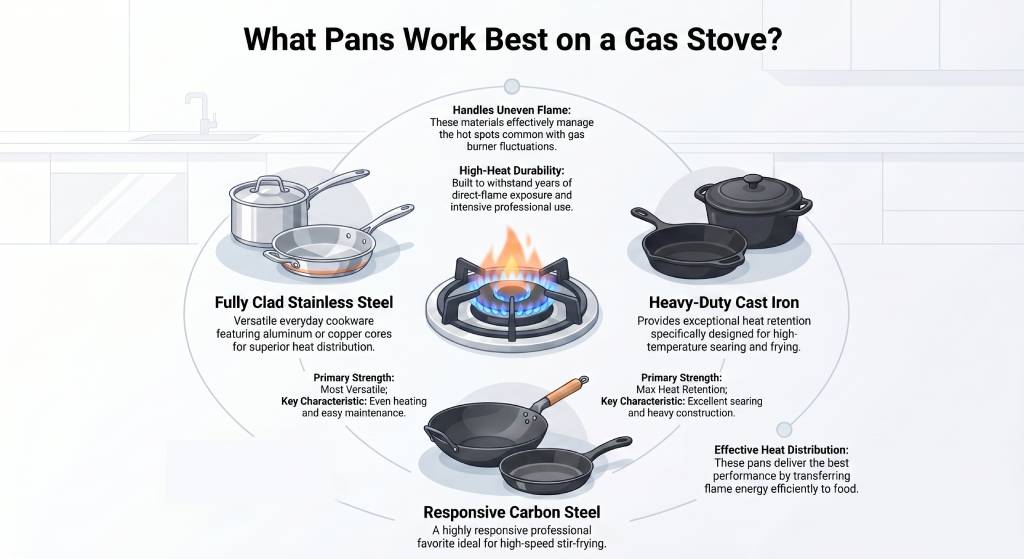
The best pans for a gas stove are fully clad stainless steel, seasoned cast iron, and carbon steel. Keep them flat-bottomed and sized within about half an inch of your burner ring for the most even heating. Avoid thin nonstick cookware that warps under direct flame, rough cast iron that can chip enamel-coated grates when dragged, and standard glass cookware that may crack under rapid temperature changes.
Gas burners behave differently than electric or induction cooktops see our gas vs electric stove comparison for a detailed breakdown. The flame delivers immediate, concentrated heat around the bottom and sides of the pan, creating hot spots that reward responsive cookware and expose weaknesses in thinner materials. A pan that performs well on one cooking surface may not perform as well on a gas range.
In this complete stove care guide, you’ll learn which cookware materials work best with gas burners, which ones can shorten the life of your stove grates, and how to match pan size to burner size for safer, more efficient cooking.
Three materials consistently perform best on a gas stove: fully clad stainless steel, cast iron, and carbon steel. Each handles direct flame differently, but all three have enough mass and durability to manage the uneven heat patterns that gas burners create.
Fully clad stainless steel is the most versatile choice for everyday cooking. Unlike bare stainless steel, fully clad cookware sandwiches an aluminum or copper core between stainless-steel layers, helping distribute heat more evenly across the cooking surface. That combination delivers durability, responsiveness, and compatibility with virtually any cooking task. This is why cookware reviewers such as America’s Test Kitchen and Wirecutter frequently recommend fully clad stainless sets for gas ranges.
Cast iron excels at heat retention and high-temperature cooking. Its heavy construction smooths out temperature fluctuations from the flame, making it ideal for searing steaks, frying, and baking. The tradeoff is weight; a large cast-iron skillet can be several times heavier than a comparable stainless-steel pan.
Carbon steel offers many of cast iron’s advantages in a lighter, more responsive package. It heats faster, develops a natural seasoning over time, and is especially popular for stir-frying and wok cooking. Many professional kitchens favor carbon steel because it responds quickly to changes in burner output while remaining extremely durable.
Among cookware brands fully clad stainless options from All-Clad, Made In, Demeyere, Tramontina, and Heritage Steel are widely respected. Lodge remains the most recognized cast-iron brand, while Stargazer and Field Company appeal to cooks looking for premium cast iron. For carbon steel, Matfer Bourgeat is one of the best-known names among both home cooks and professionals.
Flat-bottom pans are non-negotiable on most gas stoves because the grate’s support bars are designed for flat, stable contact. A round-bottom pan, including a traditional wok, balances on just a few contact points instead of resting evenly across the grate. That makes the pan more likely to rock during cooking, creates uneven heating, and can increase wear on grate coatings over time.
Even high-quality cookware performs poorly if it does not sit flat over the burner. A warped or rounded base prevents heat from spreading evenly across the cooking surface, which can lead to hot spots, inconsistent browning, and reduced cooking efficiency.
There is one important exception. Some pro-style gas ranges include a wok ring accessory or a specially designed center burner that safely supports round-bottom woks. If your range includes one of these features, a traditional round-bottom wok can work well. On most residential gas stoves with standard grates, however, a flat-bottom wok is the safer and more practical choice.
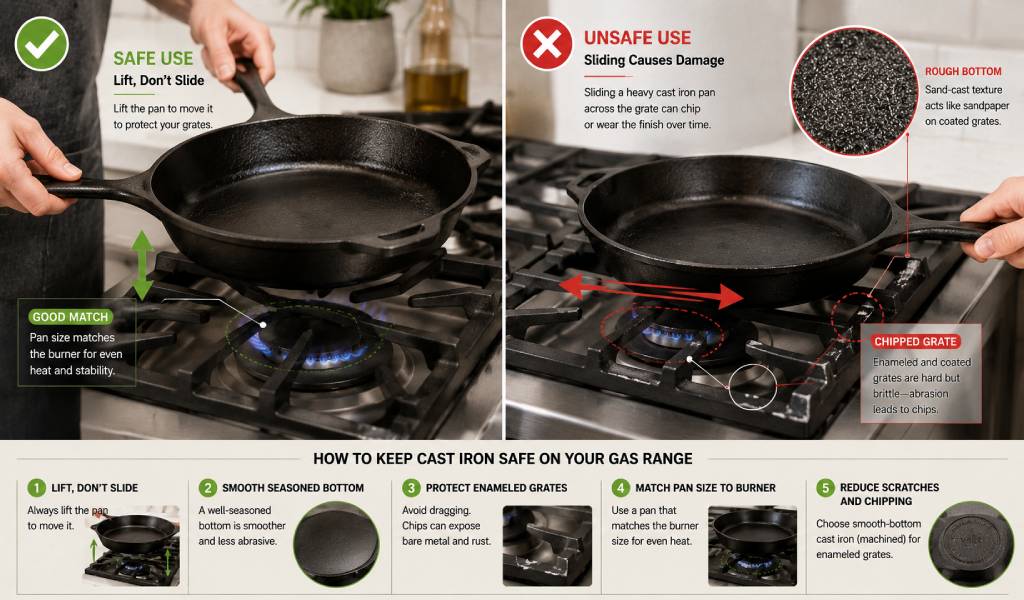
Cast iron is one of the best matches for a gas flame. The mass and the direct heat play well together. But the rough bottom of an unseasoned or factory-finish cast iron skillet is also one of the most common ways home cooks chip their enameled grates over time.
The damage mode is mechanical, not thermal. Most residential gas-range grates are either bare cast iron (Whirlpool, GE, some Frigidaire), powder-coated cast iron (LG, Samsung), or porcelain-enameled cast iron (most KitchenAid, Bosch, and pro-style). Learn about the benefits of stove protectors to help reduce everyday grate wear and simplify cleanup. The enamel and powder coatings are hard but brittle. Sliding a heavy Lodge across a porcelain grate, especially one with a sand-cast underside, works like fine sandpaper. The grate develops dull patches first, then chips.
A common argument is that if a grate is soft enough to avoid scratching cookware, the cookware may gradually wear the grate instead. This is a practical observation about material hardness, not a controlled laboratory finding. It is still useful. Home cooks notice the wear in both directions long before manufacturers admit it.
How to keep cast iron safely on a gas range:
Carbon steel is one of the most underrated cookware materials for gas stoves. It heats faster than cast iron, weighs significantly less, and because the metal is rolled rather than cast, the cooking surface is typically smoother. That smoother finish can be gentler on enameled stove grates while still delivering excellent heat responsiveness. The trade-off is maintenance: carbon steel must be seasoned regularly, should not be left soaking in water, and should be dried thoroughly after washing.
Woks deserve special consideration. Traditional round-bottom carbon-steel woks were designed for high-output burners that direct flame up the curved sides of the pan. Most residential gas ranges cannot recreate that cooking environment. As a result, a round-bottom wok may wobble on standard grates and require a separate wok ring for stability.
For most home cooks, a flat-bottom carbon-steel wok offers the best balance of performance and practicality. It maintains direct contact with the grate, remains stable during cooking, and still delivers the high-heat responsiveness that makes wok cooking effective.
Enameled cast iron cookware, including brands such as Le Creuset and Staub, occupies a separate category. The smooth enamel exterior is generally less abrasive than bare cast iron, but repeated dragging can still wear both the cookware and the grate finish over time. Like traditional cast iron, these pieces are durable and excellent at retaining heat, but they should be lifted rather than slid whenever possible.
Are Nonstick and Ceramic Pans Safe Over a Gas Flame?
Yes, provided they are used correctly. The two most important rules are to avoid overheating the pan and to choose cookware with a sturdy, warp-resistant base.
Traditional nonstick cookware uses a PTFE-based coating that performs well at normal cooking temperatures. Problems arise when an empty pan is left over a high gas flame, which can cause the cooking surface to reach temperatures far above those encountered during normal use. Excessive heat can shorten the life of the coating and reduce nonstick performance over time. For that reason, most manufacturers recommend cooking on low to medium heat whenever possible.
The bigger concern on gas stoves is warping. Thin nonstick pans heat quickly but often lack the structural rigidity needed to handle repeated exposure to direct flame. Over time, the base can warp, causing the pan to rock on the grate and heat unevenly. Heavier-gauge aluminum or fully clad cookware is generally more resistant to this problem.
Ceramic nonstick cookware is another popular option because it does not rely on traditional PTFE coatings. Many ceramic-coated pans are marketed as PFAS-free and can perform well on gas stoves when used within the manufacturer’s recommended temperature range. The trade-off is longevity. While ceramic coatings can provide excellent food release when new, they typically lose some of their nonstick performance faster than traditional PTFE coatings under regular use.
For either type of cookware, the safest approach is simple: avoid preheating an empty pan over high heat, match the pan size to the burner, and choose cookware with a thick, stable base that resists warping.
Mostly no, with one important exception. Standard clear glass bakeware (the modern American Pyrex, the Anchor Hocking bakeware, the generic Walmart loaf pan) is not designed for direct flame and can shatter under thermal shock. “America’s Test Kitchen’s Cook’s Illustrated documented three in-house shatter incidents” across their test-kitchen Pyrex pieces. None involved a gas burner directly, but all involved sudden temperature changes the glass could not absorb.
The composition change matters here. “Iowa State University Extension’s AnswerLine” documents that US-market Pyrex switched from borosilicate glass to soda-lime (tempered) glass after World Kitchen LLC bought the brand in 1998. Soda-lime tempered glass is stronger against impact but more vulnerable to thermal shock than the original borosilicate. The same extension document also references Consumer Reports’ 2010 test that replicated Pyrex shattering when a hot dish hit a wet granite countertop. Open flame is a similar shock profile.
The exception is glass-ceramic cookware, specifically the Visions line from Corelle. The manufacturer’s own “Visions FAQ” states that Visions can be used directly on gas and electric burners (it is not, however, recommended for induction), and that the Pyrex glass covers sold with Visions sets are oven-safe but cannot be placed on a stovetop burner. If you want glass on a gas flame, that is the only home-grade product family that is engineered for it.
Honest limitation most of the public evidence about Pyrex shattering is anecdotal or single-test. ATK’s three incidents and Consumer Reports’ wet-granite test are the cleanest sources. There is no large-scale dataset.
Gas stove grates are designed to withstand years of cooking, but certain cookware habits can accelerate wear. Dragging heavy pans, using rough-bottom cookware, cooking with warped pans, and placing oversized cookware on small burners are among the most common causes of grate damage.
1. Sliding heavy cast iron across enameled or porcelain grates. The grate finish is the softer surface. The damage shows up as dull contact bands at first, then visible chips at the bar edges. Solution: lift, do not slide.
2. Burner-too-large mismatches that warp thin pans AND scorch the grate finish. Food Republic’s whole piece is on this. When the flame licks up around the rim of an undersized pan, the heat that does not go into the pan goes into the grate’s powder coating or enamel. Over months, you see discoloration where the flame hit.
3. Wobbly wok rings. Cheap wire wok rings are notorious for rocking, dropping a heavy pan onto the grate at an angle. The drop chips enamel.
4. Rough-bottom factory cast iron acting like sandpaper. This is a common point of discussion in cookware communities. Many mass-market cast iron pans use rougher sand-cast finishes that can feel more abrasive on enameled stove grates when they are slid across the surface. Over time, this type of contact may contribute to visible wear on softer grate coatings. In contrast, some higher-end cast iron cookware features a smoother, machined or polished underside, which tends to reduce friction during movement and can be gentler on grate finishes.
5. Glass cookware thermal-shocking on the burner. The shatter scatters glass onto the grates and into the burner ports. The grates survive. The burner ports get harder to clean. ATK’s Pyrex evidence covers this.
6. Sugar boil-overs. Not a cookware behavior exactly, but worth mentioning. Caramelized sugar baked onto enameled grates is harder to remove than oil and tends to pull finish with it during scrubbing. If you are deglazing or making caramel, use a wider pan than you think you need.
Honest limitation worth naming most of this evidence base is community-sourced (Reddit, Facebook groups, manufacturer forums) and accumulated owner reports, not controlled lab testing. The damage modes are consistent across hundreds of comments, so they are real. But the precise hardness numbers (which finish is softest, which cast iron is roughest) have not been benchmarked publicly. Treat the list as well-established by user experience, not by published material science.
A practical guideline used by appliance technicians is to size your cookware so the base is slightly larger than the burner flame. In most cases, the flame should sit primarily under the pan rather than spilling far up the sides, and the pan should not be smaller than the burner’s support ring.
On a typical four-burner gas range, you’ll usually find a small simmer burner (around 5 inches), two medium burners (around 6 inches), and one larger power burner (around 9–11 inches). Following this layout, a 10-inch skillet pairs best with the power burner, an 8-inch saucepan fits well on a standard burner, and a small 1-quart pan works efficiently on the simmer burner.
When a pan is too small for the burner, the flame escapes around the sides instead of heating the base efficiently. This reduces heat transfer, wastes energy, and can cause unnecessary heat exposure to the grates and handles.
On the other hand, when a pan is significantly larger than the burner, heat concentrates in the center while the edges stay cooler. This uneven heating can stress thinner cookware and lead to warping over time. Heavier materials like cast iron and fully clad stainless steel handle slight mismatches better because they distribute heat more evenly.
If you occasionally need to use a smaller pan on a larger burner, a heat diffuser can help spread the flame more evenly and protect the cookware and grates. However, it’s best used sparingly, as it slows down heat response and reduces the direct efficiency that gas stoves are known for.
What type of pans are best for gas stoves?
Fully clad (tri-ply or 5-ply) stainless steel, cast iron, and carbon steel are the strongest matches. All three have enough mass to absorb a gas burner’s hot spots and enough conductivity to spread heat evenly. Wirecutter and America’s Test Kitchen both name fully clad stainless as the default all-purpose pick for gas.
What pans should not be used on a gas stove?
Thin aluminum-disc nonstick pans warp easily because the base cannot dissipate heat fast enough. Standard Pyrex glass bakeware is not designed for direct flame and can thermal-shock. Round-bottom woks rock on standard residential gas grates. Buy a flat-bottom version unless your range has a dedicated wok burner with a ring.
Are ceramic pans ok for a gas stove?
Yes, when used on low to medium heat. Many ceramic cookware brands market certain lines as PFAS-free and suitable for gas stoves, though ceramic coatings may lose nonstick performance faster than traditional PTFE cookware. Many users report shorter coating lifespan with regular daily use. Avoid prolonged high-heat searing, which can accelerate coating wear over time.
What are the best pots to use on a gas stove?
Tri-ply stainless steel saucepans are the all-purpose pick because the aluminum core conducts heat evenly across the bottom. Enameled cast-iron Dutch ovens excel at long simmers and braises. Avoid thin single-layer aluminum stockpots. They scorch on the bottom because they have no thermal buffer between the flame and the food.
Can I use glass cookware on a gas burner?
Most glass bakeware should stay in the oven. US Pyrex switched from borosilicate to soda-lime tempered glass in 1998 per Iowa State Extension, and the change made it more vulnerable to thermal shock from open flame. The one home-grade exception is Corelle Visions glass-ceramic, which the manufacturer FAQ explicitly approves for gas burners.
Does cast iron damage gas stove grates?
It can, when slid across enameled or porcelain-coated grates. The damage mode is mechanical. The rough sand-cast underside of mass-market cast iron acts like fine sandpaper on softer grate finishes. The fix is to lift the pan when moving it, season the bottom smooth, or buy a machined-smooth boutique brand (Stargazer, Field, Smithey).
To care for a ZLINE gas range, wipe the porcelain enamel cooktop and sealed burners…
RV gas stove care means a quick wipe after every meal, a deep clean where…
Miele gas stove care means wiping the porcelain or stainless deck after every meal with…
Fisher & Paykel gas stove care comes down to a daily wipe of the brushed-stainless…
To care for a Tappan gas stove, wipe the cooktop and grates after each use…
Crosley gas stove care comes down to a daily wipe-down once the cooktop is cool,…