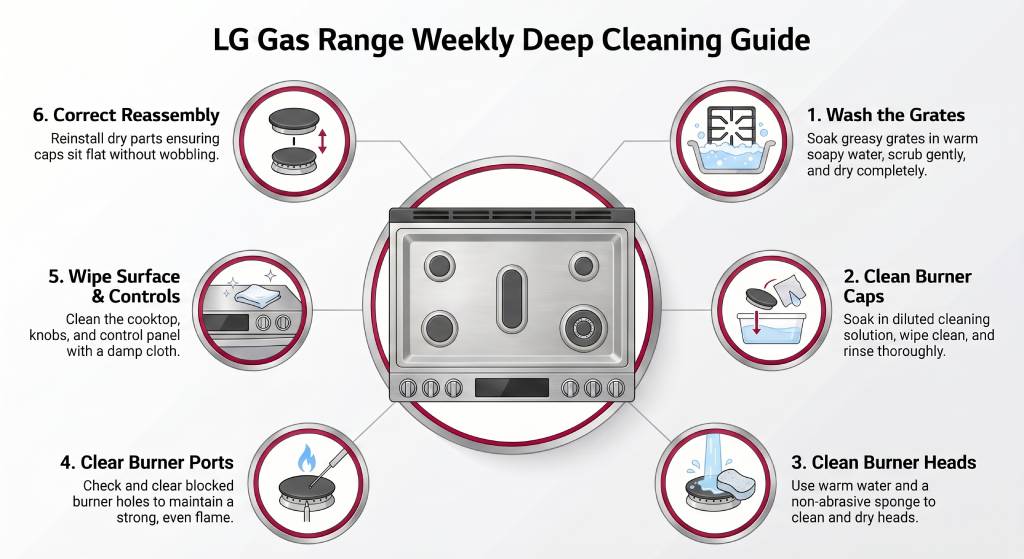
Good LG gas stove care comes down to three habits outlined in our general stove care reference: wipe the cooktop with a damp sponge once it cools, hand-wash the cast iron grates and burner caps weekly, and keep the burner ports clear so each burner lights cleanly. For the oven, LG offers a 20-minute Easy Clean for light soil and a 3 to 5 hour Self-Clean for heavy buildup.
This guide covers the LG gas ranges most US kitchens have: the standard LG freestanding and slide-in lines, the premium LG Studio series, and the higher-end LG Signature models. They share the same cooktop hardware four or five sealed gas burners, enamel-coated cast iron grates, and a porcelain surface underneath. Own a ProBake Convection model, a dual-fuel range, or a unit you run through the LG ThinQ app? The cooktop care is identical. Every cleaning step below follows LG’s published guidance, captured from lg.com. The protection notes come from our own six-month testing with one honest caveat about LG I’ll get to.
Knowing the parts makes cleaning faster. A typical LG 30″ or 36″ gas range runs four or five sealed surface burners, depending on the model. Each burner has two removable pieces: a burner cap (the black cover) and a burner head (the silver support beneath it). A spark electrode beside each one lights the gas.
Here’s the LG detail that trips people up: the heads and caps come in different sizes small, medium, large, an oval one for the center, and an extra-large power burner. They are not interchangeable. Put a cap back in the wrong spot and that burner won’t light right. Over the burners sit enamel-coated cast iron grates, noticeably heavier on the LG Studio line. When you push a knob in and turn it to Lite, you’ll hear clicking. That’s the spark module working, and the burner should catch within about four seconds.
Daily care is mostly about not letting spills bake on. Keep it short:
That last point is the one most people get wrong. LG’s cooktop guidance is genuinely that plain: water and a sponge, no harsh cleaners.
For a complete step by step process that applies to most sealed-burner cooktops, see our full gas stove top cleaning method.
Weekly LG gas range cleaning means taking the cooktop apart. Everything off and fully cool, then:
Monthly LG stove maintenance is for the things a weekly wipe misses:
This is where LG parts ways with a generic gas stove and it’s the part most cleaning guides skip.
Easy-Clean vs. Self-Clean pick the right one. LG gives you two oven cycles, and they’re not interchangeable. EasyClean is a low-temperature, roughly 20-minute cycle for light soil like cheese drips or grease, with virtually no smoke: you spray the empty cavity with warm water, run it, then wipe with the included non-scratch pad. Self-Clean is the heavy artillery, a 3 to 5 hour high-temperature cycle that burns soil to ash, recommended about every six months. Before it, pull all racks and utensils, skip the oven cleaner and foil, ventilate, and don’t run the gas cooktop during the cycle. The door locks until the oven cools; wipe out the white ash with a damp cloth afterward.
The bleach-and-water burner-cap method. Unlike the soapy-water-only advice you’ll see for most brands, LG’s own instruction for stained burner caps is a 1 to 100 bleach-and-water soak. Follow LG’s ratio rather than guessing.
LG Studio’s heavier grates. The premium Studio line ships with heavier enamel cast iron grates. They feel great under a pan but punish the porcelain if you drag them lift to clean, every time.
SmartDiagnosis and ThinQ. On connected models, the app stores your model number, surfaces diagnostic codes, and can save you a service call the LG equivalent of popping the hood before you phone a mechanic.
ProBake Convection This is a rear-mounted oven element, not a cooktop feature. The cleaning rules are the same as any LG oven cavity: EasyClean or Self-Clean, and never oven cleaner on a Self-Clean surface.
Most LG cooktop trouble traces back to a cap, a port, or a little moisture. Quick reference:
| Problem | Most likely cause | Fix |
|---|---|---|
| Igniter keeps clicking after the flame lights | Wet or off-center burner cap; food in a port | Dry and reseat the cap so it sits flat; clear the ports. |
| Burner won’t light at all | Knob not fully on Lite; cap or head off-center; dirty electrode; clogged ports | Turn fully to Lite, reseat the head over the electrode and the cap on top, clean the electrode and ports. |
| Weak or uneven flame | Clogged burner ports or orifice | Clear each port; confirm the cap and head sit flat. |
| Yellow or orange flame | Burner needs adjustment or LP conversion; cap/head not flat | Reseat the cap and head; if the flame stays yellow, call for service. |
| Lower flames under the grate legs | Normal LG behavior | No action flames shouldn’t touch the grates anyway. |
| Oven still dirty after EasyClean | Soil too heavy for the light cycle | Re-soak the spots, or step up to a Self-Clean cycle. |
If you ever smell gas, stop Don’t operate any switch. Leave the area and call your gas supplier or the fire department from another location. That holds for any gas range.
The fastest way to cut your cleaning time is to keep spills off the cooktop in the first place. A custom-fit stove protector, a heat-resistant liner cut to your range’s burner layout, catches boil-overs and grease, so you wipe a mat instead of scrubbing enamel around five burners.
Fit is the thing to get right on an LG gas range. The sealed-burner layout, including that oval center burner, means a protector has to be cut to the exact pattern, not laid down as a one-size sheet. Here’s my honest caveat: between January and June 2026, our team tested protectors on a Samsung gas range, a GE electric coil range, and a Whirlpool glass-top range. We did not test an LG unit specifically. What carries over is the cooktop type. The custom-cut, fiberglass-style protectors we tested are built for gas and electric coil cooktops, which covers LG gas, but not glass-top or induction surfaces. So treat the fit notes here as gas-cooktop guidance.
If you use a stove protector, make sure it is designed specifically for your LG model and burner layout. Because LG burner configurations vary between models, confirming the exact model number before purchasing helps ensure a proper fit. We maintain a StoveShield fit-check database for compatible sizes.
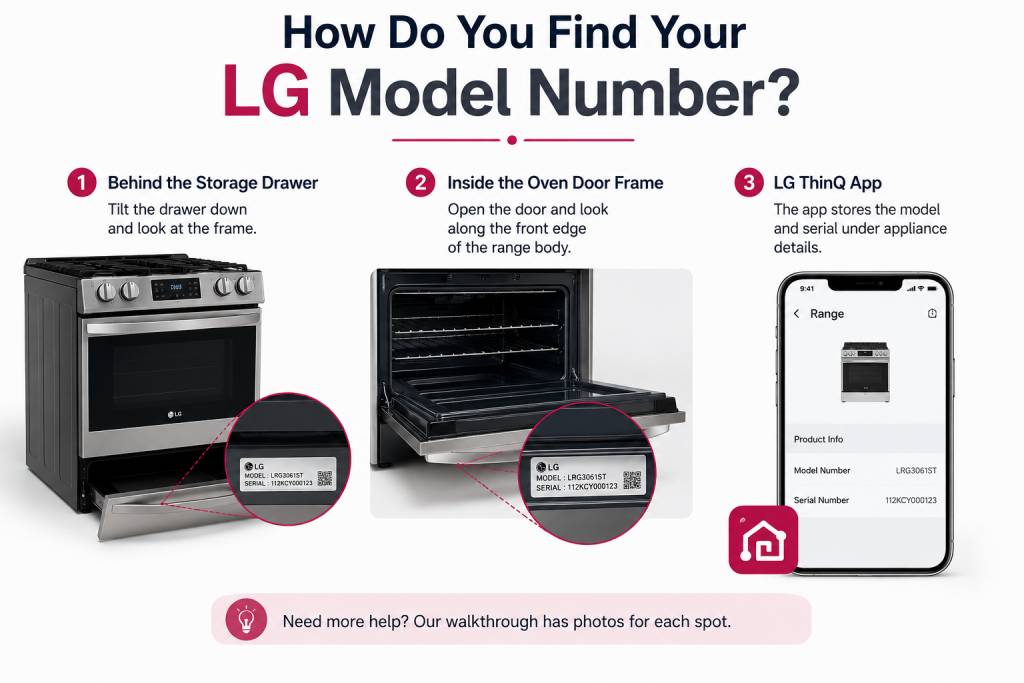
You’ll want the model number for parts, protector sizing, and warranty claims. If you’re not sure where to find it, locate your LG model number before ordering replacement parts, accessories, or a stove protector. On an LG gas range, check two spots:
On connected models, the LG ThinQ app also stores the model and serial under the appliance details. Once you’ve identified your model, such as LDGL6924S, LSGL6335, or LSDL6336F you can explore LG stove protectors designed specifically for your range. Still stuck? Follow our diagnostic walkthrough with photos for each location.
Are LG gas stove grates dishwasher safe?
Some LG manuals list grates as dishwasher safe. Wash them in warm soapy water, scrub stuck-on grease with a non-abrasive pad, rinse, and dry completely before they go back to wet cast iron rusts. Detergent and dishwasher heat strip the enamel finish over time, so the few extra minutes of hand-washing pays off.
What is EasyClean on an LG stove, and how is it different from Self-Clean?
EasyClean is a low-temperature, roughly 20-minute oven cycle for light soil. You spray the cavity with warm water and wipe it out with the provided non-scratch pad, with virtually no smoke. Self-Clean is a 3 to 5 hour high-temperature cycle that burns heavy buildup to ash and is recommended about every six months. Use EasyClean for upkeep and Self-Clean when soil is baked on.
How do I clean LG gas stove burner caps and heads?
For caps, LG’s method is a 1 to 100 bleach and water soak for 20 to 30 minutes, then a wipe with a non-abrasive sponge, a rinse, and a full dry. For heads, soak them in warm water (120 to 160°F) for 20 to 30 minutes and clean with a non-abrasive sponge. Caps and heads are consumable parts if a stain won’t lift, replace the part.
Why does my LG gas stove keep clicking?
Clicking is normal while a burner lights. If it keeps going after the flame is on, a cap is usually wet or off-center, or a port is blocked. Dry and reseat the cap so it lies flat, clear the ports, and the clicking should stop. If the igniter continues clicking after these checks, follow our clicking diagnostic for a complete troubleshooting process.
How long should an LG gas range last?
With routine care, a gas range commonly lasts well over a decade. Burner caps, heads, and igniters are wear parts you can replace through LG long before the range itself wears out which is why keeping caps seated and ports clear matters.
Can I use baking soda and vinegar in my LG oven?
For the cooktop surface, LG’s guidance is simply water and a sponge skip harsh chemicals. For the oven cavity, LG’s intended cleaners are EasyClean or Self-Clean. A light baking soda and water paste, wiped off thoroughly, is gentler than commercial oven cleaners, but never apply any cleaner to a Self-Clean surface before running the cycle.
To care for a ZLINE gas range, wipe the porcelain enamel cooktop and sealed burners…
RV gas stove care means a quick wipe after every meal, a deep clean where…
Miele gas stove care means wiping the porcelain or stainless deck after every meal with…
Fisher & Paykel gas stove care comes down to a daily wipe of the brushed-stainless…
To care for a Tappan gas stove, wipe the cooktop and grates after each use…
Crosley gas stove care comes down to a daily wipe-down once the cooktop is cool,…