Maytag gas stove care follows the same fundamentals covered in our general stove care reference: a quick wipe after every meal, a weekly soak-and-scrub of the grates, caps, and burner ports, and a monthly flame check. The Maytag-specific part: its AquaLift oven self-clean uses water and low heat, not an 800°F burn-off, so heavy soils often need a second cycle.
Maytag’s 10-year limited parts warranty covers parts like the burners, cast-iron grates, and cavity, but both the warranty and the finish reward you for cleaning the right way. Treat a Maytag like a generic stove and you can chip a grate, leave a burner clicking, or run an AquaLift cycle that disappoints you. This guide sticks to what’s specific to Maytag gas range cleaning sealed burners, cast-iron grates, the AquaLift oven, and Power Preheat. For the universal cleaning process, see our full gas stove top cleaning method.
Most Maytag gas ranges are 30-inch freestanding models that share the same core parts, and knowing them by name makes every later step faster.
The owner’s manual settles which features your range has and you’ll need your model number, covered below.
The daily routine is short by design. Once the cooktop is cool, wipe the surface, grates, and caps with a soft cloth and a little dish soap. Maytag’s own first move is plain soap, water, and a soft cloth, with affresh Cooktop Cleaner held back for stubborn film.
Two rules protect the finish from day one. Clean acid spills tomato, vinegar, and citrus as soon as the surface cools, because Maytag warns they can mark a porcelain-coated grate or cap. And skip the harsh stuff: no oven cleaners, bleach, or rust removers, and keep cleaning agents out of the gas tube opening.
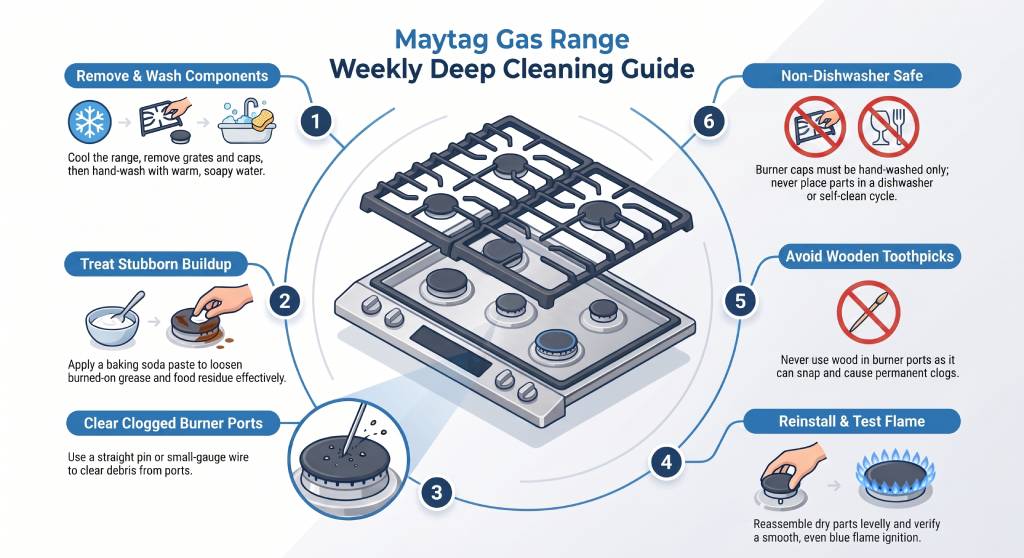
About once a week, the grates and caps come off for a real clean, following the sequence Maytag publishes for its sealed gas burners.
Two Maytag cautions caps are never dishwasher safe, and never clean caps or grates in the self-clean cycle. Some grates can go in the dishwasher on the most aggressive cycle, but only if your Owner’s Manual allows it. For rust, discoloration, or long-term maintenance, see our cast iron grate cleaning guide.
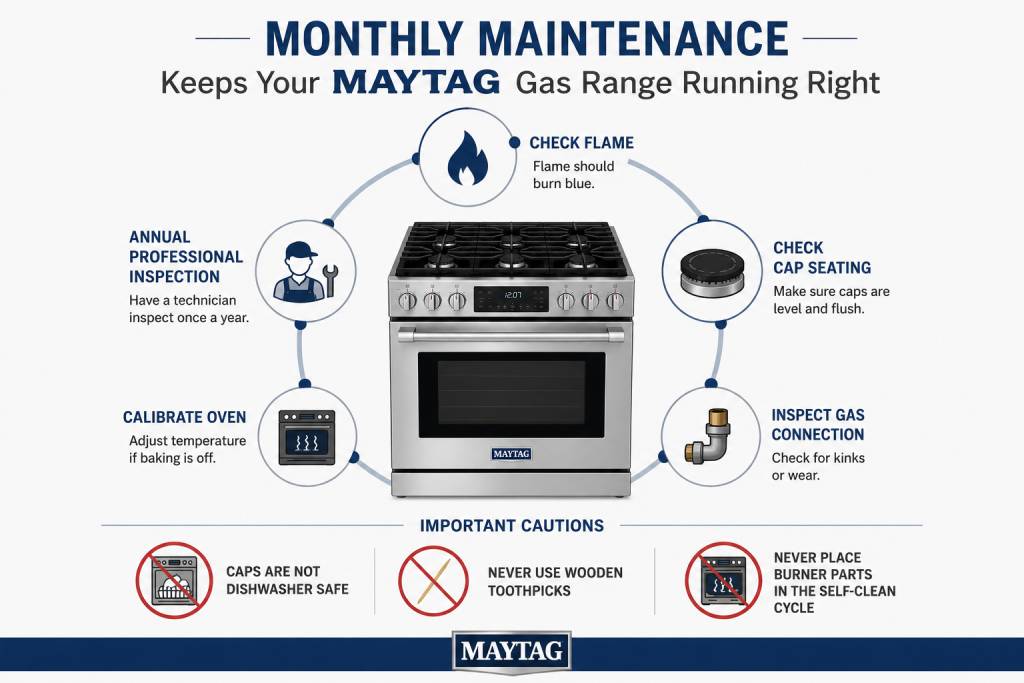
Cleaning keeps a stove looking good; maintenance keeps it safe and accurate. Once a month:
Consider periodic professional inspection of the gas and ignition systems in accordance with manufacturer guidance and local safety recommendations.
This is the Maytag feature that confuses the most owners. AquaLift is a low-heat, virtually odor-free oven cleaning cycle Maytag’s gentler alternative to traditional self-clean ovens that hit roughly 800°F. Instead of incinerating soil, it uses water and low heat to lift baked-on residue off the porcelain floor.
The Maytag-published routine:
Two things set it apart from a high-heat cycle: the range must be level so water covers the whole floor, and heavy soil usually needs a second cycle; the first pass thins it, the second lifts it. Never swap oven cleaner for the water; it can permanently damage the porcelain. If AquaLift keeps disappointing you, that’s heavy soil meeting a cycle built for light buildup, not a broken oven.
This is where a Maytag stops behaving like a generic stove.
Most Maytag gas issues are cleaning or seating problems in disguise. Here’s where to start.
| Problem | Most likely cause on a Maytag | First fix |
|---|---|---|
| Burner clicks and won’t light | Wet or misaligned cap, debris in the port | Dry and reseat the cap flush; clear the port with a pin. |
| Burner won’t light at all | Cap not seated, clogged port, or no spark | Reseat the cap, clean the port and igniter; if spark but no flame. |
| Oven won’t heat / no ignition | A worn gas oven igniter | If it no longer glows orange or sparks and won’t light, it likely needs replacement a job for a technician |
| AquaLift left soil behind | Heavy buildup, unlevel range, or too little water | Re-level, use the specified water amount, run a second cycle, finish with a non-scratch sponge |
| Grate finish looks dull | Normal high-heat aging or abrasive cleaning | Use only non-abrasive pads; matte-gray aging is cosmetic |
One reassurance: a brief click when you turn a knob is the igniter working. Continuous clicking after ignition can indicate a wet or misaligned burner cap, though other ignition-system issues may also be involved. If the clicking continues after drying and reseating the burner cap, follow our clicking diagnostic for a complete troubleshooting process.
Even a sealed-burner range collects boil-overs and grease in corners a daily wipe misses. A custom-cut stovetop protector, a thin, heat-tolerant liner cut around the burners catches that mess so you lift out a sheet instead of scrubbing. On a 30-inch Maytag it lies flat and pulls out for cleaning; keep it clear of the flame.
A liner is a between-cleaning convenience, not a substitute for clearing the ports or running AquaLift, and it is model-specific to confirm the cutout against your exact model first. These liners are intended for gas and electric-coil ranges and are not designed for glass-top or induction cooktops.
You’ll want the model number for parts, manuals, and warranty checks. If you’re not sure where to find it, locate your Maytag model number before ordering replacement parts, accessories, or a stove protector. Model-number locations vary by model, but common locations include:
Once you have it, Maytag’s services and support site pulls your manual, parts list, and warranty status. If your model is MGT8800FZ, MGR7700LZ5, or MGS8800PZ, you can explore Maytag stove protectors designed specifically for your range.If you’re still having trouble locating it, follow our diagnostic walkthrough with photos showing every common model-number location.
How do you clean a Maytag gas stovetop?
Let it cool, then wipe the surface, grates, and caps with soap, water, and a soft cloth. Weekly, lift the caps and grates, scrub with a non-abrasive pad, clear the ports with a pin, and dry everything before reinstalling. Skip oven cleaners, bleach, and rust removers.
How does Maytag AquaLift self-clean work, and do you really add water?
Yes, that’s the point of it. Cool the oven, remove the racks, pour the amount of water specified in your Owner’s Manual onto the oven floor, then press AQUALIFT SELF CLEAN and START. The cycle runs at low heat and helps loosen baked-on residue for easier wiping. It runs about 40 minutes at low heat; heavy soil usually takes a second cycle.
Are Maytag gas stove grates dishwashers safe?
Sometimes. Burner caps are never dishwasher safe, and only some grates are on the most aggressive cycle, with burned-on food scraped off first. Check your Owner’s Manual, and keep grates and caps out of the self-clean cycle.
Why won’t my Maytag gas burner light after I cleaned it?
A common cause is a burner cap that was reinstalled while wet or not seated correctly. Dry it fully, set the correct cap on the correct base, line up the pins, and seat it flush with almost no wobble.
What maintenance does a Maytag gas range need?
Wipe after each use, deep-clean the grates and burners weekly, and run a monthly check: flame blue, caps flush, gas line sound. Clean the oven with AquaLift as needed, and book an annual professional gas-line and ignition inspection.
The cleaning steps, AquaLift routine, flame guidance, and burner-port procedure here are drawn from Maytag’s own product-help pages and gas-range owner’s manuals the Owner’s Manual (W11426600), Control Guide (W11427484), and Use & Care guide (W10722064B) plus Maytag’s published 10-year limited parts warranty. Where Maytag’s behavior is model-specific, we point you to your manual for the final word.
To care for a ZLINE gas range, wipe the porcelain enamel cooktop and sealed burners…
RV gas stove care means a quick wipe after every meal, a deep clean where…
Miele gas stove care means wiping the porcelain or stainless deck after every meal with…
Fisher & Paykel gas stove care comes down to a daily wipe of the brushed-stainless…
To care for a Tappan gas stove, wipe the cooktop and grates after each use…
Crosley gas stove care comes down to a daily wipe-down once the cooktop is cool,…