
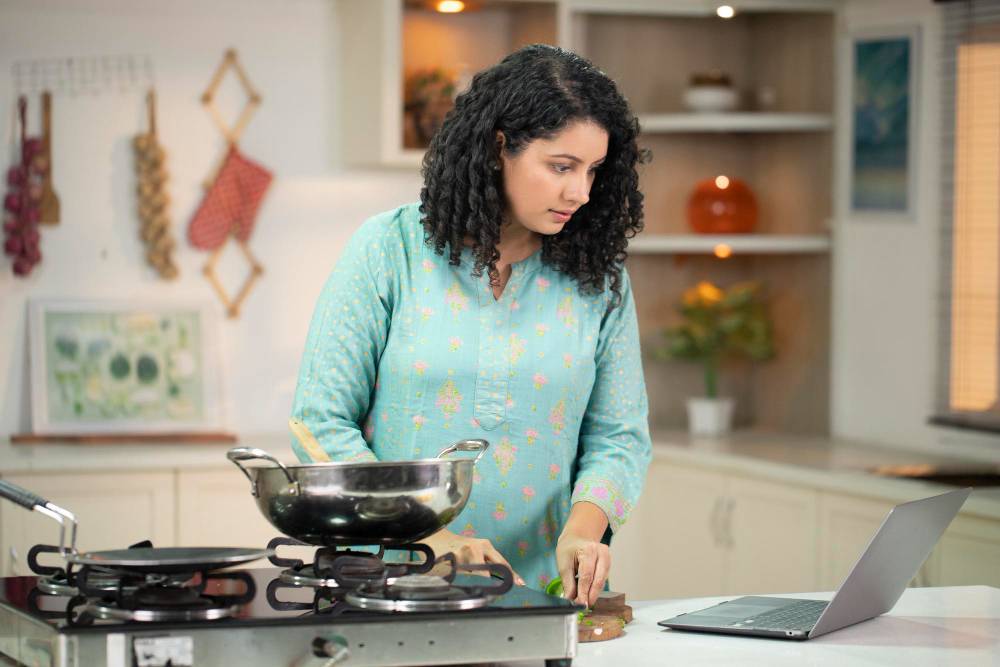
Yes, cast iron is safe and well-suited to a gas stove. If you’re evaluating other cookware materials, our guide to choosing cookware for gas stoves compares the best options. Match your pan’s underside to the burner size, preheat slowly over medium for 3 to 5 minutes, and lift the pan instead of sliding it. The two real failure modes are thermal shock and hot spots from a mismatched burner.
Cooking with cast iron on a gas stove is one of the most dependable setups in a home kitchen. Cast iron retains heat well, while a gas flame allows fast temperature adjustments during cooking. The combination works best when the pan is heated gradually and matched to the correct burner size. Because a gas burner concentrates heat into a relatively small ring beneath the pan, uneven preheating can create a very hot center with cooler edges.
This guide walks through the seven practical questions that matter most. For broader maintenance tips, see our complete stove care guide. Safety. Preheat technique. Burner-to-pan ratio. Heat management. Seasoning. Common mistakes.
Key Takeaways
- Cast iron is safe and recommended on a gas stove by every major manufacturer (Lodge, Smithey, Field Company).
- Match the burner’s flame ring to the pan’s underside diameter, within roughly one inch. A 9-inch pan generally performs best over a similarly sized flame ring.
- Preheat empty over medium for 3 to 5 minutes on a matched burner; verify with an infrared thermometer (400°F sauté, 500°F sear).
- For a restaurant-quality steak sear, preheat the pan in a 500°F oven for 30 to 40 minutes the Cook’s Illustrated technique that beats every stovetop preheat.
- Rotate the pan a quarter-turn every couple of minutes during a sear to even out hot spots; use a flame tamer for low-and-slow work.
- Lift, don’t slide Lodge’s canonical guidance, repeated for a reason.
- A mature seasoning layer can’t easily be burned off by a residential gas burner under normal cooking; if it’s flaking, it was under-cured to begin with. Grapeseed or sunflower for touch-ups. No flaxseed.
Is Cast Iron Safe on a Gas Stove?
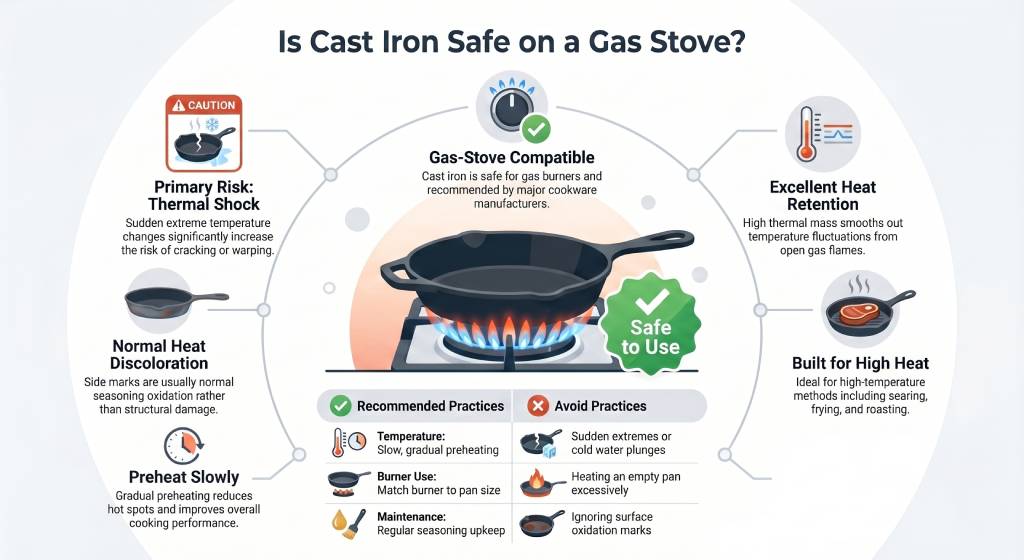
Yes. Lodge, Smithey, and Field Company all list gas as a recommended heat source for their cast iron skillets. The pan won’t react with the flame, and the iron’s thermal mass smooths out the fluctuations of an open burner.
Most cast iron safety concerns on gas stoves are easy to avoid with proper heating habits. Warping needs a sustained, extreme temperature swing usually a screaming-hot empty pan plunged into cold water. Cracking almost always traces back to a pre-existing flaw plus thermal shock. The widely-shared Quora thread about a skillet that “broke in half with a loud bang” reached that same community consensus.
Flame discoloration on the bare iron sides is cosmetic. The blue-purple heat pattern you see after a few weeks on gas is oxidation of the seasoning layer. It doesn’t hurt the cooking surface or the structural integrity. America’s Test Kitchen’s Russell Selander, in the magazine’s 2026 cast-iron coverage, makes the same point: the visible burn pattern is normal, not a defect.
One honest limitation Cast iron doesn’t heat as evenly edge-to-edge on a gas burner as it does on induction, because the flame ring is smaller than the pan bottom and the iron itself is a poor lateral conductor. Rotation and a slow preheat solve this. None of the manufacturer guidance frames gas as unsafe.
How Do You Preheat Cast Iron on a Gas Burner?
Preheating is where most cast iron problems start on a gas stove, and it’s where the gas burner is most likely to bite back. Here’s the stepwise method the published expert sources keep landing on.
- Match the burner to the pan. Use a burner whose flame ring is close to the pan’s underside diameter. A Smithey No. 10 has a 9-inch underside; a Smithey No. 12 has a 10.5-inch underside; a Lodge Logic 10.25-inch skillet sits on a standard medium burner.
- Start on medium, not high. A residential gas burner puts out roughly 9,000 to 15,000 BTU on a standard hob and 17,000 to 22,000 BTU on a high-output burner. Commercial ranges push past 25,000. Medium is enough to bring an empty cast iron pan to a sear-ready surface in a few minutes without scorching the seasoning.
- Hold for 3 to 5 minutes. Serious Eats writer Leah Collins, in her 2026 preheat guide, recommends 3 to 5 minutes of empty preheat on a matched burner. Smaller 8-inch pans trend toward the lower end; 12-inch pans toward the upper end.
- Verify with an infrared thermometer. Target 400°F at the surface for eggs and gentle sautés, 500°F for a steak sear. An inexpensive IR gun reads the surface in under a second. You don’t need a $200 model.
- Add the oil last. Heating oil with the cold pan is the fastest way to polymerize a gummy layer onto your seasoning. The pan goes on first, the oil drops in after the surface hits temperature, and the food follows within seconds.
For a steak or any high-temperature sear, Cook’s Illustrated and America’s Test Kitchen point to a better way: preheat the empty skillet inside a 500°F oven for 30 to 40 minutes, then transfer it to the burner the moment you cook. The oven’s enclosed convection erases the edge-to-center temperature gap a gas flame creates. Overkill for a weeknight egg. The gold standard for a restaurant-quality crust.
One caution Don’t run an empty cast iron skillet at high for more than 5 minutes. The polymerized oil layer is heat-stable but not infinitely so, and a 22,000-BTU burner under a dry pan can over-heat the cooking surface to the point of flaking.
What’s the Best Burner-to-Pan Ratio for Cast Iron?
The simple rule: the burner’s flame ring should be roughly the same diameter as the pan’s underside, give or take an inch. A 9-inch pan on a 6-inch burner gives you a hot spot in the center and cold edges. A 9-inch pan on a 12-inch burner wastes gas and licks flame up the sides. Most residential gas ranges give you two or three burner sizes:
- Small / simmer burner (~5-inch flame ring, 5,000-8,000 BTU) good for an 8-inch skillet or a small saucepan; too cramped for a 10-inch.
- Medium burner (~6-7-inch ring, 9,000-12,000 BTU) the workhorse for a Lodge Logic 10.25-inch or a Smithey No. 10 (9-inch underside).
- High-output burner (~8-9-inch ring, 17,000-22,000 BTU) sized for a 12-inch skillet, a cast iron griddle on a gas stove, or a heavy Dutch oven coming up to a hard boil.
Grate type matters as much as burner size. Continuous cast-iron grates the heavy interlocking pattern on most premium 2024-2026 ranges give a cast iron skillet a stable bearing surface. Older wire and spider grates have wider gaps, and a 10-pound Dutch oven on a wobbly spider grate is a stability problem long before it’s a heat problem. If you cook with cast iron daily and your range has thin wire grates, replacement continuous grates are one of the better $60-80 upgrades you can make.
For a cast iron griddle on a gas stove that spans two burners, fire both to medium and rotate the griddle 180° once mid-cook to even out the temperature. This becomes especially useful because a griddle spanning two burners can season unevenly without occasional rotation. See Lodge’s “official heat-source guide” for the full burner-pairing chart.
How Do You Manage Heat to Avoid Hot Spots?
Hot spots are real on a gas stove, and the physics isn’t your fault. Cast iron’s thermal conductivity sits at roughly a quarter of aluminum’s, per cookware-material comparisons from Serious Eats and Cook’s Illustrated, so heat moves slowly across the pan. A gas flame concentrates heat in a narrow ring. The iron under that ring gets hot fast, and the rest trails behind. Pro chefs on the ChefTalk forum keep diagnosing the same complaint. One verified-pro response in the long-running hot-spots thread put it plainly: cast iron is a worse heat conductor than aluminum, copper, or stainless, so the center will be far hotter than the edges unless you do something about it.
Here’s what to do about it practical cast iron heat management on a gas burner.
Default to medium. A medium flame, held long enough, lets the iron’s heat retention work for you.The pan’s temperature becomes more evenly distributed within four or five minutes, and you cook on stored heat rather than fighting the flame. High heat is for the last 30 seconds of a sear, not for the whole cook.
Rotate the pan a quarter-turn every couple of minutes when you’re searing or browning. It’s the simplest hot-spot fix on a gas range, and the one most home cooks skip. A quarter-turn moves the cool edges into the flame ring without disturbing the food.
Use a flame tamer for low-and-slow work. A flame tamer is a perforated steel disc that sits between burner and pan. It spreads the flame and softens hot spots for braises, slow-simmered tomato sauces, or anything that would scorch on a direct burner. They cost $15 to $25 and last forever.
Lift, don’t slide. Lodge’s canonical guidance, repeated in nearly every authoritative cast iron source for a reason. Sliding a heavy pan across a grate scratches both the grate finish and the pan’s underside. On cast iron grates, the friction also chips the enamel coating over time.
Even with all of this, cast iron on a gas stove will never be perfectly edge-to-edge even the way induction is. That’s the deal you make for heat retention.
Seasoning Preservation on Gas Heat
Seasoning is the polymerized oil layer on your pan, and a properly built layer is more resilient to gas heat than most people realize. If you’re also maintaining your range, see our guide to seasoning cast iron stove grates.
There’s a useful Stack Exchange thread on this question. The top-voted answer, posted by user rfusca in 2012, points out that 500°F shouldn’t damage a properly built seasoning, and a typical home stove “puts out barely more than half” the heat needed to burn the layer off. If your seasoning is flaking on a gas burner, it was thin or improperly cured, not abused.
So what damages seasoning on gas?
- An empty pan held at high for more than 5 minutes. A 22,000-BTU burner under a dry pan can over-heat the oil layer to the flaking point. Fine for a one-minute heat-up. Not fine as a default preheat.
- Acidic foods on a thin layer. Long-simmered tomato, wine, or citrus pulls oil out of the seasoning before the food finishes cooking. On a thick, mature seasoning, brief acidic contact is fine. On a one-month-old pan, it’s the fastest way to strip a stripe of black off.
- Soaking and dishwashing. Both will rust the iron and emulsify the seasoning. A 30-second rinse, a towel-dry, and a half-teaspoon of neutral oil rubbed in is the maintenance routine to follow.
For touch-up cures on the stovetop, Field Company recommends grapeseed or sunflower oil. Both have high smoke points and polymerize cleanly. They advise against flaxseed despite its internet fame, because the flaxseed layer is brittle and flakes off after enough heat cycles. The Field Company “maintenance guide” covers the oil selection rationale.
For a full re-cure in the oven rub a thin coat of oil over the entire pan, wipe nearly all of it off (too thick causes flaking), bake upside-down at 450 to 500°F for an hour, cool in the oven, and repeat two or three times. Experienced cast iron enthusiasts frequently recommend a similar oven-curing process across cooking forums and cast iron communities.
What Mistakes Damage Cast Iron on Gas Stoves?
Most cast iron damage on gas stoves comes from a few common mistakes, and most of them trace back to one of five habits.
Cold pan, screaming-high flame. Thermal shock is the only realistic way cast iron cracks on a gas stove. The fix is trivial: take the pan out 15 minutes before you cook, start on medium, work up.
Dishwasher. Detergent strips seasoning, and the heated dry cycle accelerates rust. Lodge, Smithey, and Field all say hand-wash. Skip the dishwasher even when it’s convenient.
Empty, dry, prolonged high preheat. Covered above. Rule of thumb: if the pan is empty, you’re not above medium and not for more than 5 minutes.
Acidic foods on bare or thin seasoning. Long-simmered tomato, wine reductions, and citrus deglazes will pull oil out of an under-cured layer. Save those for enameled cast iron or stainless until your seasoning matures.
Sliding heavy pans across grates. It chips grate coatings, dulls grate edges, and over years scores grooves into the pan’s underside. Lift even when it’s heavy. If it’s too heavy, two hands and a folded towel.
The most common cast-iron damage pattern follows the same sequence: preheating an empty pan over high heat for too long and forgetting it on the burner. In most cases, the gas flame itself is not the problem. The damage occurs when excessive heat builds up in an empty pan, potentially degrading the seasoning, causing discoloration, or increasing the risk of thermal stress.
Frequently Asked Questions
Is it safe to use cast iron on a gas stove?
Yes. Lodge, Smithey, and Field Company all list gas as a recommended heat source. The pan won’t react to the flame, and the iron’s thermal mass smooths burner fluctuations. The realistic risks are thermal shock from sudden temperature swings and hot spots from a mismatched burner both solved by preheating slowly and matching the burner to your pan’s size.
How long should I preheat cast iron on a gas burner?
Three to five minutes empty on medium, on a burner that roughly matches the pan’s underside diameter. Serious Eats writer Leah Collins’s 2026 guide uses the same window. Verify the surface with an infrared thermometer if you have one 400°F for sautés, 500°F for searing. Add oil after the surface hits temperature, not before.
Why does my cast iron have hot spots on a gas stove?
Cast iron’s thermal conductivity is roughly a quarter of aluminum’s, so heat spreads slowly across the pan. A gas burner concentrates the flame in a narrow ring, which makes the gap worse. The fix is rotation (quarter-turn every two minutes), a properly matched burner, and a default to medium heat not high so the iron has time to equalize.
Should I match the burner size to my cast iron pan?
Yes, within about an inch. The flame ring should be close to the pan’s cooking-surface diameter. Smithey’s manufacturer guidance is explicit: their No. 10 (9-inch underside) wants a medium burner; their No. 12 (10.5-inch underside) wants a high-output burner. A small burner under a large pan creates the center-hot, edge-cold pattern that hot-spot complaints come from.
Will a gas flame burn off my cast iron seasoning?
Not under normal cooking conditions. Most residential gas burners typically do not sustain enough heat to damage a mature, properly polymerized seasoning layer during everyday cooking. Seasoning problems are more commonly caused by prolonged empty preheating, acidic foods on a thin seasoning layer, or improper cleaning methods. Running an empty dry pan over high heat for too long can eventually degrade the seasoning, especially on high-output burners.
Can I use enameled cast iron on a gas stove?
Yes, with one caution. Enameled cast iron handles gas heat well for braises, simmers, and most sautés, but the enamel coating can crack from sudden temperature shock more readily than bare iron can. Preheat slowly, avoid running the empty pan dry on high, and don’t deglaze a 500°F enamel pan with cold liquid. Le Creuset, Staub, and Lodge enameled lines all share the same guidance.
How do I protect my gas range grates from cast iron?
Lift the pan, don’t slide it Lodge’s most-repeated tip, for great longevity as much as for the pan. Clean grates promptly after a cook (a soft brush, warm soapy water, towel dry); cast iron drips and seasoning oils will carbonize onto grate finishes if left overnight. Continuous cast-iron grates handle heavy pans better than older spider or wire grates. If you cook with cast iron daily, upgrading the grates is a worthwhile $60 to $80.
Sources
- “Lodge How to Use Cast Iron Over Any Heat Source”
- “America’s Test Kitchen Perfect Cast Iron Steak”
- “Serious Eats How to Preheat a Cast Iron Skillet”
- “Smithey Ironware FAQs”
- “Field Company Cast Iron Care”