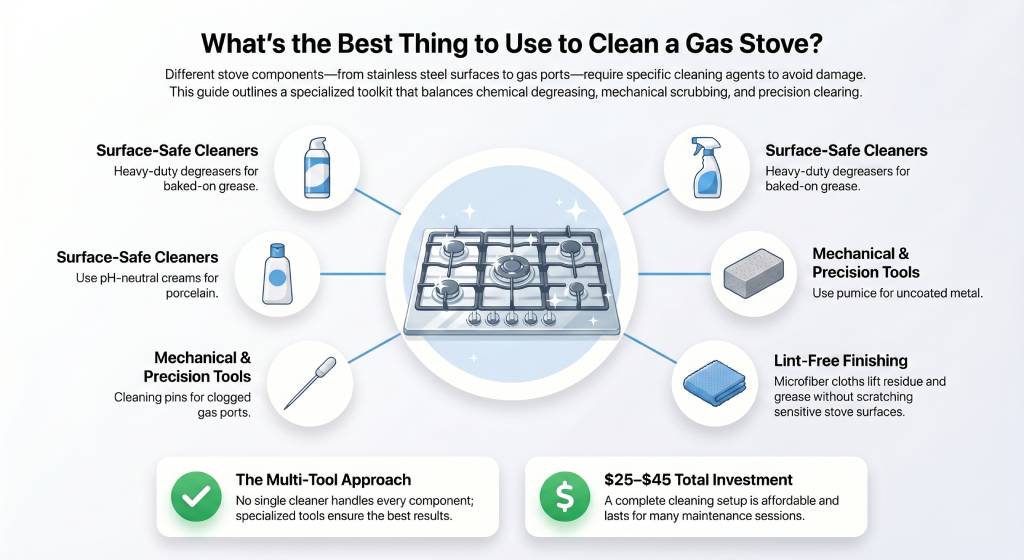
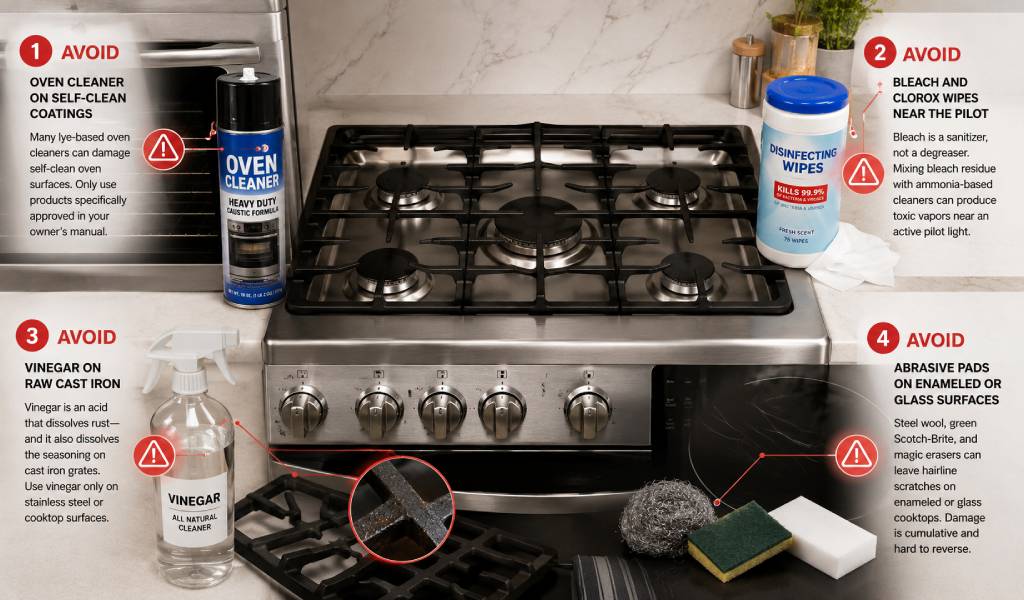
For most gas stoves, the cleaning supplies you actually need are five. A pH-neutral cooktop cream, a heavy-duty degreaser spray, a pumice stone for burner caps, a burner port pin, and a stack of microfiber cloths. Avoid oven cleaner, bleach-based wipes, and abrasive pads on coated surfaces.
A quick scan of the live People Also Ask box on Google as of May 2026 turns up 19 distinct questions about cleaning a gas range, including the best gas stove cleaning methods homeowners should use. Most questions boil down to two things: what works effectively, and what risks damaging the stove what to buy, and what to avoid. The commonly searched question queries “Can I use Clorox wipes on my gas stove?” and “Does Weiman gas range cleaner work?” sit right next to “What are common stove top cleaning mistakes?” The audience is worried they’re wasting money on the wrong gas stove cleaning products.
This guide answers both halves. We cover the short list of products that actually earn shelf space. We also cover the cleaners that can void your warranty or damage a coating, plus the household items (looking at you, oven cleaner) that homeowners on Quora repeatedly regret using. Pricing reflects typical U.S. retail data as of May 2026. Product types are described generically except where the live commonly searched question names a specific brand.
This is one of the most frequently cited questions in search results. The honest answer? No single product handles every part of a gas range. The best stove cleaner for the cooktop surface is rarely the best one for grates, and neither belongs near the burner ports. The short list below covers the full range with five purchases.
A pH-neutral cream cleaner is the safe baseline for the cooktop surface itself the steel or porcelain panel under the grates. It lifts grease without etching. It’s the type cited by current OEM use-care guides from KitchenAid as non-abrasive cleaner “non-abrasive cooktop guidance from KitchenAid”. Expect to pay roughly $5 to $13 per bottle. Single bottles in our current retail pricing ran $4.48 for the price-leader cooktop cream and up to $13.99 for premium picks.
For baked-on splatter around the burners, a heavy-duty stove cleaner in spray form is the workhorse. Interest in stove-top degreasers has increased noticeably as more homeowners look for stronger grease-cutting cleaners. That lines up with the growing popularity of citrus-based and foaming degreasers in recent product reviews. Use it on the metal surround and drip pans, not on raw cast iron, and always with ventilation. Most degreasers in this category run about $6 to $10 per bottle.
A pumice stone is commonly used for removing crusted-on grease from burner caps. Pumice-stone cleaning methods have become increasingly popular in online cleaning tutorials focused on low-chemical household cleaning. One important drawback: pumice can scratch porcelain and ceramic surfaces. Use only on uncoated metal burner caps, and always test a small area first.
The little brass holes around each burner are called ports, and clogged ports cause uneven flame. A burner port pin essential for cleaning burner heads safely sometimes sold as a “gas stove cleaning pin” costs under five dollars and unblocks the ports without enlarging them. A safety pin or paperclip works in a pinch, and Whirlpool’s published how-to mentions both “Whirlpool gas stove cleaning guide“.
Microfiber, not paper towel and not sponge. Microfiber is dense enough to lift residue from a cooktop cream without scratching, and it doesn’t shed lint into the burner heads. A six-pack runs about $8 on most US retailers.
Add the five together and a complete starter setup lands between $25 and $45. That works out to roughly $0.50 to $1.00 per cleaning if you deep-clean weekly. A standalone stove top cleaning kit from a mainstream stove cleaner brand bundles cooktop cream plus pads plus scraper for $10 to $21. It’s the cheapest entry point if you already own microfiber and a port pin.
How Do You Clean Cast Iron vs Coated Grates?
The single biggest mistake we see in community threads is treating every grate the same. Raw cast iron and coated cast iron are different materials and need different cleaners. Get this wrong once and you can strip a season’s worth of seasoning in a single soak.
Raw cast iron grates have no enamel. They rely on a layer of polymerized oil the seasoning to repel rust. Frequent soaking and heavy degreasers can weaken seasoning over time. The rule from BHG and from charcoal-grill specialists is the same: don’t soak raw cast iron, and never use vinegar on it. Brush off debris dry, wipe with a damp cloth, dry immediately on the warm burner, then re-oil. A specialty cast iron grate cleaner that is non-soap-based is acceptable for stuck-on grime.
Coated cast iron grates the matte-black sort common on newer ranges have an enamel layer. It’s dishwasher-safe on some models and soak-safe on most. A soak of 15 to 30 minutes in hot water with a teaspoon of dish soap dissolves the bulk of the grease. A non-abrasive scrub pad finishes the job. Skip steel wool it chews the enamel.
Three quick checks before you reach for a cleaner. Is the grate matte black or shiny gray? Does water bead on it when wet? Does your owner’s manual call it “porcelain-coated” or “matte enameled”? Yes to any, treat it as coated and soak is fine. If the grate has a dull, oily-looking patina and water spreads flat, treat it as raw cast iron and stay dry.
The title of this guide promises the “what you don’t need” side, and it’s the part most editorial roundups skip. These are the four categories that show up in Quora warnings, Reddit cleaning threads, and OEM use-care fine print.
Many lye-based oven cleaners are intended for traditional oven interiors and may not be compatible with self-clean oven coatings. Many appliance owners report damaging self-clean surfaces after using harsh oven cleaners. Manufacturers commonly recommend avoiding caustic oven sprays on self-clean surfaces unless the product is specifically approved in the owner’s manual.
A frequent question homeowners ask “Can I use Clorox wipes on my gas stove?” appears often in search results. Bleach is a sanitizer, not a degreaser. The Quora consensus is that mixing bleach residue with ammonia-based cleaners produces toxic vapor near an active pilot light. Want to sanitize after cleaning? Do it with isopropyl on a cool burner, not bleach.
Vinegar dissolves rust because it’s an acid. On a seasoned cast iron grate it also dissolves the seasoning. That’s why vinegar-and-baking-soda hacks are great for the cooktop surface and terrible for the grates themselves. Save the spray bottle for the steel panel.
Steel wool, green Scotch-Brite, and even some “magic eraser” pads leave hairline scratches on enameled grates and glass cooktops. The damage is cumulative and often invisible until cleaner residue starts to discolor the scratch pattern.
What’s a Realistic Cleaning Frequency Matrix?
The commonly searched question “How long to let vinegar and baking soda sit on the stove top?” tells you something about how this audience thinks in minutes, not in routines. A simple cadence keeps a gas range presentable without burning a weekend.
| Task | Frequency | Product | Time |
|---|---|---|---|
| Wipe spills with damp cloth | After each cook | Water only | 30 seconds |
| Cooktop wipe-down | Daily | pH-neutral cream, light | 3 minutes |
| Grate and burner cap soak or brush | Weekly | Dish soap soak (coated) or dry brush (raw) | 20 minutes |
| Degreaser spray on surround | Weekly | Heavy-duty degreaser spray | 5 minutes |
| Burner port pin clear | Monthly | Port pin | 5 minutes |
| Deep clean and inspect | Quarterly | Full kit | 45 minutes |
This is closer to a maintenance cadence than a chore list. The Maids and similar professional cleaning services recommend monthly attention to burner ports specifically to keep flame quality even.
The commonly searched question “What cleaning products are safe for asthmatics?” appeared on the common search results for our seed query. Two of the most-cited AI Overview sources for “best stove cleaner” Branch Basics and Therapy Clean both lean into the plant-based, fragrance-free angle. The American College of Allergy, Asthma, and Immunology lists ammonia, bleach, and fragranced aerosols as common asthma triggers in the kitchen “on asthma triggers including cleaning products”.
For an asthma-aware kitchen we recommend a fragrance-free pH-neutral cream and a plant-based degreaser sold by brands marketed for sensitive users. Look for the EPA Safer Choice label as a third-party signal “EPA Safer Choice product list”. Open the window or run the range hood whatever you use.
Honest limitations matter here. Plant-based cleaners often work slower on burnt grease and may need two passes rather than one. “Fragrance-free” on a label isn’t the same as “asthma-safe” the ACAAI guidance is to test any new cleaner on a small surface first and stop using it if symptoms appear.
Stove Top Cleaning Kit: What’s Actually in a Good One?
A boxed stove top cleaning kit can be a smart entry purchase or a marketing bundle padded with stuff you already own. The five-item list earlier in this complete gas stove cleaning guide is what a good kit contains. Below is the practical breakdown and the explicit “what you don’t need” cut.
A good stovetop cleaning kit includes a pH-neutral cooktop cream (4 to 8 oz), a pumice stone sized for burner caps, a brass or stainless burner port pin, three to six microfiber cloths, and a small non-abrasive scrub pad. That’s the entire toolkit for routine maintenance. A mainstream stove cleaner brand sells the bundle for roughly $10 to $21 at Home Depot and similar retailers in our May 2026 current retail pricing.
Here’s what you do NOT need in the kit. A separate “burner brush”, because the port pin and a microfiber cloth do that job. A “glass cooktop scraper”, unless you also own a glass-ceramic cooktop (most pure gas ranges have a steel panel under removable grates, so the scraper is wasted plastic). Aerosol “stove polish” sprays, which add fragrance and shine but no cleaning function. And any “all-in-one” wipe pack that bundles bleach into a cooktop product see the avoid section above.
The kit also doesn’t replace a real heavy-duty degreaser spray, which usually has to be bought separately and is the single product that handles the worst week-old grease. Plan to add one bottle of degreaser to whatever kit you buy.
OEM Warranty Cautions: Which Cleaners Void Coverage?
Owner’s manuals from KitchenAid, Whirlpool, and Samsung all use the phrase “non-abrasive cleaner only” in their cooktop care sections. Few enumerate which products actually violate that. Based on current OEM use-care guides at time of writing in May 2026, three categories trigger the most warranty pushback.
First, abrasive scouring powders on coated cooktops. KitchenAid’s current cooktop guidance specifies cream cleaner over powder for this reason “KitchenAid cooktop care guide”. Second, oven cleaner on any cooktop surface Whirlpool’s stovetop how-to explicitly steers users away from oven cleaner on the cooktop panel “Whirlpool cooktop how-to”. Third, steel wool on enameled grates. It gouges the coating and a manufacturer can rightfully refuse a warranty claim on a gouged grate.
The practical rule if the label says “heavy-duty oven and stove” without specifying cooktop-safe, treat it as oven-only and keep it away from the gas range panel. When in doubt, the OEM use-care PDF is free to download. It’s the source you’d cite back to the manufacturer in any warranty conversation.
Can I use Clorox wipes on my gas stove?
Clorox wipes sanitize but are not especially effective at cutting heavy grease. They can also leave behind bleach residue that may react with ammonia- or acid-based cleaners if products are mixed later, potentially releasing irritating fumes. For routine cleaning, use a microfiber cloth with a pH-neutral cooktop cleaner instead. If you want to sanitize afterward, apply isopropyl alcohol only after the burner surface has cooled completely.
Does Weiman gas range cleaner work?
Weiman gas range cleaner is the most-cited gas range cleaner brand in the current search results for “gas range cleaner” as of May 2026. It carries consistent four-star-plus ratings in our current retail pricing. It works on the cooktop panel and burner surround the way any mainstream foaming degreaser does. It isn’t magic on raw cast iron, and it shouldn’t replace a pumice stone for crusted burner caps.
How long should vinegar and baking soda sit on the stove top?
The dominant recipe across BHG, Allrecipes, and Martha Stewart is a 15 to 30 minute dwell. Spray a one-to-one vinegar-water mix, sprinkle baking soda, let it foam and sit for 15 minutes for light grease, 30 for tougher buildup, then wipe with microfiber. Keep this combo off raw cast iron grates because the vinegar strips seasoning.
What cleaning products are safe for asthmatics?
The ACAAI recommends avoiding ammonia, bleach, and fragranced aerosols. Safer picks include fragrance-free pH-neutral cooktop creams and plant-based degreasers that carry the EPA Safer Choice label. Ventilate while cleaning, and patch-test any new product on a small area. Fragrance-free isn’t automatically asthma-safe symptoms still rule.
Can you use Dawn Heavy Duty degreaser on a stove top?
Yes, Dawn Heavy Duty degreaser is safe on most gas stove cooktop panels and on coated grates as a soak agent. It isn’t strong enough for badly baked-on grease without a dwell time, and it isn’t the right tool for raw cast iron because it strips seasoning. Use about one teaspoon per gallon of hot water for routine wipe-downs.
The honest version of a gas stove cleaning products list is short: five items, plus the discipline to keep oven cleaner, bleach, and abrasive pads off surfaces that can’t handle them. The five-product kit covers 90% of the work. The frequency matrix keeps the other 10% from piling up. The OEM use-care guide settles any argument about what’s allowed on your specific range. If you take one thing from this guide, let it be the avoid list the savings on damaged grates and voided warranties outweigh whatever you save on a discount cleaner.
To care for a ZLINE gas range, wipe the porcelain enamel cooktop and sealed burners…
RV gas stove care means a quick wipe after every meal, a deep clean where…
Miele gas stove care means wiping the porcelain or stainless deck after every meal with…
Fisher & Paykel gas stove care comes down to a daily wipe of the brushed-stainless…
To care for a Tappan gas stove, wipe the cooktop and grates after each use…
Crosley gas stove care comes down to a daily wipe-down once the cooktop is cool,…