Whirlpool gas stove care comes down to a fast wipe-down after every meal, a weekly soak and scrub of the grates and burner caps, and a monthly look at the flame and burner ports. The brand-specific catch: dishwasher safe grates are a feature on select models only, so check your manual before you wet anything.
A Whirlpool gas range is built to be cleaned, not babied. The grates lift, the burner caps pop off, and the parts are cheap to replace. The trouble is that most owners clean a Whirlpool the way they’d clean any stove and a few of those generic habits will dull a great finish or leave a burner clicking for a week. This guide sticks to what’s specific to Whirlpool: AccuSimmer burners, EZ-2 Lift grates, the porcelain-versus-cast-iron rules, and the failures that tend to show up around the five-to-ten-year mark. For broader maintenance routines that apply across brands and stove types, see our general stove care reference.
Most Whirlpool gas ranges and cooktops sold in the U.S. share the same handful of parts, whatever the trim. Knowing them by name makes every later step faster.
If you’re not sure which features your range has, the owner’s manual is the source of truth and you’ll need your model number to pull it, which we cover near the end.
The daily routine is short on purpose. Once the surface is cool, wipe the cooktop and the grates with a damp cloth or a non-abrasive pad and a little dish soap. For a fresh splatter, that’s all it takes. Whirlpool’s own guidance is to clean acid spills tomato sauce, vinegar, and citrus as soon as the surface cools, because those can mark a porcelain-coated grate or cap if they sit.
Two rules that protect the finish from day one skip the oven cleaners, bleach, and rust removers, and keep cleaning agents out of the burner ports. A daily wipe is mostly about not letting sugar and grease bake on, which is what eventually forces the harder weekly clean.
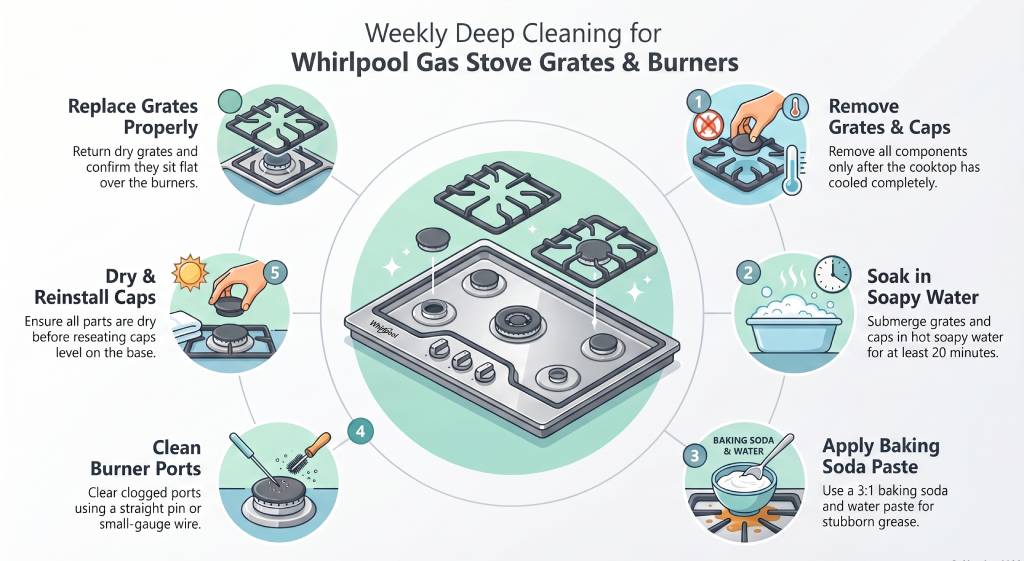
Before starting the weekly deep clean, follow our full gas stove top cleaning method for a complete step-by-step process covering the cooktop surface, burner caps, grates, and safe cleaning products. This is the same six-step sequence Whirlpool publishes for its gas cooktops, with the brand-specific cautions kept in.
Cleaning keeps a stove looking good; maintenance keeps it safe and accurate. Once a month, run a quick check:
Industry maintenance checklists also recommend a professional inspection of the gas line and ignition system roughly once a year. That’s the one job worth handing to a tech rather than DIY-ing.
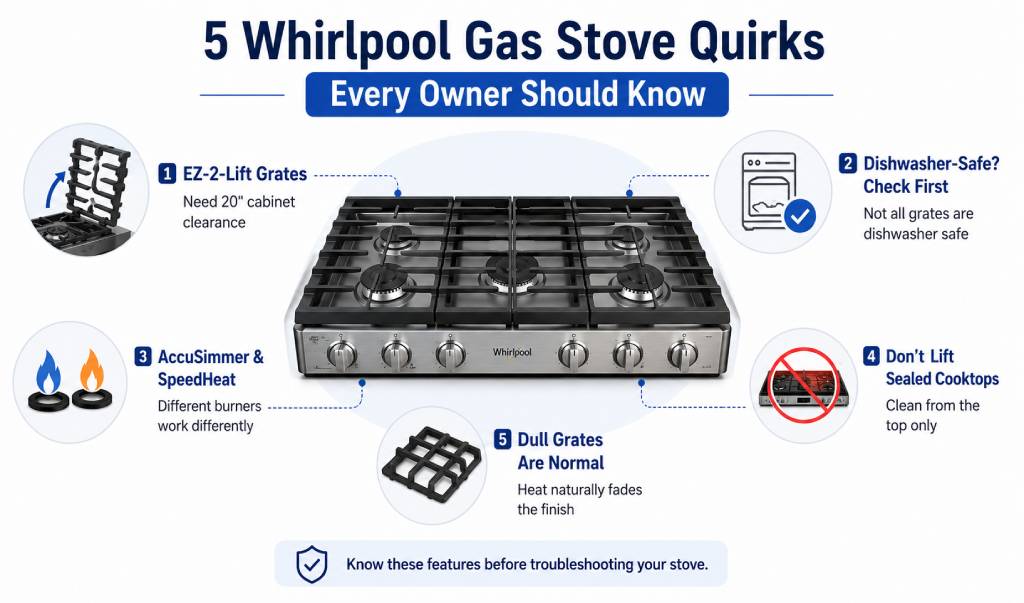
This is where a Whirlpool stops behaving like a generic stove. These are the details that trip up owners who clean on autopilot.
Most Whirlpool gas issues are cleaning problems in disguise. Here’s what tends to show up and where to start.
| Problem | Most likely cause on a Whirlpool | First fix |
|---|---|---|
| Burner keeps clicking and won’t stop | Wet or misaligned burner cap, debris in the port, or a knob left at LITE | Dry and reseat the cap level; clear the port with a pin; confirm the knob is turned past LITE. |
| Burner won’t light at all | Cap not seated, clogged port, or no spark to that igniter | Reseat the cap, clean the port; if there’s spark but no flame. |
| Yellow or orange flame | Dirty ports, poor air supply, or spills burning off | Deep clean the burner and ports; the flame should return to blue |
| Grate finish looks dull or worn | Normal high-heat aging, or acid spills left to sit | Wipe acid spills when cool; reseasoning is cosmetic only |
| Oven bakes hot or cold | Calibration drift over the years | Adjust the oven temperature offset from the control panel (see your manual) |
If your Whirlpool burner still won’t ignite after cleaning the ports and reseating the burner cap, follow our diagnostic walkthrough to troubleshoot igniters, spark modules, gas supply, and other common ignition problems
One reassurance on clicking it is completely normal for all of your burners to click when any one knob is first turned to LITE, that’s how Whirlpool’s ignition is wired. The clicking should stop within a few seconds once that burner lights and you move the knob off LITE. Clicking that won’t quit is the real fault, and it’s almost always a cap that’s wet or sitting crooked after cleaning.
If the clicking continues after the burner is dry and properly seated, use our clicking diagnostic to identify moisture, ignition switch, spark module, and burner-cap alignment issues.
Even a fast-cleaning range collects boil-overs and grease in the corners you can’t reach with a daily wipe. A properly fitted stovetop protector, a thin, heat-tolerant liner cut around the burners catches that mess so you wipe a sheet instead of scrubbing the cooktop. On a standard Whirlpool sealed-burner gas range, a protector sits flat on the surface and lifts out for cleaning; just keep it trimmed to the burner layout and clear of the flame.
A few honest caveats. A liner is a between-cleaning convenience, not a replacement for clearing the burner ports. And fit is brand- and model-specific: Whirlpool’s burner spacing and any hinged-grate hardware can affect where a liner can sit. If you know your exact model, explore Whirlpool stove protectors designed for a precise fit.
Where is the model number on a Whirlpool gas range?
You’ll want the model number for parts, manuals, and warranty checks. If you don’t know where to find it, locate your Whirlpool model number before ordering replacement parts or accessories. Once you’ve identified your model, such as WFG505M0MS0, WFG320M0MS0, or WEG745H0FS0, you can explore Whirlpool stove protectors designed specifically for your range. On most Whirlpool gas ranges it’s on a rating plate in one of two places:
Once you have it, Whirlpool’s ownership portal at whirlpool.com/services/ownership pulls your exact manual and parts list.
Are Whirlpool gas stove grates dishwashers safe?
Only on select models. Some Whirlpool gas cooktops have Dishwasher-Safe Cast-Iron Grates scrape off food and run them on the lowest rack. Porcelain-coated grates, burner caps, and uncoated cast iron should be hand-washed and kept out of the self-clean cycle. Check your owner’s manual before the dishwasher.
Why does my Whirlpool gas stove keep clicking after it lights?
A burner that keeps clicking is almost always a burner cap that’s wet or sitting crooked, or a bit of food in the port. Dry the cap, reseat it level, and clear the port with a pin. Remember that all burners clicking the moment you turn one knob to LITE is normal; it should stop once the burner catches.
Can I use Dawn dish soap to clean my Whirlpool gas stove?
Yes. Plain dish soap and warm water is exactly what Whirlpool recommends for the cooktop, grates, and caps. Save abrasive cleaners for stuck-on spots, and never use oven cleaner, bleach, or rust remover on the burners.
Why is my Whirlpool gas burner flame yellow or orange?
A yellow or orange flame points to dirty burner ports, weak air supply, or spills burning off the surface. Deep clean the burner and clear the ports with a pin; a correctly burning Whirlpool flame is blue.
How often should I clean a Whirlpool gas stove?
Quick wipe after each use while the surface is cool, and a deeper grate-and-burner clean about once a week. A monthly flame-and-port check rounds it out.
The cleaning steps, flame guidance, grate rules, and ignition behavior here are drawn from Whirlpool’s own owner’s manuals (including W11508816 and W11508721), the Whirlpool cleaning blog, and product help. The maintenance cadence reflects standard gas-range checklists. Whirlpool’s behavior is model-specific dishwasher-safe grates, AccuSimmer burners — we say so rather than generalize, and we point you to your manual for the final word.
To care for a ZLINE gas range, wipe the porcelain enamel cooktop and sealed burners…
RV gas stove care means a quick wipe after every meal, a deep clean where…
Miele gas stove care means wiping the porcelain or stainless deck after every meal with…
Fisher & Paykel gas stove care comes down to a daily wipe of the brushed-stainless…
To care for a Tappan gas stove, wipe the cooktop and grates after each use…
Crosley gas stove care comes down to a daily wipe-down once the cooktop is cool,…