


Key Takeaways
- Americans spend 1.6 hours daily on housework – with interior cleaning alone consuming about 55 minutes of that time, according to BLS data.
- Women do 2+ hours more unpaid domestic work daily than men – the gender gap in housework remains significant despite gradually narrowing over the past two decades.
- Kitchens demand the most cleaning time – accounting for roughly 40% of all interior cleaning effort due to grease, spills, and daily meal preparation.
- 49% of women engage in housework on any given day vs. 20% of men – a participation rate gap that persists across all age groups.
- Weekly cleaning averages 6 hours for most Americans – though 28% report spending 7+ hours weekly on cleaning tasks.
- Small friction reductions compound significantly – protecting high-maintenance surfaces like stovetops can save 48-60 hours annually.
- The gender gap is slowly narrowing – but at current rates, equal division of housework is still decades away.
How much time do you actually spend cleaning? If you’ve ever felt like housework eats up more of your day than it should, you’re not imagining things. The average time spent on housework per day in America adds up to nearly two hours – and that’s just the average.
For many households, especially those with children or multiple family members, the number climbs higher. And here’s what makes it frustrating: kitchens alone can consume half your interior cleaning time. That pot that boiled over last night? Those grease splatters from frying? They’re the reason you’re still scrubbing at 9 PM.
Let’s break down the actual data on how Americans spend their cleaning time, where the burden falls heaviest (spoiler: there’s a significant gender gap), and what the research tells us about reducing the friction that makes housework feel endless.
How Much Time Do Americans Spend on Housework Per Day?
The Bureau of Labor Statistics tracks this through their American Time Use Survey (ATUS), and the 2024 data paints a clear picture.
Average Daily Housework Time
| Category | Time Per Day | Annual Equivalent |
|---|---|---|
| Total household activities | ~95 minutes (1.6 hours) | ~584 hours/year |
| Interior cleaning specifically | ~55 minutes (0.9 hours) | ~335 hours/year |
| Kitchen-focused cleaning | ~20-25 minutes | ~122-152 hours/year |
Interior cleaning represents more than half of all daily housework time. That means the floors, surfaces, bathrooms, and kitchens in your home consume the majority of your domestic labor – not laundry, not yard work, not meal prep.
The American Cleaning Institute’s survey found Americans spend nearly 6 hours per week on cleaning tasks. Even more telling: 28% of respondents reported spending more than 7 hours weekly just on cleaning. That’s almost a full workday, every single week.
Time Spent Cleaning by Gender: The Numbers Don’t Lie
Here’s where the data gets uncomfortable. The gender gap in housework isn’t a myth or an outdated stereotype – it’s a measurable reality that persists in 2024.
BLS American Time Use Survey Data (2024)
| Metric | Women | Men | Gap |
|---|---|---|---|
| Daily household activities | 2.6 hours | 2.1 hours | 30 minutes |
| Unpaid domestic work daily | 2+ hours more than men | — | — |
| Participation rate (any given day) | 49% | 20% | 29 percentage points |
According to the Institute for Women’s Policy Research, women perform approximately 2 more hours of unpaid housework daily compared to men. That adds up to 14 extra hours per week – essentially a part-time job without pay.
The American Home Shield survey breaks it down further:
- Women average 2 hours 42 minutes daily on household chores
- Men average 2 hours 12 minutes daily on household chores
The Participation Gap
What makes the gender statistics even more striking is the participation rate. On any given day, 49% of women engage in housework activities. For men? Just 20%.
This doesn’t mean men never clean. It means they’re far less likely to be the ones doing it on any particular day. The burden falls disproportionately on women, day after day.
Is the Gap Narrowing?
Research published in Socius (2025) by Milkie and colleagues examined trends across the 21st century. Their findings? Yes, the gender gap in housework is gradually narrowing – but “gradually” is the key word.
The Gender Equity Policy Institute’s Free-Time Gender Gap Report (October 2024) found that mothers continue to do significantly more unpaid work than fathers. Progress exists, but equality in domestic labor remains a distant goal.
Academic research by Kolpashnikova & Kan (2021) using ATUS data from 2003-2019 examined how individual resources affect the gender gap in housework time. Their conclusion? Income and employment status help, but they don’t eliminate the disparity.
Which Room Takes the Most Cleaning Time?
The BLS doesn’t publish room-by-room cleaning data directly, but time-use subcategories and household behavior research consistently point to the same culprit: the kitchen.
Interior Cleaning Time by Room (Daily Estimates)
| Room | Daily Time | % of Interior Cleaning | Why It Takes So Long |
|---|---|---|---|
| Kitchen | 20-25 minutes | ~40% | Grease, spills, stovetop/oven use, food prep surfaces |
| Bathroom | 12-15 minutes | ~25% | Moisture, sanitation requirements, mold prevention |
| Living areas | 8-10 minutes | ~18% | Dusting, tidying, vacuuming high-traffic zones |
| Bedrooms | 5-7 minutes | ~12% | Light maintenance, bedding, minimal debris |
| Other areas | 3-5 minutes | ~5% | Entryways, utility rooms, hallways |
Kitchens account for nearly half of all interior cleaning effort. Think about that: one room out of five or more in most homes demands 40% of your cleaning attention.
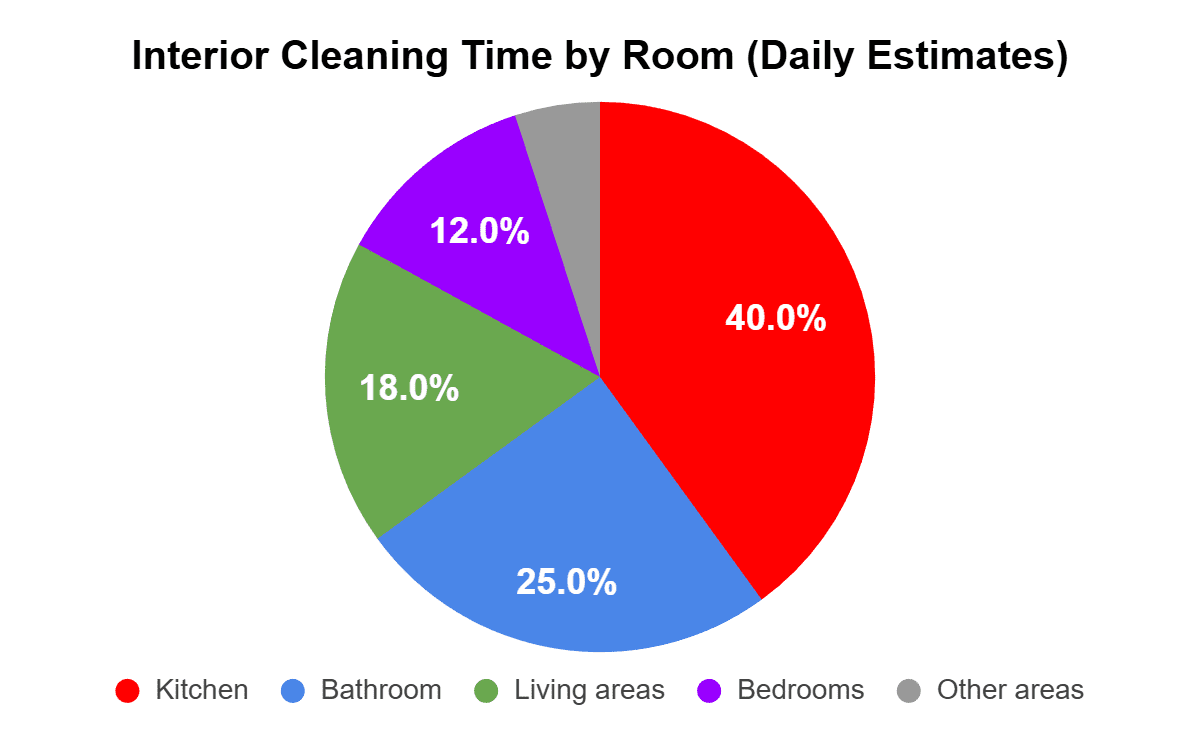
This pie chart highlights how cleaning time is distributed across different rooms in the home. Despite being just one room, the kitchen alone accounts for roughly 40% of all daily interior cleaning time — more than any other area.
Why Kitchens Demand More Cleaning Time Than Any Other Room
Your kitchen isn’t like other spaces. It’s a high-friction environment where messes happen constantly – often multiple times per day.
What Makes Kitchens Different
Daily use intensity: Most rooms get occasional traffic. Your kitchen gets used for breakfast, lunch, dinner, snacks, coffee, and everything in between. Each use creates potential cleanup.
Heat and grease combination: Stovetop cooking generates splatter. Frying an egg? Grease droplets land on the surface. Making pasta sauce? Tiny red dots everywhere. These particles bond to surfaces when heated.
The compound mess effect: A small spill that goes unaddressed hardens. Then another spill lands on top of it. Within days, you’re dealing with layers of baked-on residue that require serious scrubbing.
Surface variety: Your kitchen has stainless steel, countertops, tile backsplashes, stovetops, oven interiors, and appliances. Each surface requires different cleaning approaches.
Among all kitchen surfaces, the stovetop and oven area demand the most consistent maintenance. Spills that hit a hot burner or oven floor caramelize almost instantly, turning a quick wipe into a 15-minute scrubbing session.
Stovetop and Oven Cleanup: The Time Comparison
Here’s where the data gets practical. The difference between cooking with surface protection versus without it affects actual cleaning time.
Cleanup Comparison: Protected vs. Unprotected Surfaces
| Type of Mess | Without Protection | With Stovetop/Oven Protection |
|---|---|---|
| Oil splatter from frying | Burns onto surface, requires scrubbing | Stays on liner, wipes off easily |
| Boiled-over sauces | Hardens around burners within minutes | Caught before burning, removed simply |
| Tomato-based sauces | Acidic residue stains stainless steel | No direct surface contact |
| Sugar, syrup, marinades | Caramelizes quickly, extremely difficult removal | Prevented from baking onto surface |
| Burnt food residue | Requires scraping, soaking, and elbow grease | Surface underneath stays clean |
| Daily splash accumulation | Frequent deep cleaning sessions needed | Light daily maintenance is sufficient |
| Oven drips and spills | Burn onto oven floor, create smoke | Caught by liner, cleaned separately |
The pattern is consistent: protected surfaces require minutes of maintenance. Unprotected surfaces require serious cleaning effort.
Learn more about gas stovetop protection at stoveshield.com
How Much Time Can Surface Protection Actually Save?
Based on typical household cooking patterns, stovetop cleanup time can decrease by roughly 40% when a protective liner is used. The math adds up quickly:
Time Savings Breakdown
| Timeframe | Minutes Saved | Context |
|---|---|---|
| Per day | 8-10 minutes | One less scrubbing session |
| Per week | 60-70 minutes | About an hour back |
| Per month | 4-5 hours | Half a workday reclaimed |
| Per year | 48-60 hours | 2-2.5 full days of your life |
The reason these savings accumulate: you’re preventing the most time-consuming messes from ever reaching your cooking surface. That burnt-on tomato sauce that takes 10 minutes to scrape off? It never happens because the sauce never contacted the stovetop directly.
For households that cook daily – especially those preparing multiple meals – these numbers represent real, meaningful time recovery.
Practical Strategies for Reducing Kitchen Cleaning Time
You don’t need to overhaul your entire approach. Small changes create compound benefits.
During Cooking
Address spills immediately. A sauce splash that takes 5 seconds to wipe when fresh becomes a 5-minute scrubbing job when baked on. Keep a damp cloth nearby while cooking.
Lower the heat slightly. High-temperature cooking creates more splatter. Dropping from high to medium-high still gets the job done with significantly less mess.
Use appropriately sized cookware. That small pan for a large batch of sauce? Recipe for overflow. Match your pot or pan size to your ingredients.
After Cooking (But Before Everything Cools)
Wipe while warm, not hot. Wait for surfaces to cool enough to touch safely, but don’t let residue sit until it hardens. There’s a sweet spot between “burning your hands” and “stuck-on mess.”
Catch spills before they set. Sauces, oils, and sugary liquids are exponentially harder to remove once they’ve cooled and bonded to the surface.
Skip the scraping when possible. Scraping damages finishes over time. If you’re constantly reaching for a scraper, you’re letting messes sit too long.
Surface Protection Options
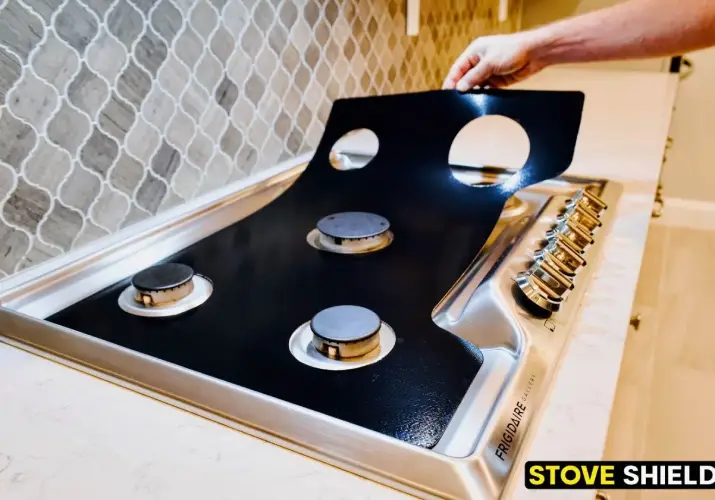
Many households reduce daily cleanup effort by protecting their gas stovetops with fitted liners. A gas stovetop protector creates a barrier between cooking mess and your actual surface, catching grease splatter, sauce spills, and burnt-on residue before it reaches the stainless steel.
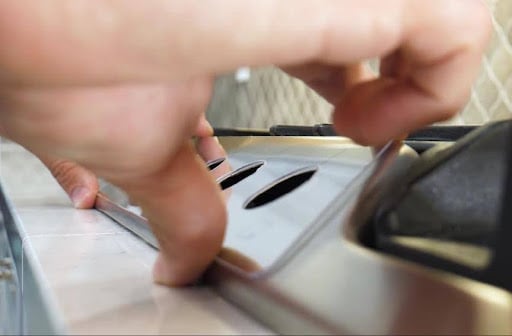
For anyone looking at this approach, stoveshield.com offers custom-fit protectors designed specifically for gas stovetops. Their protectors are thicker than most alternatives (0.5-0.6mm compared to the 0.15-0.3mm you’ll find elsewhere), ship flat rather than rolled, and come with a 365-day warranty. Care is simple: wipe down on the stovetop or hand wash at the sink. Never put them in the dishwasher or soak them in water.
Oven cleanup presents similar challenges. Drips that reach the oven floor bake on during subsequent uses, eventually requiring harsh chemical cleaners and significant scrubbing. An oven liner catches residue before it hardens, making maintenance far simpler.
What Real Homeowners Say About Cleaning Time
Reddit communities offer unfiltered perspectives on actual cleaning habits. Here’s what people report:
From r/selfimprovement: A user asking “how much time does the average well-adjusted person spend cleaning their home?” received responses ranging from 15 minutes daily to several hours weekly. The consensus? Consistent small efforts beat occasional deep cleans.
From r/CleaningTips: In a thread about weekly cleaning hours, most respondents reported 30 minutes of daily maintenance plus 1-2 hours of weekend cleaning. Those with better systems spent less time overall.
From r/AskWomenOver30: Working women who maintain tidy homes shared their strategies. The recurring theme: reducing friction wherever possible – including on high-maintenance surfaces like stovetops.
From Quora: Responses about couple housework time frequently cite BLS data, with combined couple time reaching 4-5 hours daily when all household activities are included.
The common thread across all these discussions: people who reduce cleaning friction at the source spend less time overall on maintenance.
The Bigger Picture: Why Cleaning Time Matters
Interior cleaning already consumes close to an hour per day for most households. That’s time you’re not spending on work, family, hobbies, rest, or anything else that matters to you.
The kitchen’s outsized share of that burden – roughly 40% of interior cleaning time – means small improvements there have disproportionate effects on your total housework load.
What This Means Practically
If you could reduce kitchen cleaning time by even 30%, you’d reclaim roughly 36-45 hours per year. That’s nearly a full work week returned to you annually – just from being smarter about one room.
Less scrubbing, fewer harsh cleaners, and easier daily maintenance don’t just save time. They make housework feel less overwhelming. There’s a real psychological benefit to knowing that tonight’s cleanup will take 5 minutes instead of 20.
The Gender Dimension
For women especially – who still bear the majority of the housework burden according to every data source available – any friction reduction represents meaningful relief. Two extra hours of unpaid domestic work daily adds up to 730+ hours per year. Anything that chips away at that number matters.
Conclusion
The average time spent on housework per day – roughly 1.6 hours according to BLS data – represents a significant portion of Americans’ daily lives. Interior cleaning alone accounts for nearly an hour of that time, with kitchens demanding the largest share.
The gender gap in cleaning time remains substantial: women spend approximately 2 more hours daily on unpaid domestic work than men, with 49% of women engaging in housework on any given day compared to just 20% of men. While research shows this gap is gradually narrowing, progress is slow.
Here’s what you can do now:
- Track your actual cleaning time for a week. You might be surprised by how much goes to kitchen maintenance specifically.
- Identify your highest-friction surfaces. For most households, that’s the stovetop and oven area.
- Consider protective solutions that prevent messes from bonding to surfaces in the first place. The time investment in setup pays back quickly.
- Build quick daily habits instead of relying on occasional deep cleans. Five minutes daily beats two hours weekly in total time and stress.
- Have honest conversations about household labor division. The data shows the burden isn’t equally distributed – and it doesn’t have to stay that way.
Housework will never disappear entirely. But reducing the friction that makes it feel endless? That’s within reach for any household willing to approach the problem strategically.
Sources
- Bureau of Labor Statistics – American Time Use Survey 2024 – Primary data source for daily housework time statistics
- BLS Charts: Household Activities by Detailed Household Type – Visual breakdown of time use data
- Institute for Women’s Policy Research – Women Do 2 More Hours of Housework Daily – Gender gap analysis in housework time
- Gender Equity Policy Institute – The Free-Time Gender Gap Report (2024) – Research on unpaid work distribution between parents
- American Home Shield Survey – Time Americans Spend on Chores – Survey data on gender-specific cleaning time
- American Cleaning Institute Survey (2018) – Data on weekly cleaning hours
- Milkie et al. (2025) – Who’s Doing the Housework and Childcare in America Now? – Socius – Academic research on 21st century housework trends
- Kolpashnikova & Kan (2021) – Gender Gap in Housework Time – The Social Science Journal – Research on how individual resources affect housework gender gap
- Reddit r/selfimprovement – Discussion on Average Cleaning Time – Community perspectives on cleaning routines
- Reddit r/CleaningTips – Weekly Cleaning Hours Discussion – Real homeowner cleaning time reports
About the Author
Ben Karlovich is an expert in the stove niche and has spent his career creating products and accessories that enhance household kitchen stoves. In 2016 he launched stovedecals.com (Stove Decals brand) and was the first to create and offer replacement stove decals across thousands of stove models. In 2022 he created stoveshield.com (Stove Shield brand) focused on stove top protectors, a patented knob panel protector, and other useful stove accessories fitted for your exact stove model. This niche expertise helps bring a unique blend of creativity and innovation to every article post.
Disclaimer: This article is for informational and educational purposes only and should not be relied upon as the sole basis for purchasing decisions. Product specifications, pricing, and availability are subject to change – contact the relevant manufacturer or retailer for the most current information. Stove Shield is not affiliated with and receives no compensation from any brands mentioned in this article.