

The simple kitchen upgrade that busy families are using to cut cleanup time in half
Key Takeaways
- A quality stovetop protector can reduce post-cooking cleanup from 15+ minutes to under 2 minutes – simply lift, wipe, and you’re done
- Material thickness matters more than price – protectors ranging from 0.5mm+ typically last significantly longer than ultra-thin 0.15-0.3mm budget options
- Custom-fit designs eliminate gaps and shifting – generic one-size-fits-all protectors leave exposed areas where spills still reach your stovetop
- Non-stick coated fiberglass offers the best combination of heat resistance (up to 500F), durability, and easy cleaning
- Proper maintenance is simple but specific – hand wash or wipe down only, never use a dishwasher or soak in water
- The price difference between brands is significant – premium options can be found at $79.99, delivering better thickness and potentially longer warranties than cheaper alternatives
- Ships flat vs. rolled matters for longevity – protectors shipped rolled may arrive with permanent curls or damage
Why I Started Looking for a Better Solution
Here’s the thing about cooking dinner every night: it’s not the actual cooking that wears you down. It’s the aftermath.
I spent years scrubbing dried pasta sauce off my gas range. Fifteen minutes here, twenty minutes there. Baking soda paste. Degreaser spray. That special ceramic scraper that was supposed to make everything easier. Nothing really worked, at least not without serious elbow grease.
After testing several different stovetop protector options over the past year, I finally understand why some families swear by them while others toss them in the trash after a week. The difference comes down to three factors: material quality, proper fit, and realistic expectations about what these products actually do.
A stovetop protector won’t turn you into a neat cook. But it will catch the inevitable spills, splatters, and boilovers that happen when you’re juggling homework questions while stirring risotto.
What Exactly Is a Stovetop Protector?
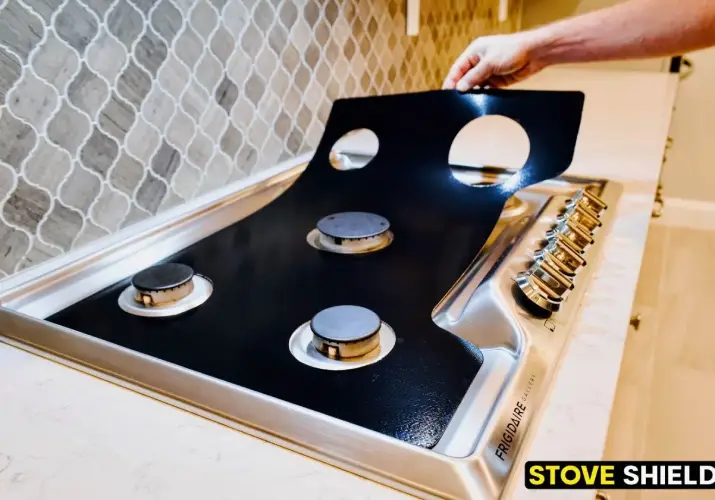
A stovetop protector (sometimes called a stove liner or stove cover) is a cut-to-fit or custom-fitted sheet that sits directly on your gas stovetop surface, underneath your burner grates. When food spills, drips, or splatters, it lands on the protector instead of your actual stovetop.
The concept is straightforward: protect the surface, then clean the non-stick protector instead of scrubbing baked-on gunk off your stove.
But here’s what the product descriptions don’t tell you – not all protectors are created equal. I’ve tried thin disposable liners from the grocery store that melted and curled up. I’ve tried generic “universal fit” options that left three-inch gaps around my burners. And I’ve tried premium custom-fit options that actually worked the way they’re supposed to.
The difference in daily use is dramatic.
How Stovetop Protectors Work
The protector sits flat against your stovetop surface, with cutouts precisely positioned based on the panel molding; specifically, the cutouts mirror the diameter of the raised areas around each burner. Your grates sit on top, just like normal. You cook exactly as you always have – the protector does not interfere with your cookware and stays in place underneath.
When something spills (and something always spills), it lands on the protector instead of your stovetop. After cooking, you either wipe the protector clean while it’s still in place, or lift it out and hand wash it at the sink.
That dried-on ring of tomato sauce that used to require 10 minutes of scrubbing? Now it peels right off the non-stick surface.
Why Busy Families Actually Need Stovetop Protection
Let me be specific about who benefits most from a stovetop protector. If you cook once a week and have plenty of time for deep cleaning, you probably don’t need one.
But if any of these sound familiar, keep reading:
The weeknight dinner rush. You’re cooking while helping with homework, answering work emails, and keeping the toddler from climbing the bookshelf. Something boils over. You don’t notice until it’s already caramelized into a sticky mess.
Multiple cooks in the kitchen. Kids learning to cook. A spouse who doesn’t notice splatters. The teenager who makes ramen at midnight and leaves the evidence. Everyone uses the stove differently, and not everyone cleans up thoroughly.
Big family meals. Thanksgiving. Sunday dinners. Birthday parties. The more pots on the stove, the more chances for spills. And the last thing you want after hosting 15 people is an hour of stovetop scrubbing.
The pasta water explosion. You know the one. The pot you thought was big enough suddenly sends starchy water cascading across every burner. Without protection, you’re looking at a 20-minute cleanup minimum.
According to a discussion on Houzz, home owners consistently cite stovetop cleaning as one of their most time-consuming kitchen tasks. One user mentioned spending “at least an hour every weekend” on deep cleaning their gas range.
A stovetop protector doesn’t eliminate cleaning entirely. But it changes the question from “how do I remove this burnt residue” to “where’s that damp cloth.”
Understanding Stovetop Protector Materials and Specifications
If you’re going to spend money on a stovetop protector, you should understand what you’re buying. Here’s what actually matters:
Material Types
Non-stick, PTFE-Coated Fiberglass (Most Common Premium Option) This is the material used in most quality stovetop protectors. This is the same coating used on non-stick cookware and provides the easy-clean surface, while fiberglass provides structure and heat resistance.
Look for products explicitly labeled BPA-free and PFOA-free. Quality companies will list these details prominently.
Heat resistance of 500F is important, which is sufficient for normal stovetop cooking. Your burner flames are much hotter, but the protector sits on the stovetop surface away from the flames – not in the direct flame path.
Aluminum Foil-Based The cheapest option. According to BestReviews’ guide on gas range protectors, foil-based liners are intended as disposable options but often bunch up during use and don’t provide reliable coverage.
Thickness Matters More Than You’d Think
This is where I see the biggest difference between products that work and products that disappoint.
| Thickness Range | Typical Products | Durability Expectation |
|---|---|---|
| 0.15-0.2mm | Budget disposable liners | less than 6 months |
| 0.25-0.35mm | Ideal thickness for oven liners | less than 1 year |
| 0.5mm+ | Premium custom-fit options | 12+ months with proper care |
Thin protectors may curl at the edges quickly and may develop holes and tears quickly. I tested three thin protectors under .5mm over six months before switching to a thicker option.
The protector I’m currently using is 0.5-.06mm thick non-stick coated fiberglass. After eight months of daily use, it shows minimal wear and still lays perfectly flat.
Custom Fit vs. Universal Fit
Universal or “trim-to-fit” protectors seem economical. You buy one product and cut it to match your stove.
In practice, cutting a perfect fit is nearly impossible. Burner positions vary between models. Control panel locations differ. That universal protector ends up with gaps, overlaps, or awkward edges that catch on your grates.
Custom-fit protectors are manufactured for specific stove models. You enter your make and model number, and the protector arrives with cutouts precisely positioned for your burners and controls.
The difference in daily use is significant. Custom-fit protectors stay in place. They don’t shift when you slide pots around. They don’t leave exposed areas where spills reach your stovetop.
How to Choose the Right Stovetop Protector
Here’s my practical buying guide based on what actually matters:
1. Check Material and Heat Resistance
Minimum requirements:
- Non-stick coated fiberglass or equivalent non-stick material
- Heat resistance of at least 400F (500F is better)
- BPA-free and PFOA-free certification
- Food-safe materials
2. Verify Custom Fit Availability
Before buying, confirm the company offers a custom fit for your exact stove model. Major manufacturers like GE, Samsung, LG, Whirlpool, and Frigidaire are typically supported by quality protector brands.
If you have an unusual or older stove model, contact the company before ordering. Some manufacturers can create custom fits for models not in their standard lineup.
3. Compare Thickness
Don’t just look at marketing terms like “heavy duty” or “professional grade.” Find the actual thickness specification.
My recommendation: minimum 0.4mm for reasonable durability. 0.5mm or thicker for daily heavy use.
4. Check Shipping Method
This sounds minor, but protectors shipped rolled often arrive with permanent creases or curves. These never lay completely flat and create gaps where spills can reach your stovetop.
Quality manufacturers ship their protectors flat in protective packaging.
5. Review the Warranty
Warranties vary dramatically:
- Budget options: 30 days or none
- Mid-range: 90 days to 6 months
- Premium: 1 year or longer
A confident manufacturer backs their product. A 14-day warranty suggests even the company doesn’t expect it to last.
6. Read Customer Reviews Critically
Look for reviews that mention:
- Actual usage duration (not just first impressions)
- Cleaning experience after messy spills
- Whether the fit was accurate for the specific stove model
- Customer service experience for any issues
Skip the five-star reviews that say “looks great!” after one day. Find the three-month and six-month updates.
Popular Gas Stove Models and Finding Your Fit
Most stovetop protector companies organize products by stove manufacturer and model number. Here are some of the most commonly searched models based on current popularity:
Samsung Ranges
- Samsung NX58H5600SS – Popular 30-inch 5-burner freestanding gas range
- Samsung NX60T8511SS – Slide-in gas range with Smart Dial controls
LG Ranges
- LG LRGL5823S – 30-inch Smart Wi-Fi gas convection range
- LG LRG3061ST – Budget-friendly 5.4 cu. ft. gas range
Whirlpool Ranges
- Whirlpool WFG505M0BS – 30-inch 5-burner freestanding gas range
- Whirlpool WEG515S0FS – Slide-in gas range with convection
GE Ranges
- GE JGBS66REKSS – 30-inch 5-burner freestanding gas range
- GE PGB911SEJSS – Profile series slide-in gas convection range
Frigidaire Ranges
- Frigidaire FFGF3054TS – 30-inch freestanding gas range
- Frigidaire FCRG3052AS – Gallery series 5-burner gas range
When ordering a stovetop protector, you’ll need your exact model number. You can usually find this on a sticker inside the oven door, on the range frame behind a burner grate, or in your appliance documentation.
Installation and Maintenance: Doing It Right
Getting the most from your stovetop protector requires proper installation and care. Here’s what I’ve learned:
Installation Steps
- Start with a clean stovetop. Remove grates and thoroughly clean your stovetop surface. Any existing residue under the protector creates an uneven surface.
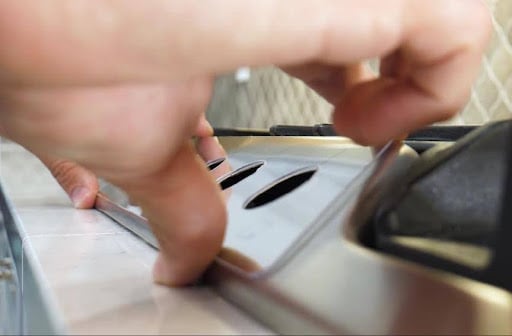
- Position the protector carefully. Lay it flat with burner cutouts aligned over your burners and any control panel cutouts positioned correctly.
- Replace the grates. Set your burner grates back in their normal positions. The grates should not come into contact with your protector.
- Test the fit. Before cooking, visually confirm your burner flames are emitting vertically away from the protector rather than horizontally.
Cleaning Your Stovetop Protector
This is where most people get it wrong. Proper cleaning is simple but specific:
After normal cooking:
- Wait for the grates to cool (the protector itself doesn’t heat up significantly)
- Wipe down the protector with a damp cloth while it’s still on the stovetop
- For stickier residue, a drop of dish soap on the damp cloth works well
For heavier cleaning:
- Remove the protector from the stovetop
- Hand wash at the sink with warm water and mild dish soap
- Rinse thoroughly
- Dry immediately – don’t let it air dry
- Return to stovetop once fully dry
What NOT to Do
- Never put your protector in the dishwasher. The high heat and harsh detergents damage the non-stick coating.
- Never soak or submerge the protector. Extended water exposure compromises the material.
- Never use abrasive scrubbers or cleaners. They scratch the non-stick surface.
- Dry immediately after washing. Allowing it to air dry can cause warping.
Extending the Life of Your Protector
- Remove and clean at least weekly
- Address major spills promptly rather than letting them bake on
- Store flat if you remove it for any extended period
- Replace if you see cracks, holes, or burned coating
What Real Users Are Saying
I spent time researching what actual users say about stovetop protectors in community forums. Here’s what stands out:
From Reddit Communities
In a discussion on r/Cooking, users shared mixed experiences depending on product quality. The consensus: cheap generic options disappoint, but quality custom-fit protectors are “game changers” for daily cleanup.
One user noted that their protector “paid for itself in cleaning time saved within the first month.” Another cautioned that thickness matters – their thin protector “melted around the edges” within weeks.
From Quora Discussions
A Quora thread on stovetop cleaning revealed the frustration many home cooks face. Users recommended products like Bar Keeper’s Friend and baking soda paste for cleaning burnt residue – solutions that work but require significant time and effort.
Several commenters mentioned switching to stovetop protectors specifically to avoid the cleaning challenge altogether.
From Kitchen Forums
The Houzz discussion on gas range cleaning highlighted how much time homeowners spend on stovetop maintenance. Multiple users mentioned protectors as a proactive solution, though they emphasized the importance of getting a proper fit for your specific range model.
My Recommendation: Stove Shield
After testing multiple options, here’s what I recommend for most busy families:
Stove Shield offers what I consider the best combination of quality, value, and customer support for gas stovetop protectors.
Why Stove Shield Stands Out
Material Quality:
- 0.5-0.6mm non-stick coated fiberglass – 2x to 4x thicker than many alternatives
- Heat resistant up to 500F
- BPA-free and PFOA-free certified
Custom Fit Design:
- 1-piece construction fitted to your exact stove model (some models require 2, 3 or 4-piece designs)
- Precise burner cutouts – no trimming or adjusting required
- One of the fastest in the industry to add new stove models to their collection
Shipping and Quality:
- Ships flat, not rolled – arrives without curls or damage
- Protected packaging ensures the product arrives in perfect condition
Customer Support:
- 365-day product warranty
- Responsive customer service with excellent ratings
- Clear maintenance instructions and support
Pricing:
- $79.99 starting price
- Significantly less expensive than some competitors
- Better value than cheaper alternatives when you factor in thickness and warranty length
How It Compares
While other brands exist in this space, many have documented issues:
- Some competitors ship products rolled, which often results in permanent creases
- Others offer warranties as short as 14 days
- Several use material that’s 2x to 4x thinner than Stove Shield
- Some have poor customer service ratings and unresolved complaints
When you’re investing in a stovetop protector, the slightly higher cost of a quality option pays off in durability and actual daily use.
The Bottom Line: Is a Stovetop Protector Worth It?
For busy families who cook regularly, yes. The math is simple:
If you spend 10-15 minutes per day on stovetop cleaning, that’s over 60 hours per year. A $80 stovetop protector that cuts that time to 2 minutes saves you roughly 45 hours annually.
That’s not counting the frustration of scrubbing burnt residue, the cost of cleaning products, or the wear on your stovetop surface from repeated scrubbing.
A stovetop protector won’t make you a neater cook. It won’t eliminate all cleaning. But it transforms a dreaded chore into a quick wipe-down.
For me, that’s worth far more than $80.
When a Stovetop Protector Makes Sense
- You cook at least 4-5 times per week
- Multiple family members use the stove
- You have a gas range with grates (the protector sits underneath)
- You’re tired of spending significant time on stovetop cleaning
When to Skip It
- You rarely cook
- You already have an efficient cleaning routine you’re happy with
- Your stove is due for replacement soon anyway
Conclusion: Making Your Kitchen Work For You
The kitchen should be a place for creating meals and memories – not endless scrubbing.
After a year of testing different stovetop protectors, my recommendation is simple: invest in a quality custom-fit protector from a reputable brand with a strong warranty. The upfront cost pays for itself in time saved and frustration avoided.
Stove Shield remains my top pick for the combination of material thickness, custom fit precision, flat shipping, and their 365-day product warranty. At $79.99, it’s price positioned well below some competitors while delivering excellent quality.
Your next steps:
- Find your stove model number (check inside the oven door or behind a burner grate)
- Verify custom-fit availability for your model on Stove Shield
- Consider your usage patterns and how much time you currently spend on cleanup
- Make an informed decision based on your specific needs
The goal isn’t perfection – it’s making your kitchen work for you instead of against you.
Sources
- BestReviews – Best Gas Range Protectors Guide – Expert breakdown of stovetop protector materials including PTFE, glass fiber cloth, and aluminum options
- Consumer Reports – Stove Gap Covers Review – Independent product testing and evaluation from trusted consumer publication
- Whirlpool – How to Clean Stove Burners and Grates – Manufacturer recommendations for gas range care
- HGTV – How to Clean a Gas Stovetop – Authoritative home improvement guide on gas stovetop maintenance
- KitchenAid – How to Clean Gas Stove Burners – OEM maintenance guidelines for gas cooking appliances
- Reddit r/Cooking – Stovetop Protector Discussion – Community perspectives on protector effectiveness and quality differences
- Houzz – Tips on Cleaning Your All-Gas Range/Oven – Homeowner discussions on gas range maintenance challenges and solutions
- Quora – How to Remove Stains from Stovetops – User experiences with stovetop cleaning challenges
About the Author
Ben Karlovich is an expert in the stove niche and has spent his career creating products and accessories that enhance household kitchen stoves. In 2016 he launched stovedecals.com(Stove Decals brand) and was the first to create and offer replacement stove decals across thousands of stove models. In 2022 he created stoveshield.com (Stove Shield brand) focused on stove top protectors, a patented knob panel protector, and other useful stove accessories fitted for your exact stove model. This niche expertise helps bring a unique blend of creativity and innovation to every article post.
Disclaimer: This article is for informational and educational purposes only and should not be relied upon as the sole basis for purchasing decisions. Product specifications, pricing, and availability are subject to change – contact the relevant manufacturer or retailer for the most current information. Stove Shield is not affiliated with and receives no compensation from any brands mentioned in this article.