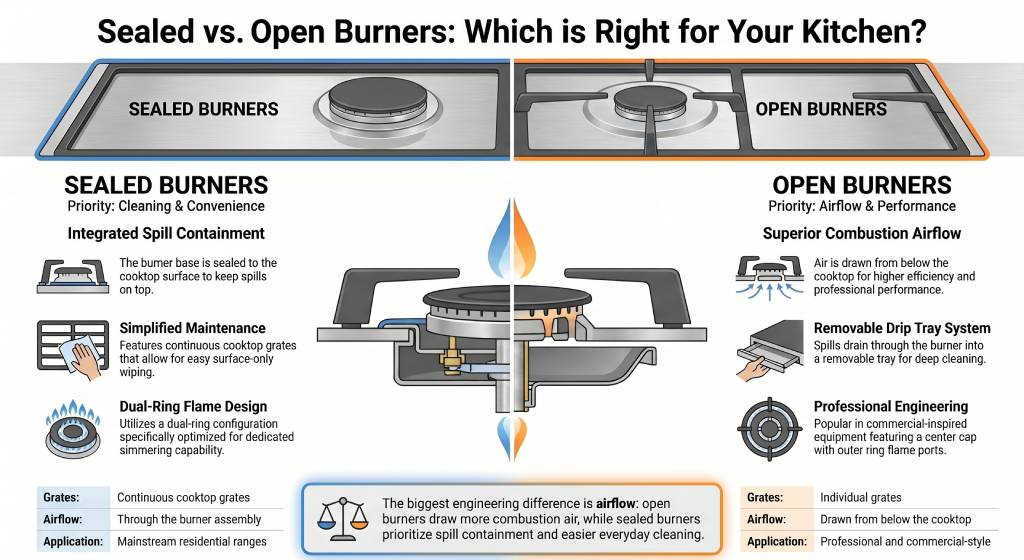
Sealed burners bond the burner head right to the cooktop, so spills stay on top the modern home default. Open burners leave the head exposed over a drop-out drip tray and pull more air, hitting higher BTU; they’re the pro-style pick. Choose sealed for easy cleanup, open for wok-grade heat.
If you’re comparing sealed burner vs open burner gas ranges in 2026, the choice has shifted under most buyers’ feet. The old shorthand was simple. Sealed for ease, open for power. That framing held up ten years ago. Today it’s half true. Wolf’s dual-stack sealed burner now hits 16,000 BTU with a 500 BTU simmer, and the Viking 7 Series sealed reaches 23,000 BTU per Yale Appliance’s Wolf-vs-Viking comparison. That puts modern sealed within about 2,000 BTU of the BlueStar Platinum open burner, which tops out at 25,000 BTU per BlueStar’s own Platinum spec page.
The real call in 2026 isn’t “which has more power.” It’s which one fits your simmer floor, your cleanup tolerance, your cooking style, and your budget. This guide walks through all five.
The mechanical split is simple. On a sealed burner, the head sits flush with the cooktop and the seam around the base is bonded. No gap for crumbs or liquid to fall into. On an open burner, the lift-off head sits above an exposed drip tray you can pull out for cleaning.
Flame design also differs. Per Wolf’s official surface burner knowledge base, sealed burners use two gas-port rings an upper ring for high, medium, and low, and a lower ring for the simmer setting. Open burners take a different shape: a center cap with an outer ring of flame ports. That layout is why they can pull combustion air from below the cooktop. The extra airflow is the engineering reason open burners reach higher peak BTU.
The first visual cue most buyers spot is the grate. Sealed burner ranges ship with a continuous cast-iron grate that spans the cooktop. Open burner ranges use individual grates that lift off above a slide-out drip tray.
Brand-wise, the split is clean. GE, Whirlpool, Frigidaire, KitchenAid, and Bosch ship sealed-only on home lines. BlueStar, Capital Culinarian, and commercial-style brands like Vulcan represent the open-burner tradition in residential and professional-style cooking equipment. Wolf, Viking, and Thermador straddle both camps, but their headline home ranges are sealed dual-stack.
Lift the cap. You’ll see two concentric port rings cast into the burner body. The cap clips down to seal the flame against the cooktop.
Lift the grate. You’ll see a spider-style head sitting on a riser above the drip tray. The whole head lifts off in your hand for cleaning.
This is the number most buyers anchor on, and it’s the most out-of-date assumption in the whole category. Here’s the 2026 picture across the headline home ranges:
| Range | Type | Max BTU (top burner) | Published simmer floor |
|---|---|---|---|
| Wolf GR (dual-stack) | Sealed | 16,000 | 500 BTU |
| Viking 7 Series | Sealed | 23,000 | not published |
| Thermador Pro Grand | Sealed | 18,000 | 100 BTU (pulsed ExtraLow) |
| BlueStar Platinum (PrimaNova) | Open | 25,000 | 130 degree dedicated simmer |
| Capital Culinarian | Open | ~30,000 (verify on Capital site) | manual low |
| Vulcan Endurance (commercial) | Open | 30,000 | not applicable |
| GE Cafe / Profile | Sealed | 17,000-21,000 | varies by model |
Sources: Yale Appliance for Wolf and Viking; BlueStar Platinum spec page for PrimaNova; Vulcan Endurance product page for the commercial reference; GE Hotpoint spec sheet for the standard home band.
Read the table this way. Open still owns the absolute top end 25,000 to 30,000 BTU is open-burner ground, and modern sealed can’t match it. But below 23,000 BTU, sealed dual-stacks are in the fight. If you’ve been telling yourself “I need open burners for the power,” and your real max load is 18,000 BTU, the gap that justified that pick in 2010 has narrowed to a few thousand BTU in 2026.
The simmer floor flips the comparison. Wolf’s published 500 BTU simmer is the industry-lowest steady figure, and it’s a sealed-burner number. If you make French sauces or melt chocolate without scorching,sealed burners win cleanly.
The answer depends on the spill type. There’s no universal winner. For broader maintenance and long-term upkeep, see our complete stove care guide.
Daily wipe-down (light splatter, oil spots, water rings). Sealed wins, no contest. Spills land on a flat sealed surface. A damp cloth usually cleans the whole cooktop in just a few minutes. No drip tray to pull, no head to lift.
Cap cleaning after spillovers. KitchenAid’s OEM owner’s manual says to remove the sealed burner caps after every spillover to prevent ignition problems. That’s a step sealed-burner owners often skip — until the burner clicks over and over trying to light. Open burner heads lift off too, but spills usually land on the drip tray below rather than around the head, so head removal happens less often.
Major boilover (pasta water, sauce overflow, milk). The picture flips. On sealed burners, liquid runs into the seam around the base, and you face crevice scrubbing plus cap removal. GE Appliances support walks through the full cleaning steps. It is not a two-minute job. On open burners, the same boilover lands on the drip tray. Lift the grate, slide the tray out, wash it at the sink. The whole process typically takes longer than a quick sealed-burner wipe-down longer than a sealed wipe-down, but no crevice scrubbing.
On the Houzz cleanup discussion thread for open-burner ranges, BlueStar owners say pulling the drip tray is no harder than taking apart sealed burner caps for moderate spills. That’s one community sample, not consensus Houzz comments split both ways on the same question.
In practice: sealed for homes with frequent light splatter and rare boilovers. Open is fine for cooks who don’t mind a weekly tray pull and an occasional pasta-water mess.
This is the most-discussed real-world complaint about sealed burners. It deserves a direct answer.
The complaint shows up across multiple communities. On the r/AskCulinary open-vs-sealed thread, owners describe edge-hot, center-cold heating on small saucepans. The same complaint shows up on the bobistheoilguy gas-burner thread, where a Dacor owner describes the exact pattern on small saucepans. Forum disagreement is the signal here. Not every sealed-burner owner reports the issue.
The cause is geometric. Most sealed burners use a ring of flame ports around the perimeter of the cap. Small pans, roughly 5 to 6 inches across, sit inside the heat ring. Direct flame hits the pan’s edge but not the center. A thin-base pan can’t conduct that perimeter heat inward fast enough, so the center stays cool.
Three fixes, ranked by how well they work:
Open burners side-step the issue because their spider geometry puts flame right under the pan center. If you cook almost only with 5 to 6-inch saucepans on high heat, a standard ring-port sealed burner is the wrong tool. A star-geometry sealed burner or an open burner is the right one.
That’s the honest limitation. It’s real, it’s fixable, and it’s not a reason to write off sealed burners across the board.
Generic “home cook vs pro chef” framing fails most buyers. The useful question is: what do you actually cook? Here are five common styles with a clear pick:
Wok cooking (Cantonese-style stir-fry). Open burner wins. Real wok cooking needs 22,000+ BTU sustained under a round-bottom wok with strong airflow. BlueStar Platinum, Capital Culinarian, or a dedicated wok burner attachment. Sealed can’t match the airflow shape, which matters as much as raw BTU for wok hei.
French sauce work (beurre blanc, hollandaise, caramel). Sealed dual-stack with low simmer wins. Wolf’s 500 BTU simmer and Thermador’s pulsed ExtraLow are sealed-burner tech. Open burners usually bottom out higher fine for searing, harder for emulsion sauces that scorch fast.
Multi-pan weeknight family dinner with four to five burners going at once. Sealed wins on practicality. Cleanup after a kid’s spillover takes two minutes, not eight. Modern dual-stack sealed burners have enough BTU for everything short of wok cooking.
Casual everyday cooking, one or two-person household. Sealed. Cleanup ease compounds over a year of weeknight dinners more than peak BTU ever will at this volume.
Charring and blistering (peppers, tortillas, charcuterie). Open. Direct flame access without a cap helps for direct-flame charring, and the higher peak BTU helps when you want a hard sear on cast iron without dropping the pan temperature.
Sealed burner pros. Easier daily cleanup. Lower upfront cost. Broader brand choice every major home brand offers sealed. Modern dual-stack designs match open BTU below 18,000.
Sealed burner cons. Standard ring-port models risk cold-center heating on small pans. The sealed igniter assembly is harder to service in the field than a lift-off open head. Max BTU caps at roughly 23,000 (Viking 7 Series). Per Yale Appliance, out-of-warranty igniter swap on a Wolf can run a few hundred dollars per burner.
Open burner pros. Highest sustained BTU at 25,000 to 30,000. Spider geometry heats small pans more evenly than a ring-port sealed. Lift-off heads make long-term service simpler a clogged port often clears with a wire brush, not a service call. Pro-kitchen pedigree, if looks matter to you.
Open burner cons. Higher purchase price, usually 6,000 dollars and up. Drip-tray cleanup needed after spills. Higher gas-line need: many pro-style open ranges call for a 3/4-inch gas supply rather than the standard 1/2-inch found in most homes, per This Old House’s pro-style range guide.
One safety note that applies to both types. Any gas combustion appliance — sealed or open gives off carbon monoxide. The Mississippi State Department of Health’s CO guidance lists dizziness, nausea, and headache as exposure symptoms. A working hood vent and a CO detector matter more than burner shape. Both sealed and open ranges pass UL/ANSI Z21.1 home certification neither type is inherently “unsafe.”
Price brackets, as of 2026:
Sticker price is only half the cost picture. Over a 10-year ownership window, open burners usually run cheaper to service because lift-off heads make repair simpler. You can clear a clogged port at the kitchen counter without a tech visit. Sealed igniter swap, as noted above, can cost several hundred dollars per burner on premium brands once you’re out of warranty.
Budget for one more line item if you go pro-style open. The gas-line upgrade from 1/2-inch to 3/4-inch supply, if your home has standard supply, usually runs 400 to 1,200 dollars with a licensed plumber. If you live in a condo or have a long line run, it can go higher.
Decision close. Three clear paths:
One honest caveat that no spec sheet captures: visit a showroom and work the controls. Knob feel, grate height, the way a pan slides between burners these matter more in daily use than most spec-sheet numbers, and they’re personal. Two cooks can read the same sealed burner vs open burner comparison and reach opposite calls for fully sensible reasons.
What is the difference between open and sealed burners?
A sealed burner has its head bonded to the cooktop with no gap around the base, so spills stay on top of a flat surface. An open burner sits as a lift-off head above an exposed drip tray, drawing combustion air from below the cooktop. Sealed wins for cleanup; open delivers higher peak BTU.
How do you clean sealed burners on a gas stove?
Wipe the cooktop with a damp cloth for daily splatter. After any spillover, KitchenAid’s owner’s manual tells you to remove the burner caps, wash them in warm soapy water, dry fully, and re-seat them before relighting. For a complete walkthrough, see our guide on cleaning burner heads and caps. Skipping this step is the most common cause of repeated click-ignite failures on sealed ranges.
What are the three types of burners?
The three common home gas burner styles are sealed burners (the modern default on most brands), open or spider burners (pro-style, commercial-derived), and dual-stack or star burners (a sealed variant with both ring-port and radial-port flame patterns for better small-pan heat distribution).
Are open burners harder to clean?
For light daily splatter, yes sealed wipes faster. For major boilovers, no open burners often clean faster because you slide the drip tray out for sink-wash rather than scrubbing crevices around a sealed burner base. The right answer depends on your most common spill type.
Do sealed burners affect cooking performance?
On small saucepans, standard ring-port sealed burners can heat the pan edge faster than the center. Star-geometry sealed burners (Wolf dual-stack, Thermador Star) fix this by adding radial flame ports. For pans 7 inches and wider, modern sealed burners perform on par with open burners up to about 18,000 BTU.
Can you convert a sealed burner range to an open burner range?
No the swap isn’t practical. Sealed and open burners use different burner-head castings, different cap designs, different gas-port shapes, and in most cases different drip-tray architecture. If you want open burners, buy an open-burner range. If you’re still deciding between appliance sizes, read our guide on choosing the right gas range size.
The sealed burner vs open burner call in 2026 isn’t the brute-force BTU debate older articles make it out to be. Sealed dual-stack ranges from Wolf, Viking, and Thermador now cover most home cooking up to about 23,000 BTU with the lowest simmer floors in the category. Open burners from BlueStar and Capital Culinarian still own the top end at 25,000 to 30,000 BTU and remain the right call for serious wok cooking or weekly high-heat searing. Cleanup, cost, simmer needs, and cooking style decide the rest. Visit a showroom, work the controls on both types with a small saucepan and a large skillet, and let your actual hands settle what your spec sheet can’t.
To care for a ZLINE gas range, wipe the porcelain enamel cooktop and sealed burners…
RV gas stove care means a quick wipe after every meal, a deep clean where…
Miele gas stove care means wiping the porcelain or stainless deck after every meal with…
Fisher & Paykel gas stove care comes down to a daily wipe of the brushed-stainless…
To care for a Tappan gas stove, wipe the cooktop and grates after each use…
Crosley gas stove care comes down to a daily wipe-down once the cooktop is cool,…