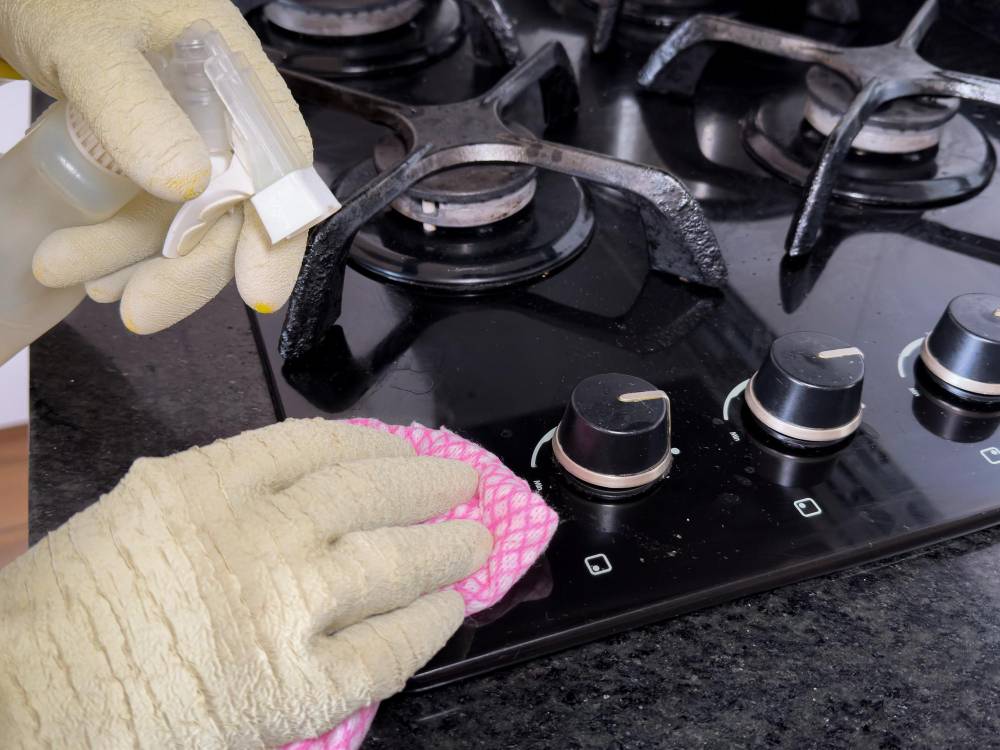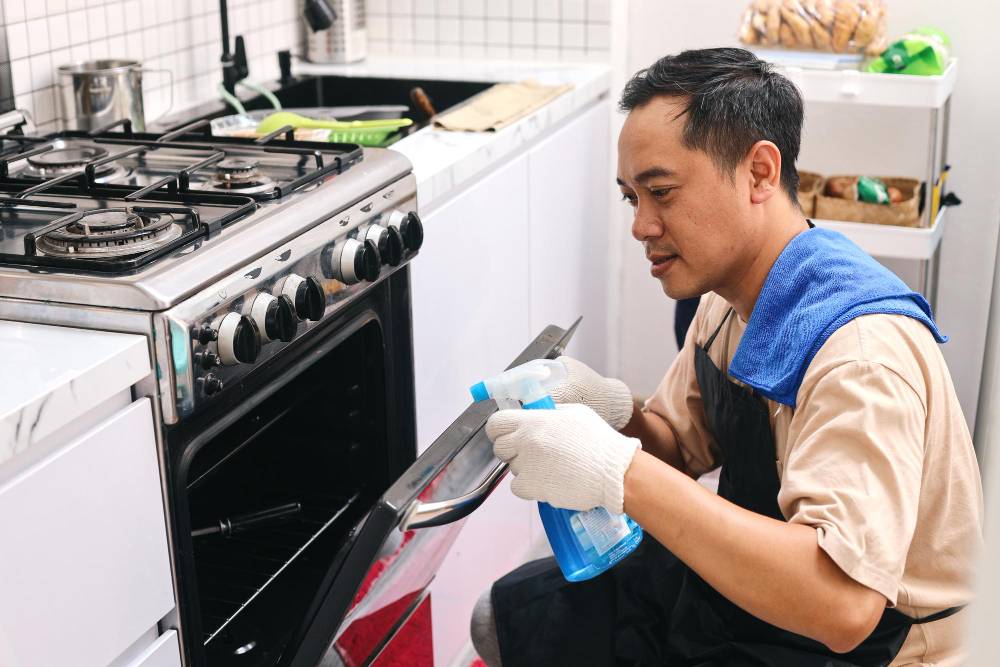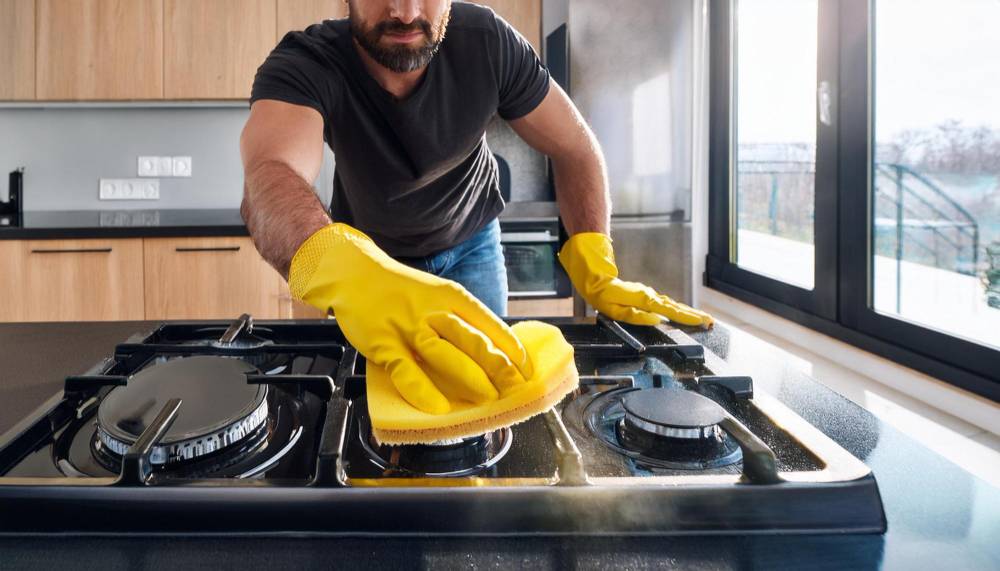

To clean stove knobs without wiping off the labels, pull each knob straight off. Wash the shaft area with mild dish soap and warm water on a soft cloth. Then gently wipe never scrub the printed face. Skip abrasives, vinegar soaks, and the dishwasher. Reinstall in the OFF position.
Most articles in our complete stove care guide focus on getting grease off and stop there.. The harder problem? Doing it without erasing the OFF/LOW/HIGH markings you need to cook safely. This guide synthesizes guidance from manufacturer manuals and support materials from GE, Whirlpool, Samsung, KitchenAid, LG, and Wolf
Key Takeaways
- To clean stove knobs without label loss, pull each knob straight off never twist or pry, since prying cracks the plastic D-shaped insert.
- Mild dish soap and warm water is the only cleaning method consistently approved across the manufacturer manuals reviewed (GE, Whirlpool, Samsung, KitchenAid, LG, and Wolf).
- Vinegar is contested Lemi Shine’s Tim Jones says it does not degrease; KitchenAid forbids it on stainless steel; LG permits it only on the manifold panel.
- Magic Eraser, baking-soda paste, and Bar Keepers Friend all work but wear down printed stove knob labels over time.
- Skip the dishwasher for printed knobs regardless of brand; Samsung’s FX710BGS manual is the most explicit.
- Replacement decals from Stove Decals have been a documented fix since the Washington Post 2021 coverage.
- Leave the cardboard splash-guards (where shipped) in place; they deflect spatter from the shaft cavity.
Why Do Stove Knob Labels Wipe Off So Easily?
The printed marks on most range knobs sit under a thin coating. They are not pressed into the plastic beneath. Sub-Zero and Wolf’s official “Knob Cosmetic Concerns” FAQ notes that the protective coating on stove knobs is susceptible to fading from oily hands, certain cleaning products, chemicals, grease splatters, spillovers, and cooking temperature.
Two things attack the coating heat from the burner and abrasion from anything gritty (green scrubbers, melamine foam, baking-soda paste). Solvents speed it up. Long contact with vinegar, ammonia, or citrus-based cleaners can soften the coating enough to lift on the next wipe. The method matters more than the cleaner.
How Do You Clean Stove Knobs the Label-Safe Way?
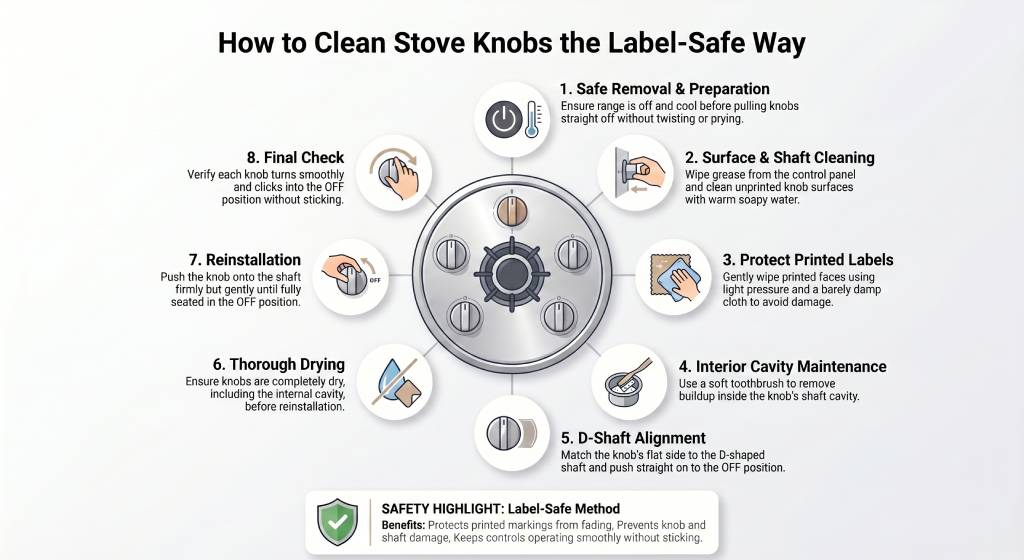
This process lines up with what GE, Whirlpool, KitchenAid, LG, Samsung, and Wolf all allow. Eight steps, roughly 12 minutes for a four-knob range.
What You’ll Need
- Mild dish soap (Dawn Platinum works; any non-citrus, non-bleach dish soap is fine)
- Two soft microfiber cloths
- A small bowl of warm (not hot) water
- A soft toothbrush for the shaft cavity
- A dry towel
The Eight Steps
- Turn the range off and let it cool. Check every knob is in the OFF spot before you remove anything.
- Pull each knob straight off the shaft. Do not twist, rock, or pry. In a 2026 interview with The Spruce, cleaning expert Lindsay Droz noted that prying can crack the plastic insert that grips the D-shaped shaft.
- Wipe the open shaft and panel area with a damp cloth. This is where grease actually pools. For the surrounding cooktop, follow our gas stove cleaning method. Do not spray cleaner straight on the control panel it can seep behind the bezel into the switch.
- Wash the back and sides of the knob in the warm soapy water with the soft cloth. Up to about 60 seconds of contact is fine for the unprinted areas.
- Wipe the printed face on its own, with a barely damp cloth. Light pressure only. If grease is stuck, let the cloth sit on the face for 30 seconds, then wipe do not scrub.
- Use the toothbrush on the inside cavity where it grips the shaft. This is where spatter from cooking builds up and never gets cleaned.
- Rinse with a second clean damp cloth, then towel dry fully. Trapped water is what makes knobs stick later.
- Line up the flat side of the inner D-shaped cavity with the flat side of the shaft, then push straight on. Confirm every knob is in the OFF spot before you turn the range back on.
Cleaning each knob separately with dedicated cloths helps prevent abrasive residue or solvents from transferring onto the printed face.
What Cleaners Should You Use (and Which Should You Avoid)?
When you clean stove knobs, the cleaner choice matters as much as the steps if your goal is keeping labels. Here is how the common options shake out against maker notes.
| Cleaner | Verdict | Why |
|---|---|---|
| Mild dish soap + warm water | Safe universal | Only cleaner with full sign-off across manuals |
| Bar Keepers Friend (paste, light pressure) | Risky on labels | Mildly gritty; KitchenAid forbids on stainless steel |
| Baking-soda paste | Risky on labels | Gritty bits lift coating; fine for backsplash, not knobs |
| Citric acid (Lemi Shine powder paste) | Safer than vinegar | Tim Jones told The Spruce citric acid is the real degreaser, not vinegar |
| White vinegar | Contested (see below) | KitchenAid forbids on stainless; LG permits 50/50 only on manifold |
| Mr. Clean Magic Eraser | Strips labels | Melamine foam scrubs a commonly recommended online cleaning method that may accelerate label wear |
| Household ammonia | Avoid | Never near bleach (chloramine gas CDC, below) |
| Oven cleaner | Forbidden | Universal “do not use” across all six manuals |
| WD-40 | Not maker-approved | WD-40 documents kitchen grease use; no range maker backs it |
| Goo Gone | Spot-use only | Fine for sticky residue; never on the printed face |
| CLR | Avoid on knobs | Calcium/lime/rust mix dulls the coating |
| Krud Kutter | Diluted only | Spray onto cloth, never the panel |
The Vinegar Disagreement
Vinegar is the autocomplete suggestion for this query and the most contested. In the same 2026 The Spruce interview, Lemi Shine president Tim Jones said vinegar has limited degreasing power compared with citric acid and recommends citric acid paste instead. The LG range owner’s manual approves a 50/50 vinegar-water mix only on the manifold panel not the knobs. KitchenAid’s stainless steel appliance guide forbids vinegar fully on stainless-steel finishes. Safer label-preserving move? Skip it on the knob face.
The Magic Eraser Caveat
Melamine foam (Magic Eraser–type products) cleans through micro-abrasion.
While effective on stuck-on grease, repeated use can gradually wear printed markings and control labels on a stove top. For this reason, avoid using melamine foam on control panels, logos, or any printed markings.
How Do You Remove Stove Knobs by Brand?
Before you can clean stove knobs well, you have to remove them and the removal method varies more than people expect. The table below pulls from each maker’s published help docs as of 2026.
| Brand | Removal | Cleaning Permitted | Watch Out For |
|---|---|---|---|
| GE | Pull straight off; flat-D lines up on reinstall | Mild soap + soft cloth | GE manual: leave cardboard splash-guards in place |
| Whirlpool | Pull straight off (no twist) | 3-step warm soapy water | Whirlpool support: “do not remove seals under knobs” |
| Samsung | Some models (NE59J7850SS) have a press-release tab | Damp soft cloth | FX710BGS manual: “Do not clean the control knobs in a dishwasher” |
| KitchenAid | Pull straight off | Mild soap only | 1999 PDF manual: “DO NOT use steel wool or abrasive cleaners” |
| LG | Pull straight off; replace in OFF | Soft cloth + mild soap; 50/50 vinegar on manifold only | Silent on dishwasher default to no |
| Wolf / Sub-Zero | Pull straight off | Mild soap only | FAQ: “do not soak the knobs or use abrasive cleaners they will remove markings” |
Not listed? The shared rule across every manual we checked: pull straight off, never twist, mild soap with a soft cloth, never the dishwasher.
What If the Knob Is Stuck or Sticky?
A stove knob that will not pull off is almost always glued by dried grease, not a mechanical lock. Wrap a warm damp cloth around it for two or three minutes, then try again with even straight-out pressure. Do not use pliers or a screwdriver both Whirlpool and GE warn that prying cracks the plastic insert. If a Samsung knob resists, check for the press-release tab on that model. Sticky controls when turning usually mean grease has worked into the switch body. That is a service call, not a cleaning fix.
Is It Safe to Soak Stove Knobs?
When you clean stove knobs by soaking, short contact (under five minutes) in warm soapy water is fine for the back and sides of an unprinted knob. Long soaks are where label damage starts. Whirlpool, KitchenAid, Wolf, Sub-Zero, and GE all say “do not soak.” The issue is not water — it is contact time with whatever is dissolved. Soap surfactants, vinegar, and citric acid all soften the coating if they sit long enough. The printed face is the most porous part of the knob. If you must soak baked-on grease, keep it under five minutes, knob-side-up so the printed face stays above the liquid.
What Should You Never Do When Cleaning Stove Knobs?
When you clean stove knobs, the “do not” list is remarkably steady across manuals:
- Do not use the dishwasher. Samsung, Whirlpool, and Wolf forbid it outright; KitchenAid permits it on a small number of models. Default to “no” and never for printed labels.
- Do not use steel wool, scouring pads, or abrasive cleansers. Banned across the board.
- Do not spray cleaner straight onto the panel. Spray onto the cloth first. Droz warns that direct spray seeps behind the bezel into the switch body.
- Do not mix ammonia with bleach or oven cleaner. According to the CDC’s 2026 ammonia chemical-emergencies guidance, mixing ammonia with chlorine bleach releases chloramine gas. The same hazard applies to ammonia plus most store-bought oven cleaners This warning is also reinforced in Mississippi State University Extension publication is1980.
- Do not use a Magic Eraser on the printed face. Shaft and back only.
- Do not return wet knobs to the range. Trapped water causes sticking.
How Often Should You Clean Stove Knobs?
A weekly damp-microfiber wipe (no soap needed) catches grease before it bonds. A full pull-and-clean using the eight-step method to clean stove knobs is monthly for most homes weekly if you cook with a lot of oil. After any spill-over event, wipe the knob area before the residue cools and sets.
GE’s support page mentions an underused trick: leave the cardboard splash-guards that ship behind certain knobs in place. They deflect spatter from the shaft cavity. People often pull them during a deep clean and never put them back.
Frequently Asked Questions
What can I soak my stove knobs in to clean them?
Warm water plus a few drops of mild dish soap (Dawn or equivalent) is the only soak liquid maker docs broadly tolerate and only briefly. Under five minutes, knob-side-up so the printed face stays above the waterline. Skip vinegar, ammonia, and degreaser concentrates if labels matter.
How do you clean stove knobs without rubbing off the numbers?
Use a barely damp microfiber cloth and light pressure on the printed face. Skip melamine foam, baking-soda paste, and anything labeled abrasive or scouring save those for the unprinted shaft and panel. If printing has started to ghost, stop scrubbing and consider a replacement decal to protect your stove control panel.
Can I put stove knobs in the dishwasher?
For most ranges, no. Samsung, Whirlpool, and Wolf explicitly forbid it; KitchenAid permits it on a small subset of models. The hot rinse cycle and detergent will lift printed labels even on dishwasher-permitted models, so the safe default is hand-wash only.
Is vinegar safe to use on stove knobs?
It is contested. Lemi Shine’s Tim Jones says vinegar has no degreasing power and recommends citric acid paste instead. KitchenAid forbids vinegar on stainless steel. LG permits a 50/50 mix on the manifold panel only not the knobs. The label-safe default is to skip vinegar on the knob face.
Can Mr. Clean Magic Eraser be used on stove knobs?
On the shaft and back, yes. On the printed face, no. Magic Eraser is melamine foam, which cleans by very fine scrubbing the same action that lifts the coating and printing underneath. The Reddit community recommends it; the makers do not.
How often should you clean stove knobs?
Wipe weekly with a damp cloth, deep clean monthly using the eight-step method, and spot clean after any spill-over event. Homes that cook with a lot of oil should compress that to weekly deep cleans.
Sources
- GE Appliances support knob care and removal
- The Spruce How to Clean Greasy Stove Knobs Without Taking Them Apart (Droz + Jones quotes, 2026)
- KitchenAid How to clean stainless steel appliances
- CDC chemical emergencies fact sheet Ammonia (updated 2026-05-05)
- Mississippi State University Extension IS1980
- Sub-Zero & Wolf Knob Cosmetic Concerns FAQ
- Reddit r/CleaningTips community thread on stove knob methods
- E-Cloth How to clean stove knobs step-by-step guide