
To season cast iron stove grates, scrub them clean, dry them fully, rub a thin layer of neutral high-smoke-point oil (grapeseed, canola, or refined avocado) over every surface, and bake them upside down at 400°F for 60 minutes. Let them cool inside the oven. The heat triggers polymerization, bonding the oil into a hard, matte black, rust-resistant finish.
I learned how to season cast iron stove grates the hard way. The first time I tried it was on a Wolf gas range in 2023. I used olive oil, baked at 300°F, and ended up with grates that stayed sticky for a week. Since then I’ve reseasoned the same set eight times, tested grapeseed against flaxseed, and read dozens of published guides. Few mainstream guides explain the chemistry in plain English. Most guides focus on only one part of the process, either cleaning or seasoning, rather than explaining how both work together. This guide includes an oil comparison, a first-time workflow, and a real troubleshooting section.
Key Takeaways
- To season cast iron stove grates, clean them thoroughly, dry them completely, apply a very thin coat of high-smoke-point oil, and bake at 400°F for 60 minutes.
- Grapeseed oil is the best all-around choice because it creates an even, durable finish with minimal smoke.
- Seasoning works through polymerization, which bonds oil to the iron and creates a rust-resistant protective layer.
- Too much oil is the most common cause of sticky, blotchy seasoning.
- New or fully restored grates benefit from 2–3 seasoning cycles to build a stronger protective coating.
- Avoid dishwashers, overnight soaking, self-clean oven cycles, and spray oils like PAM, which can damage seasoning.
- Clean seasoned grates with hot water and a nylon brush, then spot-season worn areas before rust develops.
- Light rust can usually be removed with Bar Keepers Friend, while heavy rust may require a short vinegar soak followed by re-seasoning.
- A full re-seasoning every 6–12 months is usually enough for most households.
- Properly maintained cast iron stove grates can remain rust-free and functional for many years.
Why does seasoning cast iron stove grates matter?
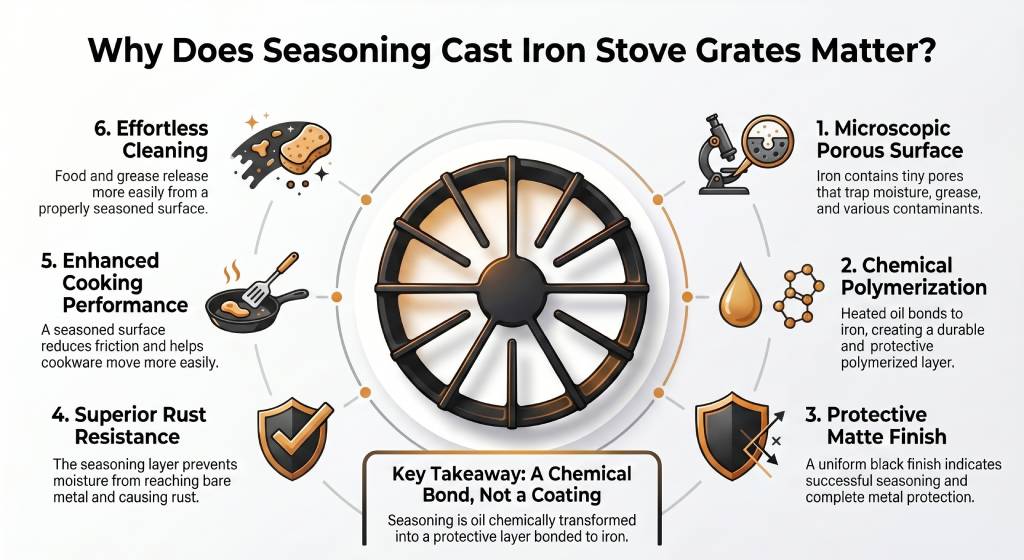
Cast iron is porous. Under a microscope, the surface looks like a sponge, full of microscopic pits and ridges. Left bare, those pits collect moisture from spills, simmering pots, and even humid kitchen air. Within a few weeks you get orange flash rust. Then deeper pitting. Then food that sticks to every burner ring you own.
Seasoning fixes that. When you heat a thin layer of cooking oil on iron past its smoke point, the oil molecules break apart and re-bond with each other in a process called polymerization. The result is a thin, hard, plastic-like film, chemically bonded to the metal. You’re not spraying on a coating. You’re chemically transforming the oil itself. Engineer Fix’s December 2025 restoration guide describes the same mechanism, alongside saponification (the soap-forming reaction that ruins seasoning if you soak grates overnight in dish soap).
A properly seasoned grate gives you four things:
- Rust resistance, because the polymer film blocks moisture from reaching bare iron.
- A semi-non-stick surface, so cast iron skillets glide on and off without scraping.
- Easier cleaning, because food releases instead of welding to bare metal.
- A consistent matte black finish, instead of the orange-and-gray blotchy look most neglected grates develop.
The matte black look isn’t cosmetic. It’s a visual confirmation that polymerization happened. If your finish is glossy and tacky to the touch, the oil didn’t fully cure. We’ll cover that in troubleshooting.
What do you need to season cast iron stove grates?
Three things: a way to clean the grates, the right oil, and an oven that fits them. Most standard gas range grates lie flat in a 24-inch or larger oven. Measure first if you’re not sure.
Tools
- A nylon dish brush or non-scratch scrubbing pad. Avoid wire wool on already-seasoned grates because it strips the finish. 0000 steel wool is acceptable only on rusted bare iron, and you should rinse thoroughly to flush stray filaments (a swallowing hazard).
- A 12-inch cast iron scraper or plastic pan scraper for stuck-on residue.
- Bar Keepers Friend powder for blotchy stains. It uses oxalic acid, which lifts oxidation without etching.
- Lint-free cloths or paper towels. Microfiber works, but it sheds at high heat, so use it for application and switch to paper towels for the final buff.
- Sheet pan or foil-lined oven rack to catch oil drips.
- Heat-resistant oven mitts. Grates stay over 300°F for 90+ minutes from oven-out to fully cool.
The best oil to season cast iron stove grates with: side-by-side comparison
Most guides skip this. Smoke point matters because polymerization needs heat above the smoke point. Bake at 400°F using an oil that smokes at 375°F and you’ll get a billowing kitchen plus a half-cured finish. Below is the side-by-side I wish I’d had in 2023.
| Oil | Refined smoke point | Pros | Cons | Approx. cost (32 oz, 2026 US) |
|---|---|---|---|---|
| Grapeseed | ~420°F | Neutral flavor, thin viscosity, even coverage, widely available | Pricier per ounce than canola | ~$10 |
| Canola | ~400°F | Cheapest, neutral, works at 400-425°F bake | Slightly thicker; can go rancid in 6-9 months if stored warm | ~$5 |
| Avocado (refined) | ~520°F | Highest smoke point on this list, ideal for 450°F bake | Most expensive; check label says “refined” not virgin | ~$15 |
| Flaxseed | ~225°F (raw) | Builds a glassy, hard finish in fewer cycles | Famously flakes off in patches months later; expensive; goes rancid fast | ~$18 |
| Vegetable shortening (Crisco) | ~360°F | Cheap, solid at room temp, easy to apply thin | Below ideal bake temp; can leave sticky residue if you over-apply | ~$6 |
| Olive oil (EVOO) | ~375°F | Always on hand | Smoke point is too low for a proper bake; will smoke at 400°F and leave a tacky finish | |
| PAM spray | n/a | Convenient | Not recommended. Contains soy lecithin and propellants that polymerize into a gummy, splotchy residue |
In my own kitchen, grapeseed gives the most consistent matte finish in a single bake cycle. Flaxseed builds a beautiful glassy black in 4-5 cycles, but it flaked off my front-left grate after about four months. I’ve stopped using it. Canola is the budget answer. Works fine.
How do you season cast iron stove grates step by step?
This is the standard oven method, sequenced for new grates that need a clean baseline or for older grates after a deep clean. If you only need a quick touch-up, skip to the “spot-seasoning” note at the end.
Step 1: Strip the grates. Run hot water over the grates in a deep sink or laundry tub. If you need a more detailed walkthrough, follow our cast iron grate cleaning guide before seasoning.. Use a few drops of dish soap and a nylon brush to lift visible grease. Soap is fine here. The “never use soap on cast iron” rule applies to seasoned skillets, not to a strip-and-reseason cycle, because you’re about to rebuild the patina from scratch.
Step 2: Tackle rust and blotchy spots. Make a thick paste of Bar Keepers Friend and water. Spread it on rust, orange spots, or white mineral deposits. Wait 60-90 seconds. Scrub with a non-scratch pad. For deep rust, switch to ultra-fine steel wool, then rinse thoroughly to remove any loose metal fibers. Rinse until water runs clear and you no longer feel grit.
Step 3: Dry completely. This is the step almost every guide rushes. Towel-dry, then either put the grates on a low burner for 5-10 minutes or in a 250°F oven for 15-20 minutes. Several appliance-care discussions and restoration guides recommend the same low-oven drying approach. Damp iron plus hot oil equals steam pockets and an uneven finish. Wait until the metal is bone dry and slightly warm.
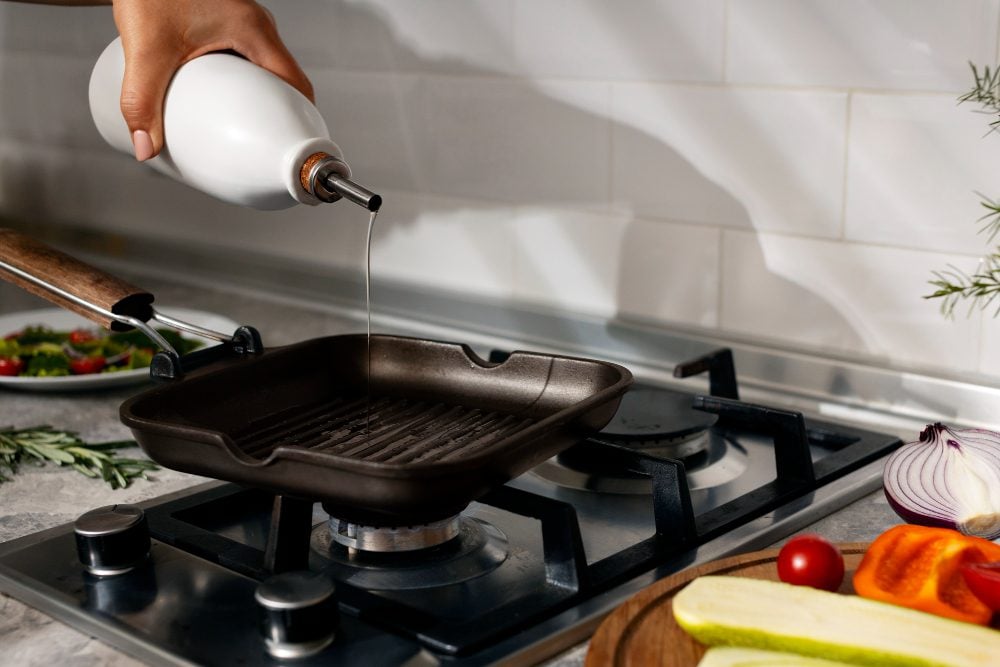
Step 4: Apply oil, thinner than you think. Pour about a teaspoon of grapeseed (or canola, or refined avocado) onto a folded paper towel. Rub the entire grate, top, bottom, sides, and inside the cross-ribs. Then take a clean paper towel and buff hard, as if you’re trying to remove the oil. You should not see a wet sheen. The grate should look almost dry. Too much oil is the number one cause of sticky, blotchy finishes.
Step 5: Bake. Place the grates upside down on the middle rack. Slide a foil-lined sheet pan on the rack below to catch drips. Bake at 400°F for 60 minutes. If you’re using refined avocado oil, you can bump to 450°F. The temperature must exceed your oil’s smoke point for polymerization to complete. Expect light smoke for the first 10-15 minutes. Crack a window and run the range hood.
Step 6: Cool in the oven. Turn the oven off. Leave the grates inside for 60-90 minutes. The slow cool prevents thermal shock and lets the polymer settle. Once the grates are cool enough to handle, they should feel dry and look matte black or very dark brown. Press a paper towel against them. No tacky spots means you’re done.
Spot-seasoning note Once your grates are seasoned, you don’t need this whole cycle every time. When you see a dull patch or a small rust freckle, scrub that spot, wipe on a drop of oil, and run the gas burner under that grate on medium-high for 10-15 minutes. That’s spot-seasoning. It’s how you maintain the finish between deep cycles.
How do you season cast iron stove grates for the first time?
New grates are different. They look ready to use straight out of the box, but most factory finishes are a thin, sprayed-on pre-season that wears off in weeks. If your range uses another grate type, see our guide to cleaning different stove grate materials.
For first-time seasoning, run the full step-by-step above, but repeat steps 4, 5, and 6 two or three times back-to-back. So you’d oil-bake-cool, then oil-bake-cool, then oil-bake-cool. Three thin cycles build a stronger, more even base than one thick cycle.
Why three? Each cycle deposits one polymer layer, maybe 1-2 microns thick. Three layers give you enough depth to survive a few months of normal cooking before you need another touch-up. BHG’s March 2024 guide says to repeat until grates look uniformly dark, which usually lands at 2-3 cycles.
A few first-time tips:
- Don’t skip step 3 (drying) between repeat cycles. Even though the grates are technically clean from the previous bake, wipe them with a dry paper towel after they cool. You’re looking for any condensation or oil pooling.
- Each cycle uses less oil than the last. The first bake might use a teaspoon. By the third, you’ll barely need half that.
- After the third cycle, cook something fatty on the burner within 24 hours. Bacon, sausage, anything that drips. Real cooking deposits another micro-layer of seasoning. It’s how cast iron actually gets “broken in.”
How do you clean cast iron grates without ruining the seasoning?
Cleaning is where most seasoning jobs go to die. For a broader maintenance routine beyond seasoning, see our complete stove care guide. The grate looks great on Sunday, you cook a tomato sauce on Tuesday, and by Friday you’ve scrubbed off half the patina with a green pad and dish soap. Here’s the routine that’s kept my Whirlpool grates black for two years.
After every cook: Wait until the grate is warm, not screaming hot. Brush off loose debris with a stiff nylon brush. If something stuck, splash a few tablespoons of warm water on the still-warm grate and scrape with a plastic pan scraper or a balled-up paper towel. Towel dry. Done. No soap.
Weekly: Lift the grates off the burners. Wipe them with a damp microfiber cloth. Inspect for dull spots or rust freckles. Spot-season any you find.
Monthly (or after a big spill): Soak grates in hot water with a few drops of dish soap for 10-15 minutes. Not overnight. Long soaks trigger saponification, which converts the polymer back into soap-like molecules and strips the finish. The Engineer Fix restoration guide (Dec 2025) discusses this in detail.
Scrub gently with a non-scratch pad, rinse, dry on a low burner, and wipe a drop of oil over the surface.
Forbidden methods (and why):
- Dishwasher. Detergent plus 90 minutes of hot water equals stripped finish and flash rust. Many appliance manufacturers warn against it.
- Self-cleaning oven cycle. Some forums recommend it. It works, but 900°F sustained heat can warp grates and almost always voids your range warranty.
- Overnight vinegar soak. Vinegar dissolves rust. It also dissolves seasoning. A 30-minute soak for restoration is fine.
- Dawn Powerwash and other foaming degreasers. They work, but the surfactants are strong enough that next time you cook, you’ll smell soap and your seasoning will look duller. Use plain Dawn liquid sparingly on the deep cycle and skip the foam.
- affresh cooktop cleaner. Designed for ceramic glass, not bare iron. It contains mild abrasives that will scratch your seasoning over time. Save it for the glass cooktop next to your gas range.
How do you restore rusted or blotchy cast iron grates?
If your grates are orange, gray, blotchy, or have white mineral deposits, you’re not seasoning them. You’re restoring them first, then seasoning. This is also the answer to “how to make cast iron stove grates black again” and “how to make cast iron stove grates look new again,” both of which appear in the People Also Ask box in May 2026.
For light rust and blotches (most grates):
- Make a Bar Keepers Friend paste and let it sit on the worst spots for 2-3 minutes.
- Scrub with a non-scratch pad in circular motions. Add water as needed to keep the paste working.
- For stubborn patches, switch to 0000 steel wool. Rinse thoroughly afterward, then run a magnet over the grate to grab any loose steel strands.
- Run the full step-by-step seasoning cycle above. For grates this far gone, do three cycles, not one.
For heavy rust (orange across the entire surface):
- Submerge the grates in a 50/50 white vinegar and water bath for 30 minutes maximum. Set a timer. Vinegar dissolves rust, but it starts eating into bare iron after about an hour.
- Pull the grates out and scrub off the loosened rust with a stiff brush.
- Rinse, dry on a low burner, then immediately oil-bake.
- Plan on three back-to-back oil-bake cycles. Restored grates start with zero patina.
For grates that have turned white (autocomplete: “cast iron stove grates turning white”): White patches are usually mineral deposits from hard water or salt residue from food. They aren’t rust. Scrub with Bar Keepers Friend, rinse, dry, and re-season the affected area. If they keep coming back, dry the grates more thoroughly after washing. Standing water plus dissolved minerals leaves a white ring every time.
How do you troubleshoot smoke, sticky finishes, white spots, and blotchy patches?
Most guides stop after the bake. Real kitchens have problems. Here are the four I see most often, with fixes that work.
Problem: heavy smoke during the bake. Cause: too much oil, or your oil’s smoke point is below your bake temperature. Fix: open the oven after 15 minutes, check for pooling oil, blot it with a paper towel, and finish the cycle. Next time, buff the oil harder before baking and confirm your oil-temp pairing (grapeseed for 400°F, refined avocado for 450°F, Avoid olive oil.
Problem: sticky or tacky finish after cooling. Cause: the polymer didn’t fully cure. That means either the oven temp was too low, the bake was too short, or you used PAM-type spray. Fix: scrub the sticky layer off with Bar Keepers Friend, dry the grates, and re-bake at 425°F for 60 minutes with a properly thin layer of grapeseed. If you’ve been using spray oils, switch to a neutral liquid oil like grapeseed or canola for more reliable seasoning results.
Problem: white or chalky spots after the bake. Cause: usually mineral deposits left behind because the grates weren’t fully rinsed or fully dried before oiling. Fix: scrub spots with Bar Keepers Friend, rinse hard, dry on a low burner for 10 minutes, then spot-season.
Problem: patchy or blotchy finish, dark in some areas, gray in others. Cause: oil applied unevenly, or the grate had spots of moisture before baking. Fix: don’t worry about cosmetics for now. Use the grates for two or three weeks. Normal cooking deposits seasoning on the hot spots and evens out the look. If it still looks bad after a month, do one more full oil-bake cycle.
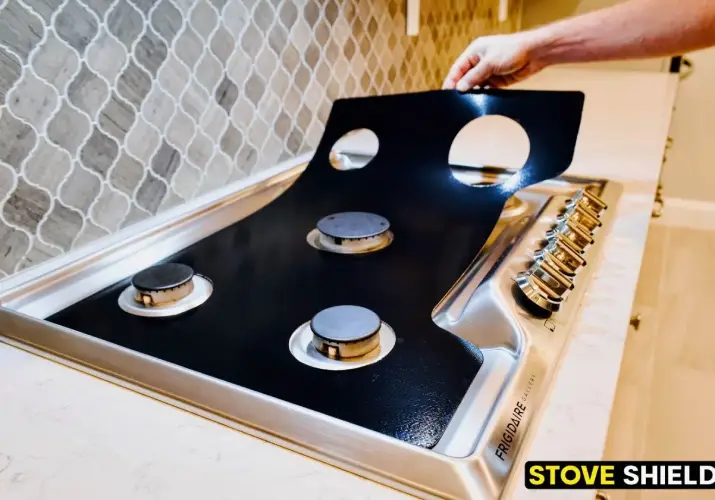
Bonus problem: silicone splatter mats melting near the burner. Silicone is rated to about 450°F. Gas flames can reach temperatures beyond what silicone mats are designed to handle. Many silicone splatter mats, oven liners, or stove-top protectors aren’t explicitly rated for open-flame contact. If you want gas-range surface protection, consider materials other than silicone designed for it.
Frequently asked questions about seasoning cast iron stove grates
What is the best oil to season cast iron stove grates with?
Grapeseed oil is the best all-around choice. Its 420°F smoke point sits just above the standard 400°F bake temperature, it’s neutral, and it goes on thin and even. Canola at 400°F is the budget alternative. Refined avocado at 520°F works if you prefer a hotter bake. Avoid olive oil (smoke point too low), flaxseed (prone to flaking), and any spray oil like PAM (gummy residue).
How often should you season cast iron stove grates?
Plan a full oil-bake every 6-12 months under normal use. Spot-season any dull patches, rust freckles, or scratched areas as you notice them. If you cook acidic foods (tomato sauce, vinegar-based marinades) often, you’ll re-season more frequently because acid degrades the polymer faster.
Can you put cast iron stove grates in the dishwasher?
No. Dishwashers strip seasoning in a single cycle. The combination of high-temperature water, detergent, and prolonged moisture exposure removes the polymerized oil layer and triggers flash rust within hours. Manufacturers and care guides from brands like Lodge and Better Homes & Gardens advise against it.
How long does it take to season cast iron stove grates?
A single oil-bake cycle takes about 90 minutes from oven-on to grates-cool: 60 minutes at 400°F plus 30-90 minutes of in-oven cooling. For new or fully restored grates, plan on 3-4 hours total to run two or three back-to-back cycles. Spot-seasoning a single dull patch on the stovetop takes 10-15 minutes.
Why are my cast iron stove grates sticky after seasoning?
Stickiness means the polymerization didn’t finish. Three usual causes: too much oil applied (the most common), bake temperature below the oil’s smoke point, or use of a spray oil like PAM that contains lecithin and propellants. Strip the sticky layer with Bar Keepers Friend and re-bake at 425°F for 60 minutes with a wiped-thin layer of grapeseed or canola.
Can you use Dawn Powerwash on cast iron grates?
Once in a blue moon, for a deep restoration cycle, yes. As a regular cleaner, no. Powerwash is a high-surfactant foaming degreaser, and the same surfactants that lift baked-on grease also strip polymerized oil. If you use it, plan on re-seasoning the grates afterward. For routine cleaning, hot water and a nylon brush are enough.
Sources
- Lodge Cast Iron. Use & Care: Seasoning Cast Iron.
Manufacturer guidance referenced for oil selection and oven seasoning method. - Better Homes & Gardens. How to Clean Cast-Iron Stove Grates Without Damaging the Finish. March 2024.
Editorial guidance supporting repeat cleaning and seasoning cycles. - Engineer Fix. How to Restore Cast Iron Stove Grates. December 2025.
Background on polymerization and saponification during cleaning and seasoning. - America’s Test Kitchen. The Best Oil for Seasoning Cast Iron.
Referenced for seasoning oil comparison.