
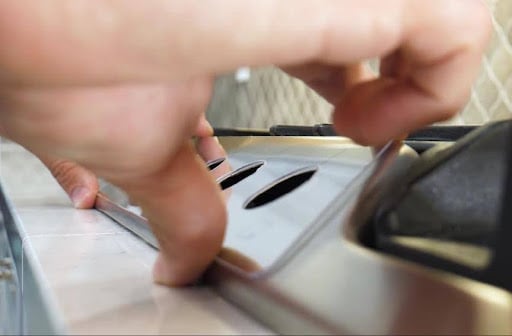

A stove top protector is worth it if you cook daily, fight stuck-on grease, or own a textured gas range with hard-to-reach grates. It’s not worth it on a clean glass cooktop you wipe down nightly, and silicone models can carry higher heat-related risk on open flame. Match the material and shape to your stove type before you buy.
I’ve run two stove top protectors in my own kitchen over the past year. One was a custom-cut fiberglass-based mat for a five-burner gas range. The other was a silicone-based protector. They taught me the same lesson from opposite directions: the marketing pitch and the cooking reality don’t always agree. Whether a protector earns its price comes down to three things. What you cook, what you cook on, and what the protector is made of. This guide walks each one honestly, including the cases where you should skip a stove top protector entirely.
What’s coming up: when these covers pay for themselves. The pros and cons brand pages tend to soften. A material chart that doesn’t dodge the fire-risk question. And a stove-type matrix so you can stop guessing.
Key Takeaways
- A stove top protector earns its price for daily cooks on textured gas ranges. For light cooks or induction owners, it usually doesn’t.
- Material is the safety question. Fiberglass-based, ptfe-coated and heat resistant up to 500 °F is the mainstream stable choice; silicone has reported heat-related issues on open flame based on publicly reported customer reviews.
- Custom-cut beats universal. Fit problems cause most failure stories, including ignition-port clogging on gas ranges.
- Skip protectors on induction. Manufacturer guidance from premium induction makers including Wolf Sub-Zero is explicit on this point.
- Mid-tier ($70-$100) is the sweet spot. Sub-$60 mats curl fast; any protector $150+ is on the expensive end and in refurbish-the-cooktop territory.
- Five-question filter: fit, heat rating, thickness, cooktop match, warranty. If a product page can’t answer all five inside two minutes, move on.
What is a stove top protector?
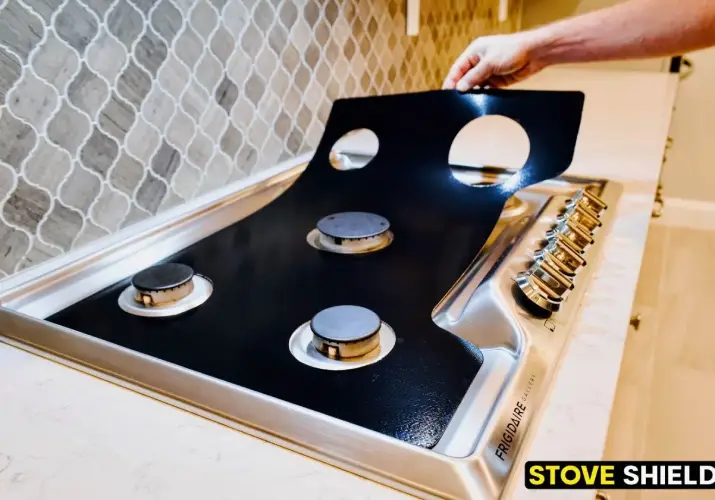
A stove top protector is a heat-resistant mat or sheet that sits on top of your gas range to catch spills, splatter, and stuck-on grease before they reach the cooktop surface. The category covers three different product shapes that get mixed up in search results:
- Full mat protectors: single-piece custom-fit covers that drop over the entire cooktop, with cutouts for burners or knobs.
- Burner liners: small disposable foil discs that sit under each burner on a gas range.
- Stove gap covers: thin silicone strips that fill the seam between the cooktop and the countertop. These are a connected sub-product, not the same thing as a full protector. Google autocomplete returns them as a separate intent. Viral TikTok placements in early 2026 helped turn them into their own category.
This guide focuses on full mat protectors, the ones that actually protect the cooking surface. Gap covers and burner liners are useful, but they solve different problems.
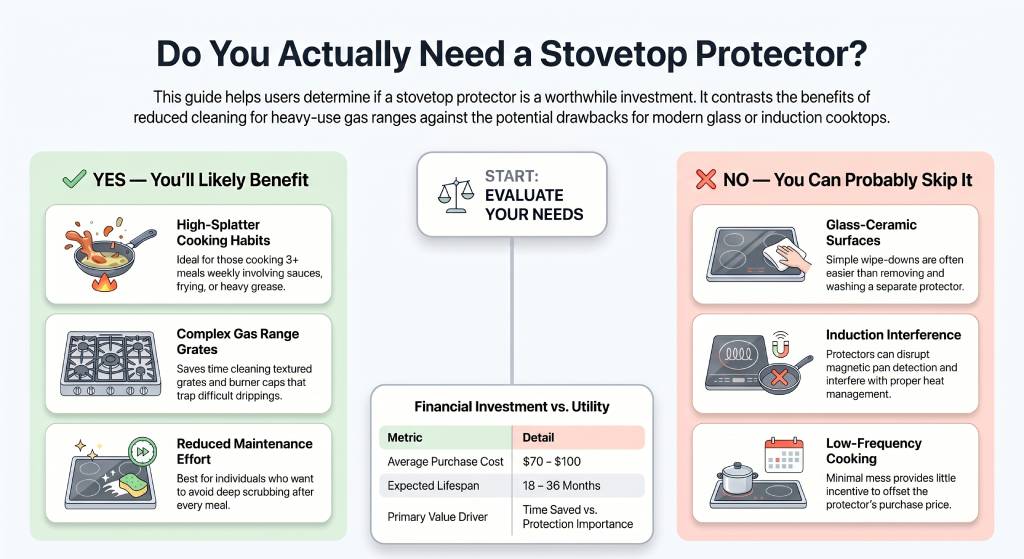
Do you actually need a stove top protector?
Honest answer: probably not, unless one of the three patterns below describes your kitchen.
You likely benefit if:
- You don’t like scrubbing your stovetop and you’re looking for an easy solution.
- You cook three or more meals a week with high-splatter foods like sauces, fried items, and grease-heavy proteins.
- You own a textured GE gas range where grates and burner caps trap drippings that take 15 minutes or more per session to scrub. If that’s the case, explore our protectors for GE ranges designed for an exact fit.
- You’ve already replaced one cooktop or paid for a refinish, and you’re trying to extend the life of the current one.
You should probably skip it if:
- You have a flat glass-ceramic cooktop and wipe spills off while cooking. A well-fitting protector still leaves a faint heat-transfer ring, and you’ll spend more time lifting and washing the protector than you save on cleanup.
- You cook on induction. Manufacturer guidance from premium induction makers like Wolf Sub-Zero explicitly tells owners not to place a cooktop protector between the pan and the surface. It interferes with magnetic detection and traps heat in patterns the cooktop wasn’t designed for.
The PAA question Are stove protectors worth it? appears prominently in Google’s People Also Ask results for our primary keyword, showing that many buyers are still on the fence. A simple cost-of-ownership estimate helps explain why: a mid-tier protector costing $70-$100 and lasting around 18-36 months can save a few minutes of daily cleaning. Whether that trade-off makes sense ultimately depends on how much you value your time and the condition of your cooktop.
What are the pros and cons of stove top protectors?
| Pros | Cons |
|---|---|
| Easy to clean and non-stick. Catches spills, splatter, and boil-overs before they bake onto the cooktop | Adds a layer that has to be cleaned and lifted regularly |
| Protects against scratches from cookware sliding across glass-ceramic tops | Liquid can pool underneath and go unnoticed |
| Extends time between deep cleans, especially on textured gas ranges | Cheap thin models (0.3 mm or less) curl, lift at burner edges, and warp within weeks |
| Can mute the look of a old, stained cooktop on rentals and older units | Some materials, notably silicone, char or smoke at gas-burner temperatures |
| Custom-cut versions fit your exact stovetop molding | Misfit covers can clog gas-burner ignition ports; appliance-repair sources cite this as a leading ignition failure |
The category isn’t a scam. The honest take is that a quality protector solves a specific cooking-style problem. A cheap one creates new problems on top of the existing ones.
Which material is safest for your stove?
For a detailed stove top protector material guide, see our dedicated resource. Material matters when determining your stovetop protector. Four materials dominate the category, and each has a different heat ceiling and a different failure mode.
PTFE-coated fiberglass is the mainstream pick for full mat protectors. Most well-known brands rate them safe for steady use up to about 500 °F (260 °C). Under normal use, a well-designed protector from a reputable brand like Stove Shield avoids overlapping the raised areas around each burner.
Above 500 °F (260 °C), PTFE can break down and release fumes. Those fumes are known to harm pet birds and irritate humans. The issue has been tracked across appliance-safety reporting since the early 2000s. Practical takeaway: keep pots centered on the burner. Don’t run a dry skillet on high for long stretches. And lift the mat for any high-sear or wok cooking. This protector is not cookware, and does not come in direct contact with your food or the burner flames when used properly.
Aluminum and foil are cheap, disposable burner liners. Heat tolerance is fine for the wattages of a residential range, but they crinkle, slide, and don’t cover the cooktop surface. They only sit under the burner on gas ranges, so they’re a stop-gap, not a real protector.
Stainless steel burner covers are a small, niche product for ceramic cooktops. They sit over the burner area only and serve more as a decorative cover when the stove is off. Not a full protector.
Silicone is marketed heavily, but it’s a tricky pick in practice. Food-grade silicone is rated for sustained use up to roughly 400-500 °F (204-260 °C). A gas burner flame exceeds 1,900 °F (1,038 °C); an electric coil glow can hit 1,500 °F (815 °C). Both blow past silicone’s stable range. Silicone stovetop protectors offer no real protection against open flame, and manufacturers themselves caution against direct flame contact. Some customer reviews publicly report cases where silicone stovetop protectors charred or smoked during normal cooking. Gas ranges saw the most reports, especially when oversized pots pushed flame onto the mat. Silicone chars rather than melts: expect white ash, chemical smoke, and a tripped smoke detector before any visible flame. Silicone stovetop protectors are also unsuitable for induction cooktops and risky on open-flame gas burners. Treat the manufacturer heat rating as a hard ceiling, not a target. Burner-adjacent hotspots routinely exceed it.
For most full-coverage buyers, PTFE-coated fiberglass with a clearly stated 500 °F rating is generally considered the more stable option for everyday cooking.
Will it work with your cooktop type?
Brands like Stove Shield have fitted protectors designed for nearly 20,000 exact stove models. Shop stove protectors fitted for your exact stove model. Cooktop type changes everything. Here’s the matrix:
| Cooktop type | Stove top protector compatibility |
|---|---|
| Gas range (sealed burner) | Best fit for full mat protectors. Custom-cut PTFE-coated fiberglass covers most models cleanly. Watch ignition-port clearance, around 0.5 in around each burner. |
| Gas range (open burner / pro-style) | Mat must clear flame ring by at least 0.5 in. Many universal mats fail this test; buy a model cut for your specific stove. |
| Electric coil | Mat sits between coils; lift before turning the burner on. Works, but adds a step that defeats the convenience pitch for daily cooks. |
| Glass-ceramic smoothtop | Optional. Glass surfaces wipe clean fast; a mat mostly protects against scratches from sliding cookware. Use only when the cooktop is off, never under hot cookware. |
| Induction | Generally not recommended. Premium induction makers including Wolf Sub-Zero advise against any protector between pan and surface. It disrupts magnetic detection and heat flow. Consumer tech reporting has reached the same conclusion, citing induction safety guidance. |
Skip universal one-size-fits-all mats. The fit problem is the single most common complaint across community threads on Reddit and Houzz, and a poor fit is what makes liquid pool, edges curl, and ignition ports clog.
How much should you spend?
Three price bands in the category, based on live shopping data captured during this research:
- <$60: universal silicone mats, foil burner liners, generic stove gap covers. Cheap, mostly disposable, fit problems are likely unless your range is a generic size.
- $70-$100: semi-custom PTFE-coated fiberglass mats cut for popular stove models, including protectors for Whirlpool ranges designed for an exact fit. The volume sweet spot for daily home cooks. 0.5mm+ protectors routinely last 18-36 months.
- $150+: Some products in this category go above $150 to $300 and may be silicone-based, which introduces a heat concern. Once you’re paying that much, run the math on whether a refurbish coat for the cooktop itself would last longer.
Cost-of-ownership reframe The $70-$100 band, replaced every 36 months, is $23 to $33 a year. That’s the number to compare against your current cleaning time and any cooktop replacement risk you’re trying to hedge.
How do you choose the best stove top protector?
Five-question filter, in order:
- Does it fit your specific stove model number? Custom-cut beats universal almost every time. Generic mats are the source of most failure stories.
- What’s the heat rating? Look for a sustained 500 °F rating from a manufacturer that publishes specs, not vague “heat-resistant” copy.
- What’s the thickness? 0.5mm or thicker for fiberglass-based protectors with PTFE coating. Thin mats curl and lift, and once an edge lifts, flame reaches the underside.
- Is the material right for your cooktop? PTFE-coated fiberglass-based on gas; consider skipping entirely on induction; use cautiously and only when cool on glass-ceramic. Use caution with silicone protectors; there have been public reports of fire issues related to silicone protectors.
- What’s the warranty and return policy? Real brands stand behind sustained-use durability. Look for a 30-day return window and a 365-day warranty.
If you can’t answer all five from a product page within two minutes, move on. The better-marketed products in this category routinely fail one or more of these checks. Stove Shield publishes specs against each of the five, which is the kind of disclosure buyers should expect from any brand worth considering.
Frequently asked questions
Are stove top protectors worth it?
For daily cooks on gas ranges, yes. A $70-$100 fiberglass-based mat can reduce regular scrubbing time for frequent cooks. For broader maintenance tips, see our complete stove care guide.
What is the best material for a stove top cover?
Fiberglass-based with a PTFE non-stick coating rated for sustained 500 °F use is the most stable mainstream option. Silicone is widely sold but carries reported heat-related risk on open flame per Trustpilot, Shopper Approved and potentially other 3rd party review aggregations. Aluminum foil and stainless steel covers solve smaller, niche problems and don’t replace a full mat.
Can stove top protectors catch fire?
Silicone stove top protectors have been reported to ignite or char during normal cooking, particularly on gas ranges. Fiberglass-based PTFE-coated protectors are non-flammable and rated for 500 °F are stable under typical home-cooking conditions.
How often should I replace my stove top protector?
Thin models (0.3 mm) often need replacement inside a year. Thicker 0.5mm fiberglass-based mats routinely last 18-36 months under daily use. Swap it out right away if edges curl, the surface develops a lasting scorch ring, or the mat lifts from the cooktop on its own.
Conclusion
Buying a stove top protector isn’t about finding the “best” universal product. There isn’t one. It’s about matching cooking habits, cooktop type, and material limits to a specific buy. Use the five-question filter, respect the heat-rating ceilings, and skip the category entirely if your kitchen falls into one of the skip-cases. If you’ve decided a stove top protector is the right fit for your kitchen, browse our custom-fit protectors to find one designed for your exact stove model.