
If your gas stove won’t light, run this 30-second test first: turn a knob and listen for clicking. Clicking but no flame usually means a wet or misaligned burner cap or clogged ports. No clicking points to a Control Lockout, a failed switch, or a spark module. Smell gas? Stop, ventilate, and call your utility.
A gas stove that won’t light almost always traces back to a short list of fixable causes. This walkthrough is a binary decision tree. Each question routes you to a named component or a stop-work safety call, so you can skip steps that don’t apply.
Key takeaways
- Two questions answer 80% of gas stove not lighting cases: does it click, and do you smell gas?
- Click + no flame = burner cap or port issue (under 15 minutes for most homeowners).
- No click = Control Lockout (post-outage), switch failure, or dead spark module.
- Water from cleaning is a very common cause of post-cleaning ignition problems. Allow the stove to air-dry for at least 15 minutes before trying again.
- Internal gas valve, regulator, and gas-line repairs are typically best handled by licensed technicians and may be restricted by local codes.
- Per CDC, repeated unsuccessful ignition releases unburned gas. Open windows for 15 minutes between attempts; install CO alarms per CPSC placement standards.
Why won’t my gas stove light? Start with this 30-second triage
When a gas stove fails to light, the cause usually becomes clear within the first few seconds of turning the knob. Many ignition problems can be prevented with regular cleaning and routine upkeep. For a broader overview of complete gas stove care guide, see our complete stove care guide. Before reaching for tools or removing burner parts, focus on two quick observations that can point you in the right direction and prevent wasted troubleshooting time.
The first thing to notice is sound. If you hear a steady clicking noise, the spark ignition module is working and the electrical side of the stove is active. In this case, the problem is more likely related to gas flow or burner components. If there is no clicking at all, the electrical path has likely stopped somewhere between the wall outlet and the spark electrode, and the issue is usually electrical rather than mechanical.
The second thing to notice is smell. If you detect the smell of gas while attempting to ignite the burner, stop immediately. Turn the knob to the off position, avoid operating switches or unplugging appliances, open windows, leave the property, and contact your gas utility from outside. Repeated unsuccessful ignition attempts can release unburned gas into the kitchen and should not be ignored.
Using these two observations sound and smell most ignition problems fall into four common categories. If the burner clicks but does not light, the spark is working and gas is likely not reaching the burner, often due to a blocked cap or clogged ports. If there is no clicking and no flame, the electrical side has likely failed, such as a control lockout, switch, or ignition module issue. If the burner clicks and lights but the flame does not stay lit, the flame-safety component may be the cause. If there is no clicking and you smell gas, stop troubleshooting and contact your gas utility.
Is your gas stove clicking but not lighting?
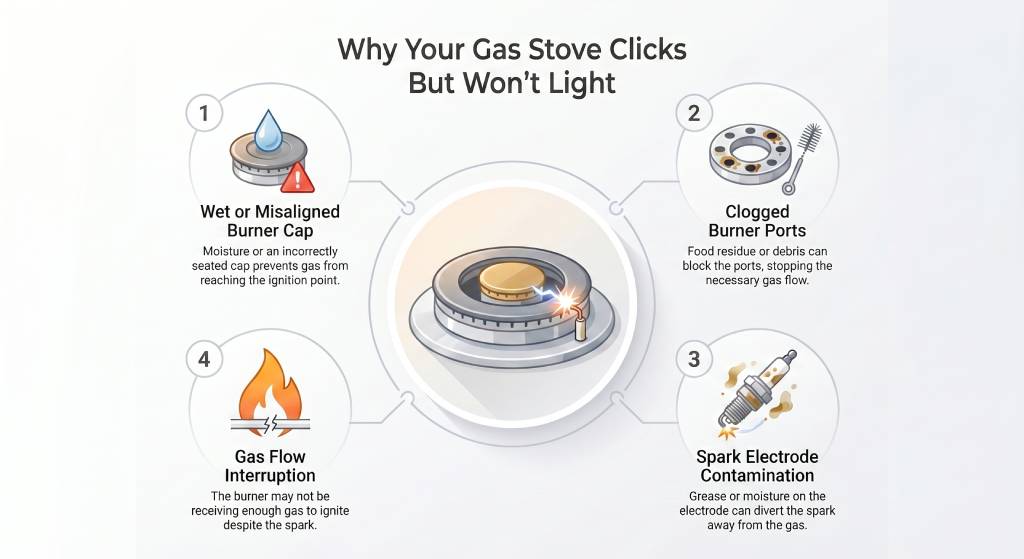
If you hear the rapid tick-tick-tick when you turn the knob but nothing ignites, the spark module and electrode are working. The fault is on the gas-delivery side of that burner. Many homeowners report that a misaligned or wet burner cap is one of the most common causes.
Wet or misaligned burner cap (one of the most commonly reported causes)
The burner cap is the round metal disc on top of the burner head. It must seat flat and centered. When the cap is wet, soapy, or rotated even a few millimeters, gas can’t reach the flame port and the spark has nothing to ignite.
Lift the cap, towel it bone-dry, and check the burner head pin or notch. The cap has a matching slot, and they must line up. After a deep clean, it’s easy to drop a small-burner cap on a medium head: looks fine, never lights. Reseat, wiggle to confirm it’s flat, then try the knob again.
Clogged burner ports the paperclip method
The burner head has tiny ports drilled around its rim. Boil-over residue can plug them. This Old House and iFixit recommend the same fix: straighten a paperclip and gently push it through each port. Skip toothpicks (they break off) and sewing needles (too narrow). Run the burner on high for 30 seconds afterward to blow out debris. For a complete guide to cleaning clogged burner heads and caps ports, including burner head removal, deep cleaning, and proper reassembly, see our dedicated walkthrough.
Spark electrode contamination
The spark electrode is the ceramic-tipped pin next to the burner head. If the ceramic is greasy or wet, the spark shorts to the burner instead of jumping to the gas. Wipe the tip with a cotton swab dipped in 90% isopropyl alcohol. Never use water, which leaves mineral deposits. Air-dry two minutes before retrying.
If your stove continues clicking after these checks, follow why your gas stove keeps clicking to troubleshoot persistent ignition clicking problems.
What if your gas stove won’t ignite and there’s no clicking sound at all?
No click means the spark module isn’t getting power, or a switch between the module and the knob has failed. Post-2010 cooktops add a wrinkle most editorial guides skip.
Control Lockout after a power outage
Per Whirlpool’s product help, the cooktop’s electronic control may engage its Control Lockout after a recent power outage. That’s a safety feature that disables ignition until you reset it. Reset is usually a three-second press on a button labeled “Lock” or showing a key icon. Older mechanical-knob ranges don’t have it.
Failed ignition switch (multimeter test)
Each knob connects to a switch that closes when you press and turn. If the switch fails, the spark module never gets the trigger. iFixit’s appliance guide recommends a multimeter continuity test: with the stove unplugged, set the meter to continuity, probe the switch terminals, and turn the knob. A working switch reads 0 ohms when engaged and OL (open line) when off. OL in both positions means the switch is dead. A $15 continuity meter (the Klein Tools MM320 is common) is plenty.
Spark module failure
The spark module is the small box mounted inside the cooktop housing, often under the cooktop or behind the back panel. It takes 120V AC and converts it to the high-voltage pulse that fires the electrodes.
If every burner clicks except one, the module isn’t dead. That burner’s switch or wire is. If the gas stove burner won’t light on any burner and nothing clicks, the module itself is the suspect. Replacement modules run $30-$80 from RepairClinic or Sears Parts Direct. One veteran technician has argued that many replaced spark modules were actually fine and the real fault was upstream. Confirm it’s dead with the multimeter before ordering. If testing confirms the ignition component has failed, follow our how to replace a gas stove igniter for step-by-step replacement instructions.
Why won’t your gas stove light right after cleaning?
“Gas stove won’t light after cleaning” gets about 90 dedicated searches a month and that understates how often it happens, since most people search the broader “gas stove not lighting” and find the cleaning angle midway through.
Water in burner ports
If you ran soapy water across the cooktop or pulled the burner caps for a deep clean, water can pool in the ports. Liquid in the gas path stops ignition cold. Pull the caps, towel everything you can reach, then leave the cap, head, and electrode exposed to air for at least 15 minutes (longer in humid kitchens). A hairdryer on cool from 12 inches away is fine. Never use heat or a torch on gas-system components.
Cap dropped back on the wrong burner head
This bites people who clean all four caps at once. Caps look interchangeable but aren’t. Small-burner caps mate to small heads, medium to medium. Match cap diameter to burner ring before reseating. A cap that teeters or won’t sit flat is the wrong one.
Is gas reaching the burner? How to tell in 60 seconds
If you’ve confirmed the spark works and the cap is correctly seated, the next branch is gas supply.
The long-reach utility lighter test
This is iFixit’s underrated diagnostic. Take a long-reach BBQ-style utility lighter (the one with a 6-inch metal nozzle), light it, hold the flame at the burner edge, then turn the knob to “Light.” If the burner ignites from the lighter flame, gas is flowing, so your problem is purely the spark side. If nothing lights from a known flame source, gas isn’t reaching the burner. Never use a short match; keep your hand outside the burner zone, and run the range hood on high before lighting.
Main shutoff orientation + LP tank check
Behind or beside the stove, the gas shutoff valve has a lever. Parallel to the pipe means gas is on; perpendicular means off. If you’ve recently moved the stove, had kitchen work done, or had a tenant turnover, this is a thirty-second check. For propane (LP) homes: look at the tank gauge. Below 20%, the regulator can throttle output enough to underperform a high burner. Refill before troubleshooting further.
Air in the line (new install)
KitchenAid’s product help notes a newly installed gas range can hold a slug of air. Turn one burner to high and let it click for 10-15 seconds. If it lights, run it 30 seconds to purge, then test the others. If it never lights, shut the knob and re-check the connection.
Is it one burner or all burners?
This single question splits the diagnosis in half.
One burner only solenoid or safety valve
If spark fires and other burners light but this one burner won’t ignite, the fault is local. In many real-world repair cases, the most likely causes are the burner solenoid valve, followed by the gas control valve and the ignition harness. Solenoid replacement on a sealed-burner cooktop typically requires pulling the cooktop, so many homeowners choose to hand this repair off to a technician.
All burners gas supply or 120V power
If no burner ignites and nothing clicks, check the breaker. Gas cooktops still need 120V AC for the spark module. A tripped breaker presents exactly like a dead stove. If the breaker holds and other gas appliances work, the next suspect is the spark module or the main gas valve to the appliance.
How do you fix a clogged burner port or wet burner cap, step by step?
This procedure handles the two highest-frequency causes. Most resolve in under 15 minutes.
Tools you’ll need
- Steel paperclip (not plastic-coated)
- Microfiber towel
- 90% isopropyl alcohol + cotton swabs
Step 1: Turn off the burner and let it cool
If it’s been running, give it 10 minutes. Hot caps burn fingers and crack if they hit cold water.
Step 2: Lift off the cap and head
The cap lifts straight up. The head usually lifts off too on sealed-burner designs. Sit them upside-down on a towel.
Step 3: Inspect each port
Hold the head against the light. Clean ports look like dark holes; plugged ports look gray-white or black.
Step 4: Clear with the paperclip
Push the straightened end through each port from the outside. Don’t ream, or you’ll widen the port and change the flame pattern.
Step 5: Wipe the spark electrode
Cotton swab + 90% isopropyl alcohol on the ceramic tip. Air-dry two minutes.
Step 6: Reassemble and test
Drop the head on the base, line up the notch, set the cap on top. Turn the knob to high. The burner should ignite within 1-3 seconds. Gas stove burner not working after a clean reseat? Go back to the triage and check gas supply.
Maintenance habits that keep your gas stove lighting reliably
Most ignition problems are downstream of boil-overs and aggressive cleaning that drives water into the ignition path.
After-cooking wipe-down + monthly cap removal
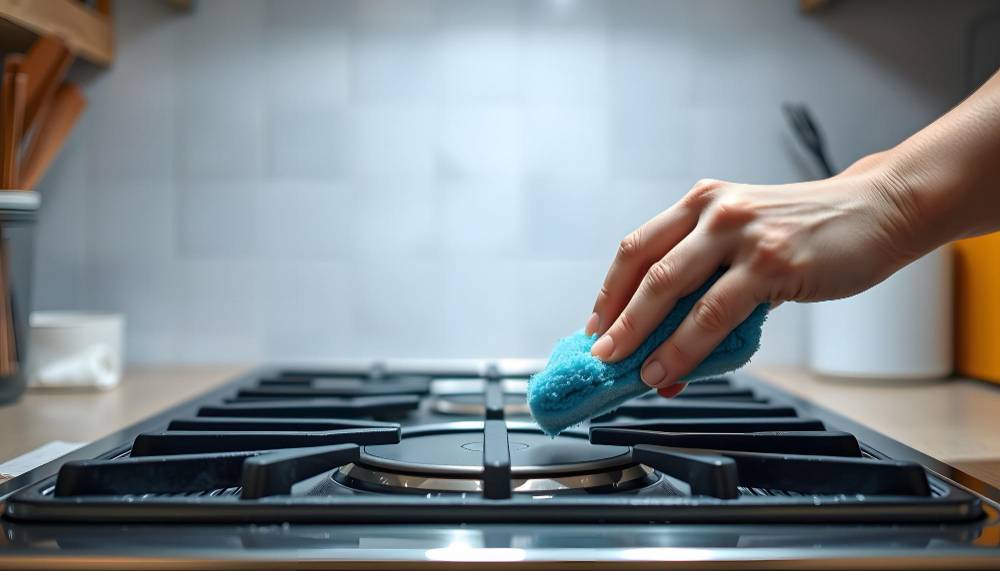
Wipe the cooktop after every cook, while it’s warm enough to loosen residue but not hot. Once a month, lift each cap, dry-brush the ports, and wipe the electrode. Five minutes total.
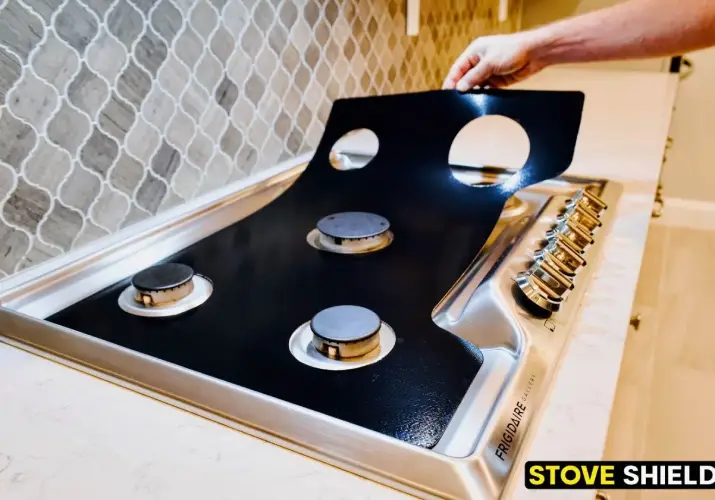
Stove top protection between cooks
Boil-over residue is the biggest trigger for the “won’t light after cleaning” failure mode. A simple “kitchen protection mat” sits between the burner grates and catches splatter before it reaches the ports, and can help reduce splatter build uparound burners.
When should you stop and call a licensed gas technician?
The DIY/pro line on a gas appliance is sharper than on most kitchen equipment.
Internal gas-valve work never DIY
Work involving the internal gas system such as the gas safety valve, pressure regulator, or connections to the main gas line typically requires a licensed technician in many U.S. jurisdictions and may be restricted by local codes and insurance requirements. Replacing a surface-burner spark electrode is usually considered a homeowner-level repair. Pulling the cooktop to access a solenoid valve may be manageable for experienced DIYers, but any repair that requires breaking the gas seal should be left to a qualified professional.
Repeated gas smell or yellow flame call utility
Per SoCalGas safety guidance, a yellow or wavering blue flame indicates incomplete combustion, which produces carbon monoxide. CDC reports more than 400 unintentional non-fire CO deaths occur annually in the United States. Install CO alarms on every level and outside each sleeping area, per CPSC’s residential placement standard. If your alarm chirps near the kitchen, leave the home and call the fire department from outside.
National repair-cost ranges
Repair costs vary by region, appliance model, and local labor rates. Typical service calls include a diagnostic fee plus parts and labor, with final pricing depending on the specific fault and accessibility of the repair.
Frequently Asked Questions
Why is my gas stove clicking but not lighting?
The spark is firing but gas isn’t reaching the burner head. Most often, a wet, dirty, or misaligned burner cap is blocking flow. Dry the cap, reseat it square, and clear debris from the ports with a paperclip.
How do I fix a gas stove that won’t light after cleaning?
Water in the burner ports or under the cap is usually the cause. Remove the cap, towel dry, and air-dry the assembly off the stove for 15-20 minutes. Soapy water can leave residue, so wipe again with a dry cloth.
Why won’t my gas stove light after a power outage?
Many gas cooktops have a Control Lockout that engages after a power interruption. Per Whirlpool’s product help, hold the Control Lock pad for three seconds until the indicator clears. Check your owner’s manual for the button on your model.
Can I replace a gas stove igniter myself?
Replacing a surface-burner spark electrode is a common DIY repair on most post-2010 cooktops, typically 20-40 minutes with a screwdriver. Replacing an internal gas safety valve, solenoid, or pressure regulator is not DIY; those require a licensed gas technician.
How long should I air out the kitchen after a gas burner is left on?
Open windows and run the range hood on high for at least 15 minutes. Leave the kitchen for that period, don’t operate switches, and check no pilot is still on. Still smell gas? Leave the home and call your utility.
Why does only one burner on my gas stove not light?
If other burners work, the cause is isolated to that burner: a clogged port, misaligned cap, or, if spark and pressure both check out, a failed solenoid valve. Single-burner solenoid issues need professional service.
Can I manually light a gas burner with a match?
On most surface burners, you can light the flame with a long-reach utility lighter once the knob is on “Light.” Never use a short match. Never manually light a sealed-burner oven; that’s an internal-valve job and unsafe to bypass.
Is it safe to use my gas stove if it keeps clicking?
A burner that keeps clicking with the knob off usually points to a stuck ignition switch or moisture in the ignition system. Persistent clicking can allow unburned gas to accumulate, so cut power at the breaker and contact a qualified technician.
Sources
- U.S. Consumer Product Safety Commission (CPSC) – Carbon Monoxide Safety Guidance
- Centers for Disease Control and Prevention (CDC) – Carbon Monoxide Basics
- U.S. Environmental Protection Agency (EPA) – Carbon Monoxide Factsheet
- SoCalGas – Carbon Monoxide Safety Information
- Whirlpool Product Support – Gas Burner Troubleshooting