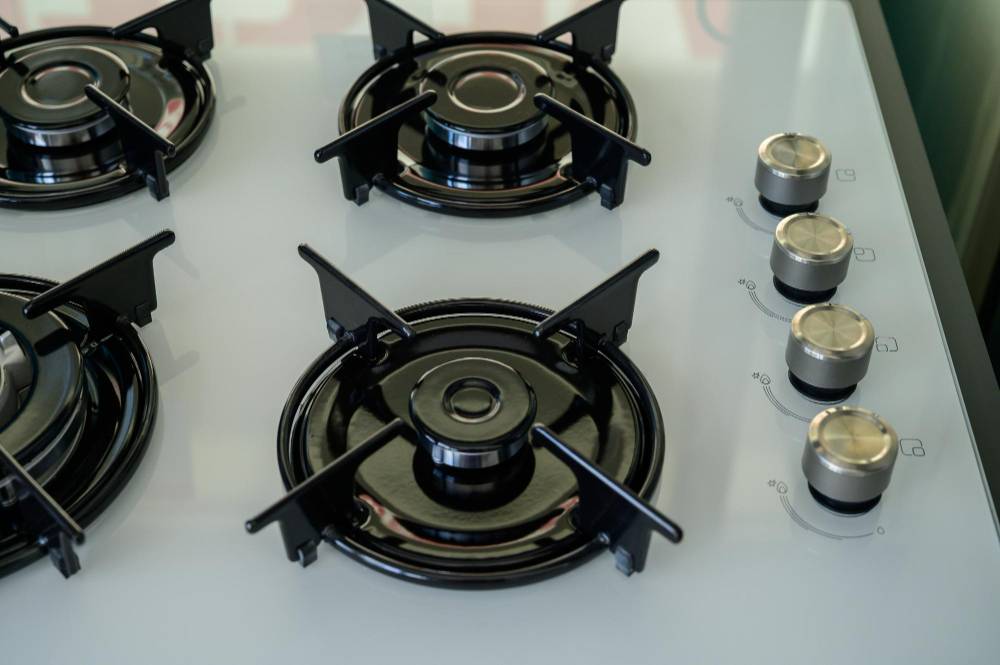


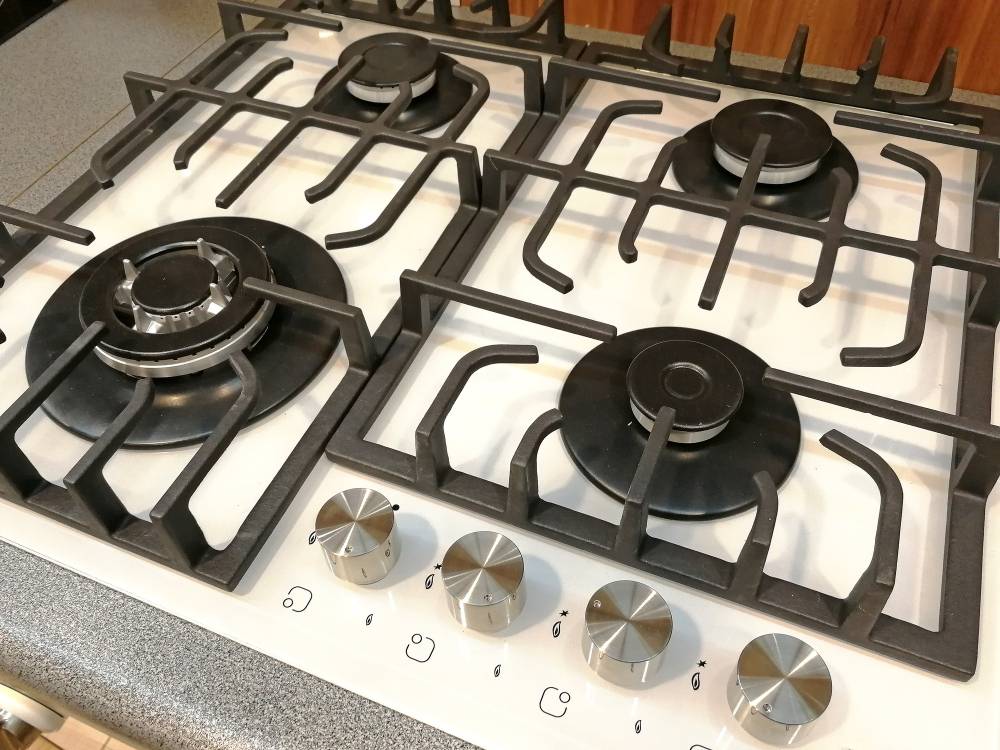
A 30-inch gas range remains the standard size in the US, fitting the vast majority of existing kitchen cutouts. Most models offer 4 to 5 sealed burners and are available across a wide range of price points. A 36-inch gas range adds 6 inches of width, typically provides more cooking space, often includes 5 to 6 burners, and usually offers a larger oven capacity.
The choice between a 30-inch and 36-inch gas range is rarely just about appliance width. Burner count, total BTU output, oven size, cabinet cutout dimensions, ventilation requirements, and even a home’s gas line capacity can all affect the upgrade cost and installation process. For broader appliance maintenance and buying advice, see our complete stove care guide.
While 30-inch models continue to dominate the US market, 36-inch ranges have become increasingly popular among homeowners seeking more cooking capacity and a professional-style kitchen setup.
Key Takeaways
- The 30 inch vs 36 inch range default is 30 inches: Yale Appliance reports roughly 85% of US homes still use a 30-inch range the dominant standard, set in the post-WWII production-housing era.
- A 36-inch gas range adds 1 to 2 burners, 0.8 to 1.5 cubic feet of oven capacity, and 25,000 to 45,000 BTU of cooking power.
- Live Google Shopping data captured May 2026 (n=40) shows 36-inch gas ranges priced $1,649 to $9,299, with a median around $3,150.
- Pro brands (Wolf, Thermador, Monogram, BlueStar, Miele) cluster between $7,000 and $15,000 per Yale Appliance’s 2025 guide.
- Real-world upgrade cost including hood, cabinet mod, and gas work typically runs $2,000 to $4,000 over a 30-inch baseline.
- Hood CFM target = total BTU / 100. A 30-inch range wants 300 to 450 CFM; a 36-inch wants 600+; a pro 36-inch often wants 900 to 1,200 plus make-up air.
What’s the actual difference between a 30-inch and 36-inch gas range?
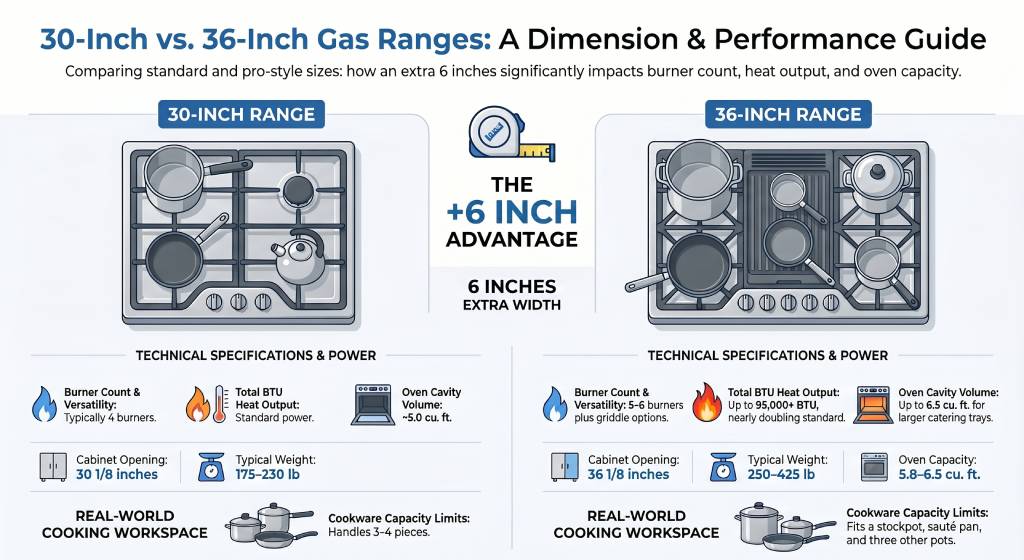
In the 30 inch vs 36 inch range matchup, the headline gap is 6 inches of cooktop width. That single number drives almost every other spec. A standard 30-inch gas range ships with 4 sealed burners, a roughly 5.0 cubic foot oven, and combined output in the 50,000 to 60,000 BTU range. A 36-inch gas range moves up to 5 or 6 sealed burners (some pro-style models add a center griddle or grill). The oven cavity grows to 5.8 to 6.5 cubic feet, and combined output jumps to 75,000 to 95,000+ BTU.
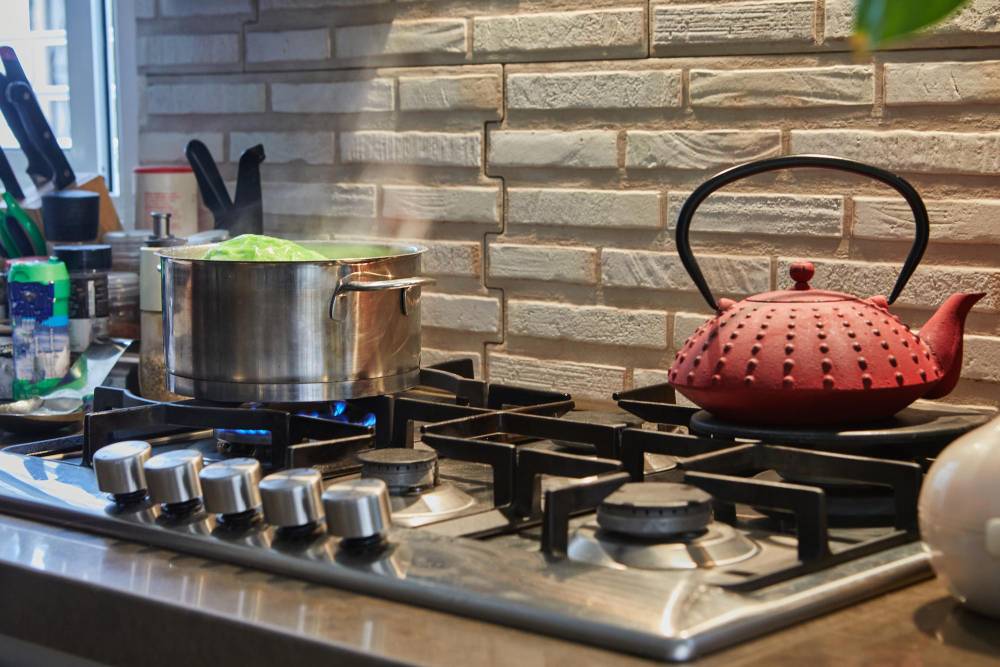
In real kitchen terms, that means a 36-inch range can run a stockpot, a saute pan, a saucepan, a small pot, and a kettle all at once. A 30-inch handles three of those at the same time and forces choices on the fourth.
The cabinet cutout shifts too. Whirlpool’s published spec sheet calls for a minimum 30 1/8 inch cabinet opening for its 30-inch ranges. The 36-inch version needs 36 1/8 inches. That single 6-inch gap is what makes “just swap them” harder than it sounds covered in detail in section 6 below.
What is the standard width of a gas range in US homes?
Thirty inches. Yale Appliance’s buying guide, authored by Steve Sheinkopf, puts the figure at roughly 85% of US homes and that ratio has held remarkably steady for two decades. The 30-inch cutout became the de facto American standard in the post-WWII production-housing boom, when builders standardized cabinet runs around appliances that were themselves standardizing. Once the production-home cabinet template was set, every major brand built around it.
Honest caveat: “30-inch” ranges aren’t always exactly 30 inches. Most measure between 29 7/8 and 30 1/8 inches on the cabinet-facing side, with trim taking up the variance. The standard 30 1/8 inch cutout is the install tolerance, not the appliance width.
Standard residential range depth is 25 to 27 inches. The deeper end tends to be pro-style models with insulated oven walls. Standard height is 36 inches at the cooktop surface, built to sit flush with a 36-inch counter run.
When the 30-inch standard breaks
Three things move buyers off the 30-inch default: open-concept kitchens with no neighboring cabinet to fight, remodels that touch the cabinet run anyway, and a household cooking pattern that genuinely needs more burners going at once. Most US production homes still use the 30-inch cutout. So the upgrade call is usually downstream of a bigger remodel, not a standalone buy.
30-inch vs 36-inch gas range: side-by-side comparison table
| Spec | 30-inch gas range | 36-inch gas range |
|---|---|---|
| Cooktop width | 30 inches (29 7/8 to 30 1/8 actual) | 36 inches |
| Sealed burners | 4 | 5 or 6 |
| Total BTU output | 50,000 to 60,000 | 75,000 to 95,000+ |
| Oven capacity | ~5.0 cu ft | 5.8 to 6.5 cu ft |
| Cabinet cutout (minimum) | 30 1/8 in | 36 1/8 in |
| Range hood width (minimum) | 30 in | 36 in |
| Hood CFM (recommended) | 300 to 450 CFM | 600+ CFM |
| Weight (typical) | 175 to 230 lb | 250 to 425 lb |
| Typical retail price band | $700 to $3,500 | $1,649 to $9,299 |
| Median observed price (May 2026) | ~$1,200 | ~$3,150 |
| Best-fit kitchen size | under 120 sq ft, standard production home | 150+ sq ft, open-concept or custom |
The 36-inch numbers come from SerpAPI’s Google Shopping data (n=40 listings). The 30-inch range pulls from major retailer price data over the same period because the category is more crowded and commoditized.
Should you get a 30-inch or 36-inch gas range?
The 30 inch vs 36 inch range choice usually sorts buyers into three honest personas:
Before deciding on size, it also helps to compare gas, electric, and induction stoves if you’re still choosing the best cooking fuel for your kitchen.Stay 30 inches if: you have a standard production-home kitchen, you cook one major meal a day for one to four people, your budget is under $3,000 all-in, and your cabinet run is already built around 30 inches. This describes most buyers. There is no shame in it the 30-inch range is a mature category with excellent options at every price.
Upgrade to 36 inches if: you entertain weekly, you cook with two people in the kitchen at once, you regularly run more than three burners at the same time (large families and serious home cooks both qualify), or you are already in a remodel that touches the cabinet run. The 36-inch upgrade pays back hardest when at least two of these are true.
Stay 30 inches even if you can afford 36 inches if: the home is a rental, you plan to sell within 3 years, or the gas line behind the wall is undersized for the BTU load (often the case in homes built before 2000). On resale, an unusual 36-inch cutout can actually shrink your buyer pool in production-home neighborhoods.
The 4-question test
Ask yourself:
- Is my kitchen 150 square feet or larger?
- Is my gas supply line 3/4 inch (or can I run a new one)?
- Will I lose the 6 inches of cabinet I actually use?
- Do I run 4+ burners in the same meal at least once a week?
Two or more “yes” answers, the 36-inch upgrade earns its keep. Zero or one, the 30-inch stays the smarter buy.
Why are 36-inch gas ranges so expensive?
Inside the 30 inch vs 36 inch range debate, price is the top People Also Ask question for a reason. The 36-inch segment carries a real price bump, and the math has four layers.
Layer 2 Pro-brand concentration. The 36-inch width is where the high-end brands live. Per Yale Appliance’s 2025 buying guide, expected 36-inch pricing runs:
- Monogram 36″: $7,000 to $10,000
- Thermador 36″: $8,000 to $12,000
- Wolf 36″: $10,000 to $15,000
- BlueStar 36″: $11,000 to $14,000
- Miele 36″: $12,000 to $15,000
Volume brands (Cosmo, ZLINE, Forno, Thor) keep the floor low. SerpAPI’s shopping data shows the FORNO Marco 36″ at $1,649 and the Duro 6-burner at $1,844. But the segment median sits around $3,150 because the pro tier pulls it up.
Layer 3 Hood upgrade. A bigger range needs a bigger, more powerful hood. The extra hood spend over a 30-inch model usually lands at $300 to $1,200. More if you need ducted make-up air for a high-BTU pro range.
Layer 4 Cabinet and gas changes. Reframing a 30-inch cutout to 36 inches usually means new cabinets on at least one side, countertop seam work, and sometimes a gas line upsize. Real-world install quotes typically add $400 to $1,500 in cabinets alone, and $150 to $600 for gas line work when needed.
Stack all four layers. The true cost gap between a 30-inch and 36-inch buy (including the hood swap and basic cabinet work) usually runs $2,000 to $4,000 not the $500 to $1,000 the spec-sheet pricing alone suggests.
Actual project costs vary by region, contractor labor rates, permit requirements, venting complexity, and existing kitchen layout
One way to claw back 10 to 15%
Yale Appliance notes that all-gas ranges typically run 10 to 15% cheaper than the same brand’s dual-fuel (gas cooktop, electric oven) version in the 36-inch tier. If electric-oven precision isn’t a hard need, sticking with all-gas is a quiet savings lever.
Can you replace a 30-inch range with a 36-inch range?
The 30 inch vs 36 inch range swap is rarely as simple as appliance brochures imply. KitchenAid’s own guide admits the cabinet-mod reality. Here’s the realistic step-by-step.
Step 2 Check countertop seam location. Countertops over a 30-inch cutout often have a seam at the cabinet break. Widening to 36 inches may push the seam into the new opening, which means a new countertop segment ($300 to $1,500+ depending on material).
Step 3 Confirm gas line size. Standard residential gas supply is 1/2 inch. Most production 36-inch ranges are fine on 1/2 inch. Pro-style ranges with 90,000+ BTU often spec 3/4 inch for full-output use a plumber needs to verify.
Step 4 Confirm electrical. Gas ranges still need 120V for the ignition, controls, oven light, and convection fan. The existing outlet location works in most cases. But the new range’s plug position may differ confirm before delivery day.
Step 5 Plan the hood swap. The hood has to grow with the range. A 30-inch hood over a 36-inch range is a code and capture problem (and it looks wrong). Budget for a new hood plus install see section 7 below.
Step 6 Get the total install quote. A representative real-world swap (cabinet mod + countertop seam + gas check + new hood + appliance swap) usually quotes between $1,800 and $4,500 in labor and materials, on top of the new appliance itself. Get three quotes.
Honest take: if you are not already renovating, the swap math rarely works out. If you are, fold the 30-to-36 decision into the larger remodel and the marginal cost drops by half or more.
What size range hood do you need for a 30-inch vs 36-inch range?
Venting is the most overlooked half of the 30 inch vs 36 inch range call. The cooking-surface rule is simple: hood width must match or beat range width, and ideally 3 to 6 inches wider on each end for proper capture. So a 30-inch range pairs with a 30 or 36-inch hood. A 36-inch range pairs with a 36 or 42-inch hood.
- 30-inch range (50,000 to 60,000 BTU): 300 to 450 CFM hood
- 36-inch range (75,000 to 95,000 BTU): 600+ CFM hood
- Pro-style 36-inch range (90,000 to 120,000 BTU): 900 to 1,200 CFM hood, often with make-up air requirements per local code
The make-up air requirement is the one most buyers miss. Many areas require a mechanical make-up air system whenever a kitchen exhaust tops 400 CFM (sometimes 300 CFM). That’s a $1,000 to $3,000 sub-system that nobody mentions until the permit inspector flags it.
Ducted vs ductless matters too Ductless (recirculating) hoods recycle filtered air rather than venting outside. They’re quieter and easier to install but much less effective at clearing combustion byproducts from a high-BTU 36-inch range. For 36-inch all-gas, ducted is strongly preferred.
When the hood upgrade alone tips the math
If your kitchen has no existing exterior duct run and your local code requires make-up air for the 36-inch’s CFM target, the hood-plus-venting upgrade alone can add $2,500 to $5,000 to the project. At that point, the 36-inch upgrade is often the third or fourth-largest line item in the build worth knowing before you commit.
Frequently asked questions about 30-inch vs 36-inch gas ranges
Are 36-inch gas ranges worth it?
Worth it when at least two of these are true: you entertain weekly, you cook with a partner in the kitchen, your kitchen is 150+ square feet, or you’re already in a remodel. The all-in cost gap runs $2,000 to $4,000 over a 30-inch buy once the hood and cabinet work are baked in.
What size range do chefs prefer?
Pro chefs at home overwhelmingly pick 36-inch or 48-inch ranges, citing burner spacing and oven size. But the more common honest answer from working chefs (per Houzz and Reddit threads) is that pan management and venting matter more than width a well-set-up 30-inch can outcook a poorly vented 48-inch.
Are 30-inch ranges actually 30 inches?
Not exactly. Most “30-inch” ranges measure 29 7/8 to 30 1/8 inches on the actual side panel. The standard cabinet cutout is 30 1/8 inches, which gives the small tolerance gap for sliding the range in and out without scuffing the cabinets.
Does anyone make a 40-inch gas range?
Practically no residential standard widths jump from 36 to 48 inches. A 40-inch can be custom-commissioned but no major maker mass-produces one. Buyers asking this are usually choosing between 36 and 48.
Should I get a 36-inch or 48-inch range?
Stick with 36 inches unless you have a 200+ square foot kitchen, you cook for 8+ regularly, or you specifically want a built-in griddle plus 6 burners. The jump from 36 to 48 typically adds $4,000 to $10,000 in appliance cost alone, plus hood, cabinet, and venting upgrades that often double the project budget.
Conclusion
If you’ve decided 36 inches is the right fit, the next step is comparing current models within your target budget range. You can also find the right stove protector to help keep your new range clean from everyday spills. If you’re still undecided, work through the 4-question test in section 4 before finalizing cabinet plans.
Sources
- Sheinkopf, S. (2026). Buy the Right Range in 5 Steps. Yale Appliance Blog. (~85% US-homes 30-inch stat.)
- “Yale Appliance How to Buy a Professional Range (2025)” pro-brand 36-inch pricing.
- “KitchenAid 30 vs 36-inch Cooktop guide” Google AI Overview position 3 source.
- “Whirlpool 30-inch vs 36-inch Cooktop” AIO position 4 source.
- “Reddit r/Homebuilding Ranges 30 vs 36 thread” AIO position 1 community source.
- “Houzz discussion 30in vs 36in Range” AIO position 2 community source.
- Whirlpool WFG320M0BS spec sheet via “us-appliance/” (cabinet cutout dimensions).
- Consumer Reports (2026). “Best Pro-Style Ranges of 2026.”