
Repair a gas stove when it’s under 8 years old, the fix costs less than 50% of a new range, and you see no safety red flags. Replace it when it’s 13+ years old, the repair tops 50% of replacement cost, or you smell gas, see yellow flames, or notice carbon monoxide symptoms. For broader maintenance advice, see our complete stove care guide.
Cost figures here come from Consumer Reports’ 2021 survey of 39,447 ranges. Safety standards come from CPSC’s ANSI Z21.1-2016 and the U.S. GAO’s March 2025 safety report.
Key Takeaways
- Repair a gas stove if it’s under 8 years old, the repair costs less than 50% of a comparable new range, and there are no safety concerns.
- Replace a gas stove if it’s 13+ years old and the repair exceeds 50% of replacement cost.
- Most standard gas ranges last 13–15 years, while premium pro-style models can reach 18–20 years.
- Safety issues such as persistent yellow flames, gas odors, carbon monoxide symptoms, or active recalls override cost calculations and typically justify replacement.
- Typical gas stove repairs cost $150–$400, while replacing a range usually costs $500–$3,200+ depending on model and installation requirements.
- Use the 50% Rule: if the repair costs more than half the price of a comparable new stove, replacement is usually the better long-term investment.
How Long Does a Gas Stove Last?
The honest answer? Most U.S. gas ranges last 13 to 15 years. The wider real-world band is 10 to 20.
The 13-15 year benchmark
Plaza Appliance Mart says 13 to 15 years. Angi says 10 to 15. The Spruce lands at about 15. These are repair-shop consensus numbers, not first-party research. But they line up closely enough to trust as a baseline. Past 12 years, you’re already in the replace-leaning half of expected life. That matters for the 50% rule below.
Premium pro-style ranges (18-20 years)
Pro-style gas ranges from brands like Wolf, Viking, and Thermador use heavier cast components and serviceable burner heads. Real-world reports from owners and techs put these at 18 to 20 years. Sometimes more, with periodic seal and igniter swaps.
The calculation changes too. A $212 repair on a $1,250 premium range is 17% of replacement cost. Easily worth doing per the Consumer Reports survey. The same $212 on a $400 mid-tier range is 53%. Replace.
What Is the 50% Rule for Repair vs Replace?
The 50% rule is the single most useful number in appliance triage. It comes in two flavors, and you apply both.
How the rule works (worked example)
Cost version: If the repair quote is more than 50% of what a comparable new gas range costs, replace instead of repair.
Worked example using real numbers:
- Your stove: 11-year-old mid-tier gas range, originally $850
- Repair quote: $450 (oven igniter assembly + diagnostic + labor)
- Comparable new range: $900
- Repair as % of new: $450 / $900 = 50%, right at the line
- Decision: Lean replace, especially if anything else has been flaky lately
Many appliance repair professionals use a 50% threshold as a practical repair-versus-replace guideline.
The age corollary (50% of lifespan)
Age version: If your stove is past 50% of its expected lifespan AND the repair is non-trivial (over ~$200), the math gets harder to justify.
For a standard 14-year-life gas range, year 7 is your tipping point. Beyond year 7, you’re essentially renting more time on a depreciating asset. A $300 repair on a 6-year-old stove buys you 8+ likely good years. The same $300 on a 12-year-old stove buys you maybe 2 or 3.
When the 50% rule does NOT apply
Three situations override the rule:
- Premium ranges. Lifespan is 18-20 years, so the math shifts. A 10-year-old Wolf is closer to a 7-year-old Whirlpool in remaining useful life.
- Safety failures. Yellow flame, gas smell, CO symptoms = replace regardless of cost. We cover this in the safety section below.
- Sentimental or design-locked installs. If your stove is a built-in custom unit, the “comparable new range” cost is sometimes 3x a standalone, which can tilt the math back toward repair.
How Much Does a Gas Stove Repair Cost in 2026?
Use these numbers as your sanity check when a tech hands you a quote.
National averages (cost ranges)
| Source | Repair Range | Median / Average | Date |
|---|---|---|---|
| Consumer Reports (gas range, member survey) | n/a | $191 median | 2021 survey |
| HomeAdvisor (gas oven repair) | $100-$600 | $200 typical | April 2025 |
| Fixr (gas stove repair) | $150-$400 | $200 national avg | January 2025 |
| Angi (oven repair, all types) | $150-$500 | n/a | 2025 |
If your quote is north of $600 and you’re not replacing a major gas valve, get a second opinion.
Cost by repair type
| Repair | Typical Total Cost (parts + labor) | DIY-able? |
|---|---|---|
| Spark module / surface igniter replacement | $150-$400 | Sometimes (burner side) |
| Oven igniter (hot surface igniter) | $200-$400 | No (gas exposure) |
| Gas valve replacement | $300-$600 | No (licensed only) |
| Control board / electronic panel | $400-$700 | No |
| Burner cap / drip pan / knob | $20-$120 | Yes |
| Thermocouple | $150-$300 | Sometimes |
Parts alone are cheap when you can DIY. Whirlpool oven igniter part W10918546 runs $44.24. WP74009336 is $28.95. W11596211 is $58.74 from Appliance Parts Pros. The GE burner spark electrode WB02X10822 is $106.97 direct from GE. Labor is where the bill grows. Worth knowing: most techs charge a flat diagnostic fee ($75-$125) on top of parts and labor, and that fee usually gets waived only if you go through with the repair.
Cost of a new gas range
Before deciding on a replacement, consider comparing gas and electric stoves when evaluating the cost of a new gas range. Per a new gas stove installation runs $525 to $3,200, with $2,500 typical including the unit. The stove itself:
- Builder-basic gas range: $500-$800
- Mid-tier (GE, Whirlpool, Samsung, LG, Frigidaire): $800-$1,500
- High-end (KitchenAid, Bosch, Café): $1,500-$3,000
- Pro-style (Wolf, Viking, Thermador): $3,500-$10,000+
That spread is why the 50% rule alone isn’t enough. You have to plug your comparable replacement price into the math, not a generic average.
Which Age Tier Is Your Stove In?
The age tier you fall into changes the default answer before you ever look at the repair quote.
Decision matrix
| Stove age | Repair cost vs new | Safety red flags? | Default answer |
|---|---|---|---|
| 0-7 years | Under 50% of new | None | Repair (high confidence) |
| 0-7 years | Over 50% of new | None | Repair, but get second quote |
| 8-12 years | Under 30% of new | None | Repair |
| 8-12 years | 30-50% of new | None | Run the math; lean repair if reliable brand |
| 8-12 years | Over 50% of new | None | Replace |
| 13-15 years | Under 25% of new | None | Repair (buying 2-3 more years) |
| 13-15 years | Over 25% of new | None | Replace |
| 16+ years | Anything non-trivial | None | Replace |
| Any age | Any cost | Yes (yellow flame, gas smell, CO) | Replace immediately |
0-7 years (almost always repair)
You’re barely halfway through expected life. Parts are available, component warranties may still apply, and replacement makes no financial sense unless safety is in play. Quick caveat: a control-board failure on a budget unit can hit $500+. That’s the one scenario where a young stove can still trigger the 50% rule, especially on units that originally sold for under $700.
8-12 years (it depends, run the math)
This is the gray zone where most readers land. Three questions to ask. What’s the repair quote? What’s your comparable replacement? Has anything else been acting up (knobs sticking, intermittent ignition on other burners)? I’ve seen this on a 12-year-old GE: the burner igniter is the symptom, but two months later the oven thermostat goes. If anything-else-is-flaky is a yes, lean replace even when the single-repair math says fix.
13+ years (lean replace)
Past 13 years, you’re spending money on a stove that is past its expected midpoint. At this age, repair decisions should be based on repair cost, overall condition, and remaining expected lifespan. Pro-style ranges are the main exception. A 14-year-old Viking with a $400 igniter repair is not in the same conversation as a 14-year-old builder-grade unit with the same quote.
What Safety Red Flags Mean Replace, Not Repair?
These override the cost math. If any of the following is happening, stop reading and act.
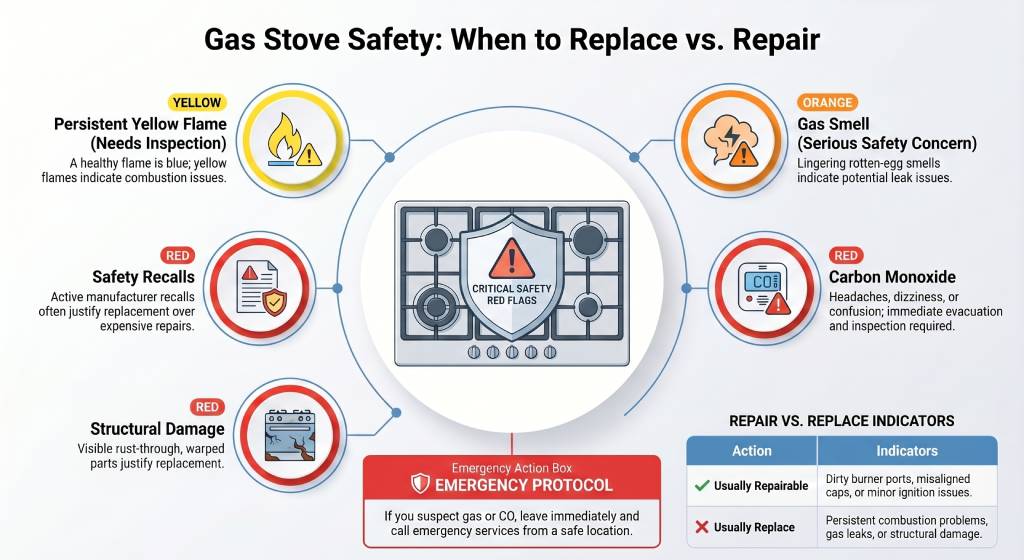
Yellow flame (incomplete combustion that produces CO)
A correctly burning gas stove produces a steady blue flame with a small inner cone. Persistent yellow or orange flames mean incomplete combustion, which produces carbon monoxide. Sometimes the culprit is a clogged burner port that a deep clean fixes. If cleaning doesn’t restore a blue flame, the burner head, orifice, or gas pressure regulation is failing. On a 10+ year stove, that’s replacing territory.
Gas smell that does not clear
Natural gas is odorless. The “rotten egg” smell is mercaptan, an odorant added so leaks are detectable. If you smell gas, leave the home, leave the door open, call your gas utility’s emergency line from outside, and do not flip light switches or use phones inside. Do not attempt to diagnose a gas leak yourself. After the utility clears the home, a licensed appliance or gas technician (not a handyman) needs to inspect the stove.
Carbon monoxide symptoms
Possible symptoms may include headache, dizziness, nausea, or confusion, or flu-like symptoms that improve when you leave the home, which can be consistent with carbon monoxide (CO) exposure. If symptoms persist or are concerning, seek professional medical advice.
Carbon monoxide detectors are not gas-leak detectors, so separate protection or a combo alarm is recommended.
Some U.S. GAO findings suggest that nitrogen dioxide (NO₂) emissions from gas stoves can, under certain conditions, exceed EPA outdoor air quality limits indoors.
CPSC data indicates dozens of gas stove recalls over past decades, including notable recall activity in 2022–2023 involving tens of thousands of units linked to safety issues, including CO-related defects.
Recall status (CPSC lookup)
Before you spend a dollar on a repair, check your model number against the CPSC recall database. If your stove is in an active recall, the manufacturer is required to repair, replace, or refund. You shouldn’t be paying. The CPSC enforces the ANSI Z21.1-2016 / CSA 1.1-2016 standard for household cooking gas appliances, and recalled units may involve products found to present safety or compliance concerns under these standards.
Structural damage
Cracked manifold, warped burner cap, visible damage to the gas line connection, or rust eating through the burner box are all replacement conditions. These aren’t parts you patch on a 10-year-old appliance. NFPA 54 (the National Fuel Gas Code) governs how gas appliances are installed and maintained, and an appliance with compromised structural integrity is no longer code-compliant. Most home insurance policies also exclude damage caused by a known-defective appliance, so deferring replacement on a structurally compromised stove can void your coverage if a fire or leak follows.
Which Gas Stove Problems Can You DIY and Which Need a Pro?
Per Consumer Reports’ 2021 survey, 70% of gas ranges were successfully repaired on the first try. And 24% of those repairs were done by the owner or a family member. A meaningful share is within reach if you know which ones.
DIY-friendly (the 24%)
- Burner spark igniter / electrode. Usually a clip-out, clip-in swap. Part costs $20-$110 (GE WB02X10822 is $106.97; many off-brand equivalents are under $30). Power off at the breaker before touching it.
- Knobs, drip pans, burner caps, grates. Straight cosmetic and functional swaps. $15-$80 per part.
- Surface burner cleaning (clogged ports). A needle and warm soapy water, not a tool. Often fixes a “won’t light” complaint without any part our guide to diagnosing common gas stove problems covers the next steps if it doesn’t.
- Drip-tray and seal replacement. Model-specific but rarely above $50.
Pro-only (the other 76%)
- Oven igniter (hot surface igniter). Even though Whirlpool W10918546 is $44.24 and WP74009336 is $28.95, replacing a gas stove igniter requires partial gas-line disconnection. Licensed tech only
- Gas valve. Never DIY. NFPA 54 territory.
- Control board / electronic panel. High failure rate on modern stoves, $400-$700 with diagnostic. This is the repair that usually triggers the 50% rule.
- Regulator. Never DIY.
- Anything behind the back panel involving gas-line fittings. Never DIY.
The 70% rule from Consumer Reports
If you call a technician and the issue isn’t resolved on the first visit, the likelihood of additional service calls increases and the overall repair path often becomes less cost-efficient. Consumer Reports’ survey data suggests approximately 70% of gas range repairs are resolved on the first service visit, while the remaining cases require follow-up visits or ultimately lead to replacement.
If you’re on your second service call for the same issue, the decision often shifts toward replacement rather than continued repairs, especially when costs start stacking.
One practical filter before booking a technician is to ask whether they carry the likely replacement part on their truck (such as an oven igniter, spark module, or thermocouple). If the answer is that the part must be ordered, a second visit is usually unavoidable, which can add roughly $80–$150 in additional service fees. That cost should be included in your repair-vs-replace calculation.
Frequently Asked Questions
Is it worth repairing a gas stove?
Usually yes, if it is under 10 years old, the repair quote is under 50% of a comparable new range, and there are no safety red flags. Consumer Reports’ 2021 survey put the median gas range repair at $191, and 70% of those repairs succeeded on the first try.
What is the average lifespan of a gas stove?
The average gas stove lasts about 13–15 years, while budget models typically last 10–12 years and high-end pro-style ranges can reach 18–20 years. Some manufacturers estimate shorter lifespans of around 7 years for certain models, depending on design and usage.
What is the 50/50 rule for appliances?
Replace the appliance if either (a) the repair cost exceeds 50% of a comparable new unit, or (b) the appliance is past 50% of its expected lifespan and the repair is non-trivial. If replacement is the better option, read our guide on protecting your next stove purchase.
Is it worth fixing a 10-year-old gas stove?
Usually yes if the repair is under $400 and you have no safety concerns. A 10-year-old stove still has 3-5 expected years left at the industry-average lifespan, which is plenty to justify a sub-$400 fix. Past $500, run the 50% math against your replacement price.
Can a 20-year-old gas range be repaired?
Technically yes. Practically, parts availability became the constraint past year 15-18. Manufacturers stop stocking control boards and proprietary igniters, and aftermarket substitutes are inconsistent. A 20-year-old pro-style range is often worth restoring. A 20-year-old budget unit almost never is.
How do I know when my gas stove needs replacing?
Five signals: persistent yellow flames after cleaning, a gas smell that doesn’t clear, CO symptoms (headache, dizziness, nausea), an active CPSC recall on your model, or structural damage (cracked manifold, warped components, rusted-through burner box). Any one of those means replace.
How much does it cost to repair a gas stove igniter?
$150-$400 total for a professional repair per Fixr’s January 2025 cost report. Parts alone run $22-$110: Whirlpool W10918546 is $44.24, WP74009336 is $28.95, W11596211 is $58.74, and the GE WB02X10822 is $106.97. Surface (burner) igniters are sometimes DIY-able; oven igniters should be left to a licensed tech.
Can a gas stove cause carbon monoxide poisoning or dizziness?
Yes. Incomplete combustion (often signaled by persistent yellow flames) can produce carbon monoxide (CO). Some studies and U.S. GAO findings suggest that nitrogen dioxide (NO₂) emissions from gas stoves can, under certain conditions, exceed EPA outdoor air quality limits indoors.
Install a carbon monoxide detector near sleeping areas for early warning. Note that CO detectors do not detect raw natural gas, so a combo detector or a separate gas-leak alarm is also recommended.
Possible symptoms may include headache, dizziness, nausea, or confusion. If symptoms persist or improve after leaving the home, seek professional medical advice and ensure the space is properly ventilated and inspected.