
A yellow flame on your gas stove signals incomplete combustion and a possible carbon monoxide risk. For broader maintenance tips, see our complete stove care guide. Low or uneven flames usually point to clogged burner ports, a misseated burner cap, or a gas-supply issue. Clean the ports first, reseat the cap on its locator pin, and call a licensed gas technician if the yellow flame sticks around after cleaning.
Key Takeaways
- A clean gas stove flame is sharp blue with a defined inner cone. Yellow, orange, or lazy flames signal incomplete combustion and possible carbon monoxide.
- Five causes drive most yellow flames: clogged burner ports, a misseated cap, primary-air starvation, an LP-on-natural-gas-orifice mismatch, and high indoor humidity.
- Most low flames trace to a clogged orifice, a failing regulator, a near-empty or vapor-locked propane cylinder, or a partially blocked gas valve.
- Uneven flames are usually single-burner mechanical issues: clogged ports, a warped cap, debris in the venturi, or a swapped cap.
- Clean ports with a metal pin or paperclip only. Never use a wooden toothpick per KitchenAid service documentation.
- A small yellow tip on the outer cone of an LP flame can be normal; a lazy yellow flame across the whole cone is not.
- Stop and call a licensed gas technician if yellow persists, all burners are affected, or you smell rotten egg, hear hissing, or see soot on cookware.
What does my gas stove flame color tell me?
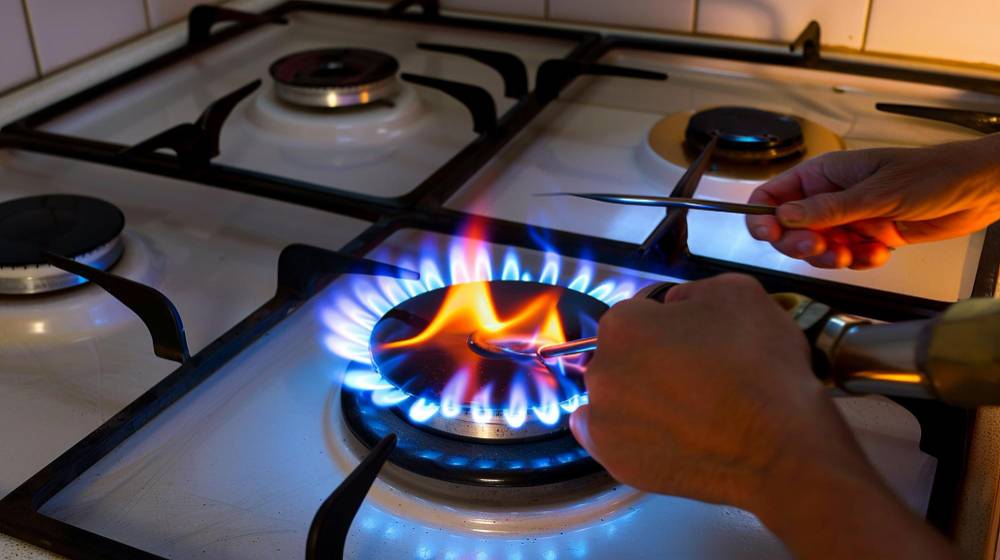
Flame color is the fastest read on whether your stove is burning cleanly. A complete burn produces a sharp blue cone with a slightly lighter inner cone. Anything else is worth diagnosing. Use this table to triage what you’re looking at:
| What you see | What it usually means | Risk level |
|---|---|---|
| Sharp blue cone, quiet | Complete combustion. Working as designed. | None |
| Yellow or orange cone | Incomplete combustion. Air-to-gas mixture is off. | High (carbon monoxide risk) |
| Small yellow tip on outer cone of an LP flame | Often normal on propane | Low (verify) |
| Low or lazy blue flame across all burners | Likely a gas-supply or regulator problem | Medium |
| Single burner uneven, others fine | Clogged ports or a misseated cap on that burner | Medium |
| Loud roaring or whistling flame | Too much primary air | Medium |
| Soot deposits on cookware | Long-running incomplete combustion | High (carbon monoxide risk) |
If your flame is yellow on more than one burner, read the safety section first.
Is a yellow or orange gas stove flame dangerous?
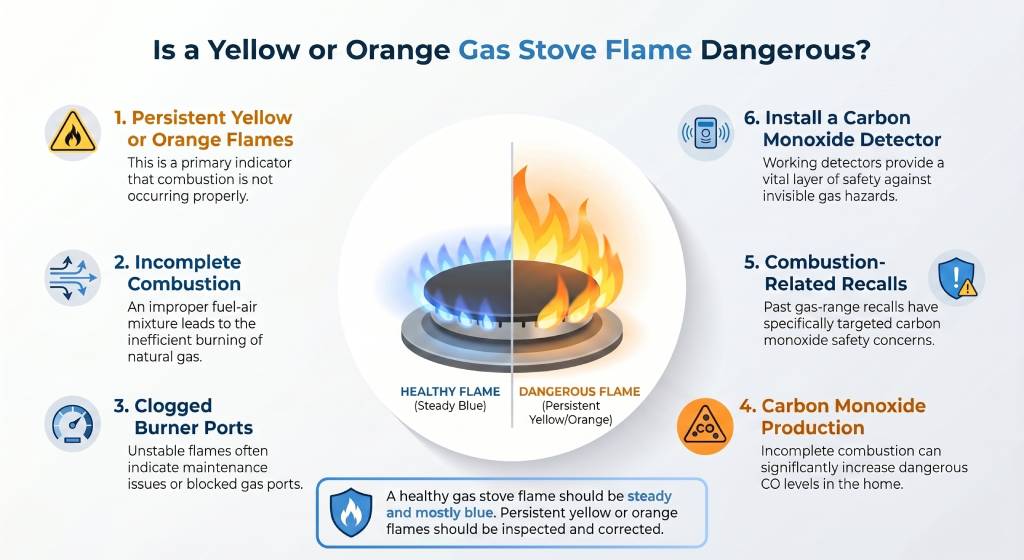
Yes. A persistent yellow or orange flame on a gas stove is a safety concern, not just a cosmetic issue. It usually indicates incomplete combustion, which may lead to increased production of carbon monoxide (CO), a harmful gas that cannot be seen or smelled.
The U.S. Consumer Product Safety Commission (CPSC) notes that carbon monoxide from consumer products such as gas ranges, furnaces, and generators remains a serious safety risk and highlights the importance of proper appliance maintenance and ventilation.
To help control emissions from gas appliances, voluntary safety standards such as ANSI Z21.1 define performance requirements and testing conditions for residential gas ranges.
In real-world use, a yellow or unstable flame can indicate that the fuel-air mixture is not balanced, which may lead to inefficient combustion. If not corrected, this condition can contribute to higher carbon monoxide output depending on appliance condition, ventilation, and fuel type.
There have also been documented safety recalls involving gas ranges where combustion issues were identified. For example, in 2023 the CPSC recalled approximately 28,000 ZLINE gas ranges due to reports of carbon monoxide emissions during normal operation.
A similar recall in 2009 involved Electrolux ICON and Kenmore PRO gas ranges where a component issue was linked to elevated carbon monoxide output.
Because carbon monoxide cannot be seen or smelled, installing a working CO detector in the kitchen and nearby living areas is strongly recommended. While flame color is a useful visual indicator of combustion quality, a detector provides a more reliable layer of safety monitoring in case an issue develops.
Why is my gas stove flame yellow or orange?
Five main causes account for almost all yellow or orange gas flame issues. They are listed in order of how commonly they appear in appliance service documentation and real-world troubleshooting cases.
1. Clogged burner ports
The small holes around the edge of each burner head control the flow of gas as it mixes with primary air. Over time, dust, food spills, grease, and debris can partially block these ports. When airflow is restricted, the gas does not burn completely, resulting in a yellow or weak flame.
2. Misseated burner cap
The burner cap sits on a locator pin on top of the burner head. If it is slightly rotated, tilted, or not seated properly, the gas-air mixture is disrupted as it exits the burner. This imbalance can cause yellow or unstable flames. Whirlpool identifies improper burner cap placement as a common cause of yellow or noisy flames on gas ranges.
3. Primary-air restriction (air starvation)
Each burner draws in primary air through an air shutter located at the base of the venturi tube. If airflow is restricted due to a tightly sealed kitchen, poor ventilation, or nearby air disturbances the burner may not receive enough oxygen. This can result in a yellow flame instead of a clean blue one. In some cases, improving ventilation restores normal combustion.
4. Incorrect fuel setup (LP vs natural gas mismatch)
Gas stoves are designed to operate with specific fuel types. Natural gas and propane (LP) operate at different pressure levels, which require different orifice sizes to properly regulate gas flow.
Natural gas typically operates at around 4 inches of water column, while propane (LP) operates at approximately 10–11 inches of water column. If a stove designed for natural gas is used with propane without changing the orifices, the fuel-air mixture becomes incorrect. This can cause yellow flames across multiple burners and may also produce visible soot on cookware due to incomplete combustion.
5. Reduced ventilation or unusual indoor conditions
In some cases, poor ventilation or unusual indoor air conditions may contribute to incomplete combustion. This is less common than mechanical or setup-related issues and should only be considered after checking the first four causes.
Why is my gas stove flame too low or weak?
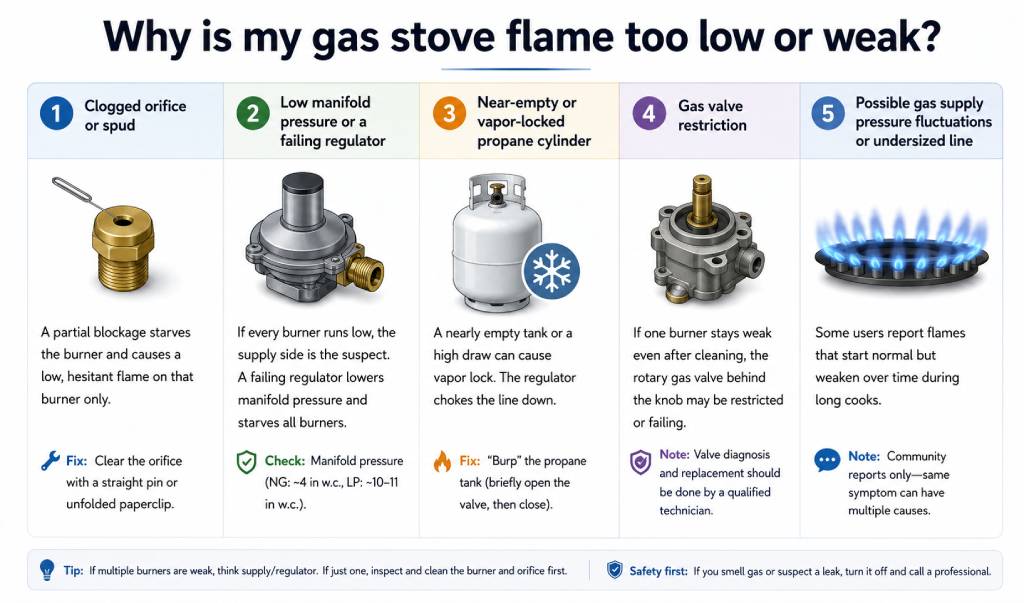
A flame that lights normally but stays small, or that fades during a long cook, points to gas delivery rather than air mixing. Four causes cover almost every case.
1. Clogged orifice or spud. The orifice is the brass jet that meters gas before it enters the venturi. A partial blockage starves the burner and causes a low, hesitant flame on that burner only. Family Handyman recommends clearing the orifice with a straight pin or unfolded paperclip as a common first-step fix for weak burner flames.
2. Low manifold pressure or a failing regulator. If every burner runs low, the supply side is the suspect, not the burner. The pressure regulator on the back of the range steps incoming gas down to manifold pressure (about 4 in w.c. for natural gas, 10-11 for LP). A failing regulator drifts low and starves all burners at once. A repair-shop blog at 911 Service Today walks through the symptom set in plain language “911 Service Today: Weak Gas Stove Flame Causes and Fixes”; treat it as expert-but-non-OEM context.
3. A near-empty or vapor-locked propane cylinder. On LP, a tank that’s nearly empty or that just had a high draw event can vapor-lock. The regulator senses excess flow and chokes the line down. Camp Chef documents the “burp the propane tank” procedure for its grills and gas stoves, which works on most home LP setups too “Camp Chef: How to Fix Low Flame on Your Gas Grill or Stove”.
4. Gas valve restriction. If one burner remains weak even after you’ve cleaned the burner head and orifice, the rotary gas valve behind the control knob may be partially worn, restricted, or failing internally. Diagnosing and replacing a gas valve involves working on the gas supply system and is best left to a qualified technician.
Community reports: Some homeowners describe a pattern where burners start with a normal flame but gradually weaken during longer cooking sessions. In those cases, users often suspect gas supply pressure fluctuations or an undersized household gas line. Treat these reports as anecdotal observations rather than a confirmed diagnosis, as the same symptom can have multiple causes.
Why is my gas burner flame uneven?
An uneven flame, strong on one side of the burner ring and weak on the other, is almost always a single-burner mechanical issue. The first triage question is whether one burner is uneven or every burner is uneven.
Single burner uneven:
- Partially clogged ports. Some ports on the ring are blocked; the rest flame normally.
- Bent or warped burner cap. A dropped cap or years of thermal cycling can warp the cap so it doesn’t sit flat, and gas bypasses the ports.
- Spider webs or debris in the venturi tube. Gas range service manuals list this as a standard inspection item, especially on stoves used seasonally.
- Wrong cap on the wrong burner. On ranges with mixed-size burners, swapping caps after cleaning puts a small cap on a large head and you see an immediate uneven flame.
All burners uneven at once is rare and pushes the diagnosis back to manifold pressure, regulator drift, or a low LP cylinder. Treat it as a gas-supply problem, not a burner problem.
Sub-Zero Wolf’s service page on green or yellow burner flames notes that improper air-gas mixture and unseated burner heads are the two most common single-burner causes “Sub-Zero Wolf: Green or Yellow Burner Flames”.
How do I fix a yellow, low, or uneven gas flame?
Work through these six steps in order. Stop at any point if you smell rotten egg, hear hissing, or feel uncertain.
Step 1: Turn off the stove and shut the gas supply at the appliance valve
Turn every burner knob to OFF. Reach behind or beside the range and close the manual gas shut-off valve. The handle should sit perpendicular to the gas line when closed. Wait two minutes for any residual gas to clear and the burners to cool.
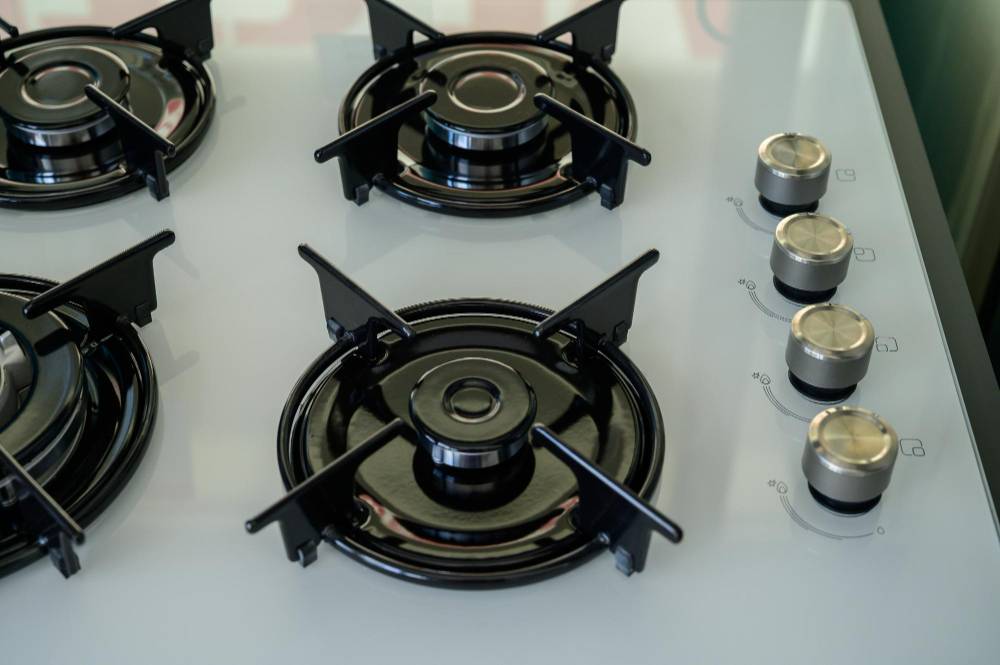
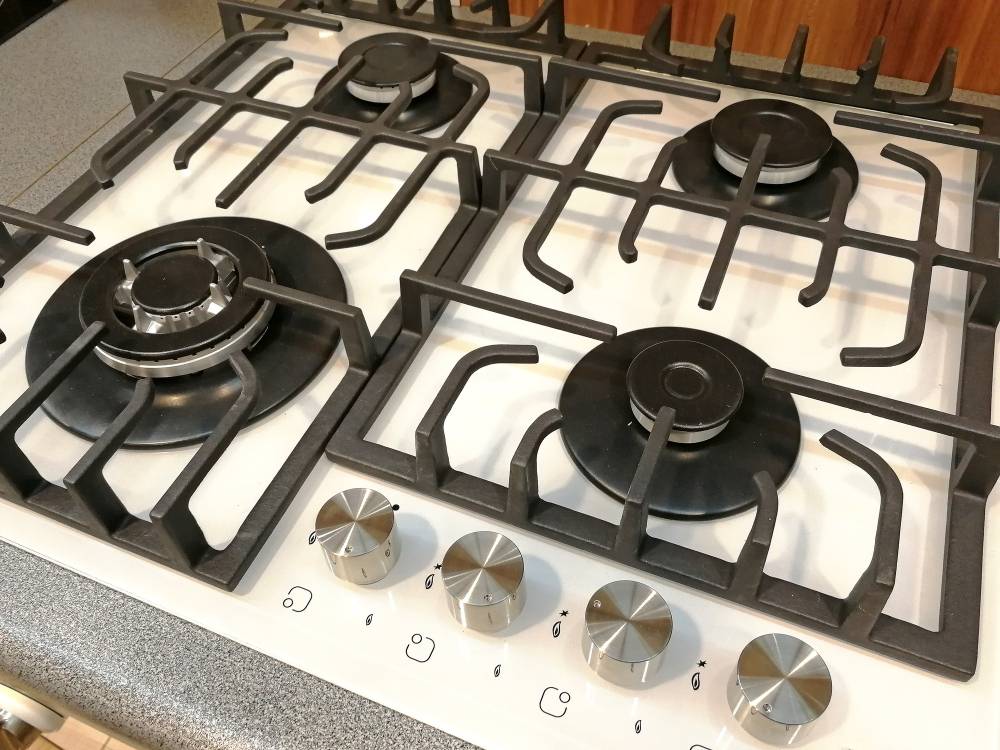
Step 2: Lift the burner cap and head, then inspect every port
Once cool, lift the burner cap straight up. Lift the burner head off the orifice. Hold each up to the light and look at every port around the ring. Black crusty residue, dried spillover, and food crumbs are the usual suspects. Wipe the cap and head with a damp cloth.
Step 3: Clear the ports with a straight pin or unfolded paperclip
This is the Family Handyman method, and it works because the pin matches the port size. For a complete guide to cleaning clogged burner ports, follow our detailed walkthrough. Push the pin into each port, twist once, withdraw. Do every port on the ring. If a port stays stubborn, soak the cap and head in warm soapy water for 15 minutes, dry fully, and try again.
Do not use a wooden toothpick. KitchenAid specifically warns against this because a wooden toothpick can break off inside the burner ports, where it may later ignite or permanently block gas flow.
Step 4: Reseat the burner head and cap
Set the burner head back over the orifice. It should drop into place with no lift. Set the cap on top. Most caps have a locator pin that engages a notch on the head. The cap should sit flat. Spin it a quarter turn; if it wobbles or rotates freely, it’s not seated. Lift and try again. If the igniter continues clicking after the cap is properly seated, see our gas stove clicking fixes guide.
Step 5: Check the air shutter, only if you have the service manual
The air shutter is an adjustable collar at the base of the venturi tube that controls how much primary air enters the burner. Service manuals show the position by model. If you don’t have the manual or you can’t find the diagram for your stove, don’t adjust it. A bad air-shutter setting can make CO emissions worse, not better. Call a licensed technician.
Step 6: Relight and observe for 60 seconds
Relight and observe for 60 seconds. If the burner fails to ignite after reassembly, follow our gas stove won’t light troubleshooting guide before assuming a larger gas-supply problem.
When is yellow flame tipping normal on propane?
Not every yellow color on a gas flame is a problem. On propane (LP), a small yellow halo on the very tip of the outer cone is often acceptable. Sub-Zero Wolf documents this in its service FAQ: a slight yellow tip on the outer cone of an LP flame is within spec “Sub-Zero Wolf: Green or Yellow Burner Flames”. GE Appliances notes the same nuance in its LP support pages.
The line that matters: a small yellow tip on the outer cone of an LP flame is usually normal. A lazy yellow flame across the whole cone, or yellow on the inner cone, is not. Natural gas shouldn’t show any yellow tipping in normal operation. If it does, treat it as a real symptom.
When should I stop and call a licensed gas technician?
The honest limit of DIY troubleshooting is the point where the symptom doesn’t respond to cleaning. Stop and call a licensed gas technician if any of the following are true:
- You smell rotten eggs (mercaptan) near the stove, the line, or the connector.
- The yellow flame persists after you’ve cleaned every port and reseated the cap.
- All burners go yellow at the same time.
- Every burner is weak, not just one.
- You hear hissing, whistling, or a roaring sound from a burner that was previously quiet.
- You see soot deposits on the bottom of your cookware after a normal cook.
Jackson Energy Authority puts the safety case plainly: “Incomplete combustion could cause too much carbon monoxide to be present in your home, so it is imperative for a qualified professional to check the appliance”Jackson Energy Authority: Proper Flame”. That’s the safety stop-line for this article. If you have any doubt about whether your flame is normal, treat it as a hazard and stop cooking until a pro confirms otherwise.
Frequently Asked Questions
How do you fix a yellow flame on a gas stove?
Turn the stove off, shut the gas valve, lift the burner cap and head, and clear every port with a straight pin or unfolded paperclip. Reseat the burner head and cap on the locator pin, relight, and watch for 60 seconds. If yellow persists, call a licensed gas technician.
What causes a yellow flame on a gas stove?
Yellow flames mean the air-to-gas mixture is wrong. The five usual causes are clogged burner ports, a burner cap that isn’t seated correctly, primary-air starvation in a tightly sealed kitchen, propane gas running through natural-gas orifices, and elevated indoor humidity. Clogged ports and misseated caps account for the majority.
Is it safe to cook with a yellow flame on a gas stove?
A persistent yellow flame may indicate incomplete combustion, which can increase carbon monoxide production. The U.S. Consumer Product Safety Commission (CPSC) identifies carbon monoxide from consumer gas appliances such as ranges, furnaces, and generators as a serious safety risk and emphasizes proper appliance maintenance and ventilation.
How do I make my gas stove flame higher?
First confirm every burner knob is fully open. If the flame is still low, clean the burner ports and orifice with a straight pin, reseat the burner head and cap, and check that your gas supply valve is fully open. If every burner is low, the manifold-pressure regulator or supply line is the likely cause and needs a technician.
Why is my gas oven staying on low flame?
Gas ovens cycle between high and low to hold the set temperature, so an intermittent low flame is normal. A flame stuck on low usually points to a failing oven thermostat, a clogged orifice, or a weak regulator. Call a service technician. Oven gas valves aren’t a safe DIY target.
What if I accidentally left my gas stove on low flame?
If the burner is lit, the gas is being consumed and the room-level CO and gas-leak risk is usually low, but ventilate the kitchen, turn the burner off, and check your CO detector. If the burner was off but unlit gas was flowing, leave the home immediately, don’t flip any switches, and call your gas utility from outside.
How do I burp my propane tank?
Close every appliance valve. Close the propane cylinder valve. Disconnect the regulator from the tank. Wait 30 seconds for residual gas to vent. Reconnect, open the cylinder valve slowly, then open the appliance valves. This resets a vapor-locked regulator on most LP setups.
Sources
- CPSC Carbon Monoxide Fact Sheet
- CPSC ZLINE Gas Range Recall (2023)
- CPSC Electrolux ICON / Kenmore PRO recall (2009)
- ANSI Z21.1 voluntary standard for gas ranges
- KitchenAid: Surface Burner Flames Too Low
- Whirlpool: Noisy or Yellow Flames
- GE Appliances: Yellow Flames or Soot on Top Burners
- Sub-Zero Wolf: Green or Yellow Burner Flames
- Jackson Energy Authority: Proper Flame
- Family Handyman: How to Fix a Gas Stove Burner
- Camp Chef: How to Fix Low Flame on Your Gas Grill or Stove