

The 2026 gas stove vs electric stove vs induction decision comes down to three trade-offs: induction is fastest and most efficient (84-90%) but needs magnetic cookware and may require a $1,000-$3,400 panel upgrade; gas stays cheapest to run but emits NO2 linked to childhood asthma; electric is cheapest upfront. The IRA HEAR rebate covers up to $840 for induction.
Key Takeaways
- Induction is the fastest and most energy-efficient cooking option in 2026, but it requires compatible cookware and may need an electrical panel upgrade in some homes.
- Gas stoves offer strong heat control and lower running costs, but they produce indoor air pollutants and require proper ventilation.
- Electric coil and smooth top stoves are the most affordable to buy, but they are slower and less energy-efficient compared to gas and induction.
- From a safety and indoor air quality perspective, induction performs best, while gas has the highest emissions risk if ventilation is poor.
- From a cost perspective, gas is usually cheapest to operate, but induction can become more affordable after rebates and efficiency savings.
- For most modern households with electrical capacity, induction provides the best overall balance of performance, safety, and long-term efficiency.
Gas vs Electric vs Induction at a Glance (2026 Comparison)
Need a quick comparison? This side-by-side covers the decision factors that actually move the needle. Numbers come from CNET’s 2026 hands-on test, the DOE, ENERGY STAR, and Rewiring America.
| Factor | Gas | Electric (smoothtop / coil) | Induction |
|---|---|---|---|
| Pan-level efficiency | 32-42% | 70-75% | 84-90% |
| Boil time, 60oz water | ~8 min | ~9.5 min | ~5 min |
| Upfront price (range) | $629-$1,599 | $628-$1,549 | $898-$4,149 |
| 10-year operating cost (NY example) | low ($0.17-0.20/hr) | high ($0.46/hr) | mid ($0.35/hr) |
| IRA HEAR rebate eligible | No | Yes (up to $840) | Yes (up to $840) |
| Cookware required | Any | Any | Magnetic / ferrous only |
| Cool-touch surface | No | No | Yes (around the cooked area) |
| Indoor air quality impact | Emits NO2, CO, methane | Neutral | Neutral |
Sources: CNET 2026 hands-on boil test; DOE / ENERGY STAR efficiency ranges; Rewiring America HEAR calculator.
A few things this table won’t tell you. What it actually costs to wire a 240V, 40-50A circuit if your panel is full. Which cookware you may need to replace. And how the open-flame vs flat-glass experience changes the way you cook. The next sections handle those. For ongoing maintenance after choosing a stove, see our complete gas and electric stove care guide.
Which Stove Is Most Energy Efficient in 2026?
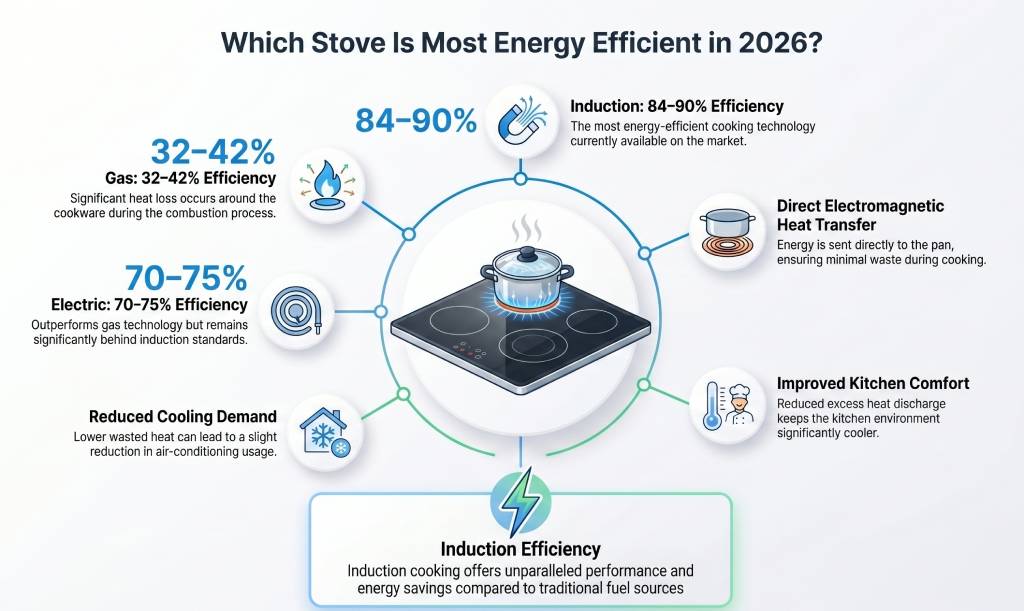
Induction is currently the most energy-efficient cooking technology by a wide margin. U.S. Department of Energy and ENERGY STAR data typically place induction at 84–90% pan-level efficiency, electric at 70–75%, and gas at 32–42%. The gap exists because induction heats the cookware directly using an electromagnetic field, while gas burns fuel under the pan and loses much of the heat to the surrounding air.
Energy experts frequently highlight this difference. Induction can send around 85–90% of heat directly to the pan, while gas delivers roughly 40%.
Here’s the catch: that extra lost heat isn’t just wasted energy it also warms the kitchen. In hot climates, households that switch to induction often notice their kitchens feel cooler while cooking, which can slightly reduce air-conditioning demand during summer.
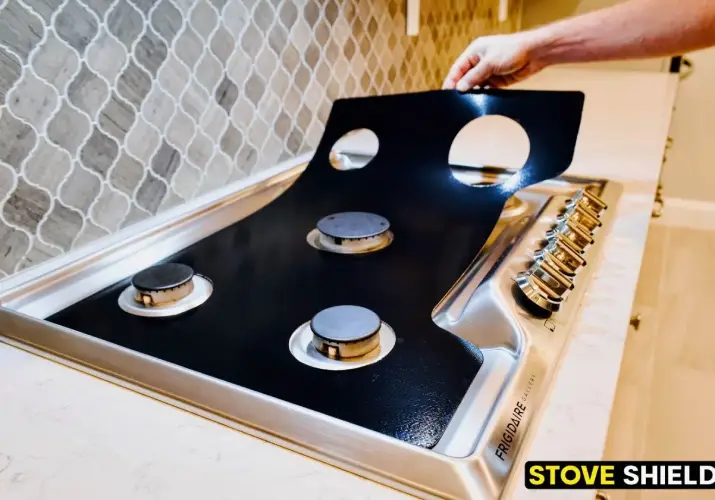
If you choose an induction or smooth-top electric range, you may also wonder do you need a stove top protector to help prevent scratches, stains, and everyday surface wear.
How Much Does Each Stove Cost to Buy and Run?
There are three cost layers: upfront, install, and operating. Skipping any one of them is how buyers get burned.
Upfront price (CNET’s 2026 7-brand audit):
- Electric: $628 to $1,549
- Gas: $629 to $1,599
- Induction: $898 to $4,149
Induction starts higher and tops out roughly 2.5x the gas ceiling for premium 36-inch ranges.
Installation:
- Gas range, hookup already in place: usually $150-$300 for a plumber to swap the unit.
- Electric or induction in a wired kitchen: similar swap cost.
- Induction with no 240V circuit: 30-inch units need a 40A circuit, and 36-inch units need 50A. Roughly 15-20% of US homes need a panel upgrade. Consumer Reports and Rewiring America peg that at $1,000-$3,400 for the full switch from gas. That’s the honest number every “induction is cheaper long-term” article tends to bury.
Operating cost (NY-specific from CNET 2026):
- Gas: $0.17-0.20 per hour of cooking
- Induction: $0.35 per hour
- Electric coil/smoothtop: $0.46 per hour
National operating averages from Cooktophunter 2026 (at $0.17/kWh and $1.30/therm) come out to about $113/year for gas, $193/year for induction, and $236/year for electric coil. Gas usually wins on raw running cost. The math flips once you stack the $840 HEAR rebate, an HVAC offset in cooling-heavy climates, and the long-term trajectory of natural-gas prices in states tightening hookups.
Is Induction Worth It in 2026? (Including the $840 IRA Rebate)
For many homeowners now considering induction for their next purchase, the deciding factor is rebate math. Here’s the part many competitor articles mention without clearly explaining the numbers.
The IRA HEAR rebate, according to the Rewiring America calculator:
• Up to $840 toward an electric or induction stove
• Households at or below 80% of Area Median Income (AMI): 100% covered, up to $840
• Households at 80–150% AMI: 50% covered, up to $420
• Households above 150% AMI: Not eligible
• Maximum household cap across electrification rebates: $14,000
• As of early 2026, more than 20 states had live HEAR programs
You can often stack this with state and utility rebates. In some cases, a New York buyer at 70% AMI replacing an older electric coil range with a 30-inch induction range can land in the $400–$700 out-of-pocket range after federal and state incentives, before installation.
The 2026 policy backdrop also matters. New York’s All-Electric Building Act bans gas hookups in new buildings up to seven stories starting December 31, 2026, with broader coverage planned by 2029 (currently in legal review). Many jurisdictions across the U.S. are exploring similar policies, making long-term gas planning less certain in some regions.
Is induction worth it for you?
Yes, if your electrical panel has capacity and you cook with flat-bottom cookware.
No, if your panel is full and you have no budget for electrical upgrades — at least until you plan a future renovation.
What Are the Health and Safety Differences? (Stanford + RMI Data)
This is where the conversation has moved fastest since 2022, and where gas faces the most criticism.
RMI’s 2022 peer-reviewed MDPI study estimated that 12.7% of current US childhood asthma cases are attributable to gas-stove use (95% CI 6.3-19.3%). State-by-state population attributable fractions: Illinois 21.1%, California 20.1%, New York 18.8%, Massachusetts 15.4%, Pennsylvania 13.5%.
A 2024 Stanford study (Kashtan et al., Science Advances) measured a long-term NO2 exposure increase of 4.0 ppb in homes with gas and propane stoves. That’s about 75% of the WHO unsafe-exposure threshold from cooking alone. The team estimates roughly 50,000 current US pediatric asthma cases are attributable to long-term stove NO2 exposure on top of all other sources.
An earlier 2022 Stanford study found that gas stoves leak 0.8-1.3% of their gas as unburned methane, even when off. Total US emissions hit 28.1 Gg/year, roughly the climate footprint of 500,000 gasoline cars.
Quick reality check on what this doesn’t mean. Gas stoves aren’t banned and aren’t unsafe to use. It just means ventilation matters more than most owners realize. A vented range hood ducted outside (not recirculating) is the single biggest mitigation for any gas-stove household.
Burn risk and surface safety Induction is the safest of the three on contact. The cooktop only heats where the pan sits, and the surrounding glass stays close to ambient temperature. Gas open flames remain the highest risk for children and loose sleeves. Electric coil and smoothtop burners stay hot for several minutes after shutoff with no visual cue, which is its own hazard.
Do Chefs Prefer Gas or Induction in 2026?
The honest answer: it’s split, and the split is moving.
Michael Handal of the Institute of Culinary Education told CNET in 2026: “Gas allows immediate and precise control… gas ranges are still seen as the gold standard for professional cooktops. Electric cooktops are the least popular cooktops of all.” That’s the traditional position.
Stuart Pyburn, a 36-year veteran at Mr. Appliance, says gas remains easier to control, while induction relies on magnetic cookware compatibility.
Induction is winning converts at the high end, though. Real-world switcher reports shared on Reddit are increasingly common: “Induction is way better than gas for cooking and I was a gas only cook for many years. The dynamic range of heat is much wider and the cooking surface is cooler and safer.” Industry surveys show many professional kitchens still default to gas, while interest in induction continues to grow among professionals planning future kitchen upgrades.
The two cases where gas still clearly wins for serious cooks:
- Wok cooking with carbon-steel rounded-bottom woks (induction needs a flat ferrous bottom)
- Open-flame techniques: charring peppers, flambeing, blistering tortillas
For everything else (sear, simmer, sous-vide-adjacent low temps, high-volume boil) induction’s responsiveness and precision now beat or match gas in side-by-side tests.
Which Stove Is Right for You? (5-Persona Decision Tree)
Skip the abstract scoring. Find the persona that fits and follow the call.
- Family with young kids or any household with asthma history. Induction. The Stanford 2024 NO2 data and RMI 12.7% asthma fraction are the deciding inputs. Cool-touch surface is a bonus. If a panel upgrade is a no-go, a 120V plug-in induction unit (Channing St. Copper, Impulse) is a real option that didn’t exist five years ago.
- Renter. Use whatever the unit has. If you cook seriously and the unit is electric coil, a portable induction burner ($80-$200) plus your existing flat-bottom cookware solves 80% of the responsiveness gap. No need to pay for an install you won’t benefit from.
- Kitchen remodeler with panel headroom. Induction range. Stack the $840 HEAR rebate, claim any state or utility top-up, and budget another $300-$800 for an electrician to pull a 50A circuit if it isn’t already there.
- Kitchen remodeler with a full 100A panel. Honest answer: dual-fuel range or hold gas. Budget $1,000-$3,400 for the panel upgrade if you want to go all-electric. If that’s not in scope this cycle, gas with a properly vented hood is a defensible choice.
- Off-grid, RV, or spotty-grid household. Propane gas wins. Induction needs sustained 240V at meaningful amperage, which solar-and-battery setups rarely deliver without sizing up the system.
Bonus: serious wok cook with great ventilation and gas already plumbed? Stay on gas. Add a vented hood at 600+ CFM. Revisit when you remodel.
Frequently Asked Questions
Do professional chefs prefer gas or induction?
Most still default to gas. Many professional chefs continue to prefer it, and Michael Handal of the Institute of Culinary Education calls gas the professional “gold standard,” as he told CNET in 2026. At the same time, interest in induction continues growing for future kitchen installations, and pros like Maricel Gentile and Rachelle Boucher publicly advocate for it. For home cooks in 2026, induction matches or beats gas for most techniques except open-flame cooking and round-bottom wok work.
Is there a downside to an induction stove?
Yes, three real ones. Upfront cost runs $898 to $4,149. Roughly 15-20% of US homes need a $1,000-$3,400 electrical panel upgrade to support a full-size induction range (Consumer Reports / Rewiring America). And induction only works with magnetic / ferrous-bottom cookware. Pure copper, pure aluminum, and most glass cookware will not heat. A simple fridge magnet test on a pan tells you in two seconds whether a piece works.
What cannot be cooked on induction?
Anything that requires direct flame contact with the food: charring peppers over the burner, flambeing with the pan tilted into flame, blistering tortillas directly on the grate. Round-bottom carbon-steel woks also do not get full surface contact on a flat induction zone, so true wok hei is harder. Everything else (sear, simmer, deep fry, sous-vide-style holds, rapid boil) works as well or better than gas.
Can you use induction if you have a pacemaker?
Yes, with a clearance rule. Medtronic’s published guidance is to keep cardiac implanted devices at least 60 cm (about 24 inches) from the active induction heating zone. Most cooks already stand farther away than that during normal use; the issue is leaning over the cooktop or reaching across an active burner. If you have any cardiac device, confirm with the manufacturer of your specific model before buying.
Is gas or electric stove cheaper to run?
Gas is usually cheaper per hour. CNET’s 2026 New York data shows gas at $0.17-$0.20 per cooking hour versus $0.46 for electric coil. Cooktophunter’s 2026 national averages: gas about $113 per year, electric coil about $236, induction about $193. Induction beats traditional electric on operating cost despite using electricity, because of its 84-90% efficiency.
How much is the IRA rebate for an induction stove?
Up to $840 under the federal HEAR program, administered through your state energy office. Households at or below 80% of Area Median Income get 100% covered up to $840. Households at 80-150% AMI get 50% covered up to $420. Above 150% AMI: not eligible. Maximum household cap across all HEAR electrification rebates: $14,000. As of early 2026, 23 states had live programs accepting applications (BenefitsUSA). Verify your state and income eligibility using the Rewiring America calculator or the DOE Home Upgrades portal.
Is an induction stove worth it in 2026?
For most homeowners with electrical headroom: yes. You get 84-90% efficiency, the fastest boil times of any cooking technology, a cool-touch surface, no NO2 emissions, and up to $840 back from federal rebates. It is not worth it if your panel is full and you have no budget for an upgrade, or if your cooking relies heavily on open-flame techniques.
Will my pots and pans work on induction?
Test each piece with a fridge magnet. If the magnet sticks firmly to the bottom, the pan is induction-ready. Cast iron, carbon steel, and most stainless steel pass. Pure copper, pure aluminum, and most glass and ceramic do not. Many “tri-ply” stainless pieces have an aluminum core but a magnetic stainless exterior, so they work.