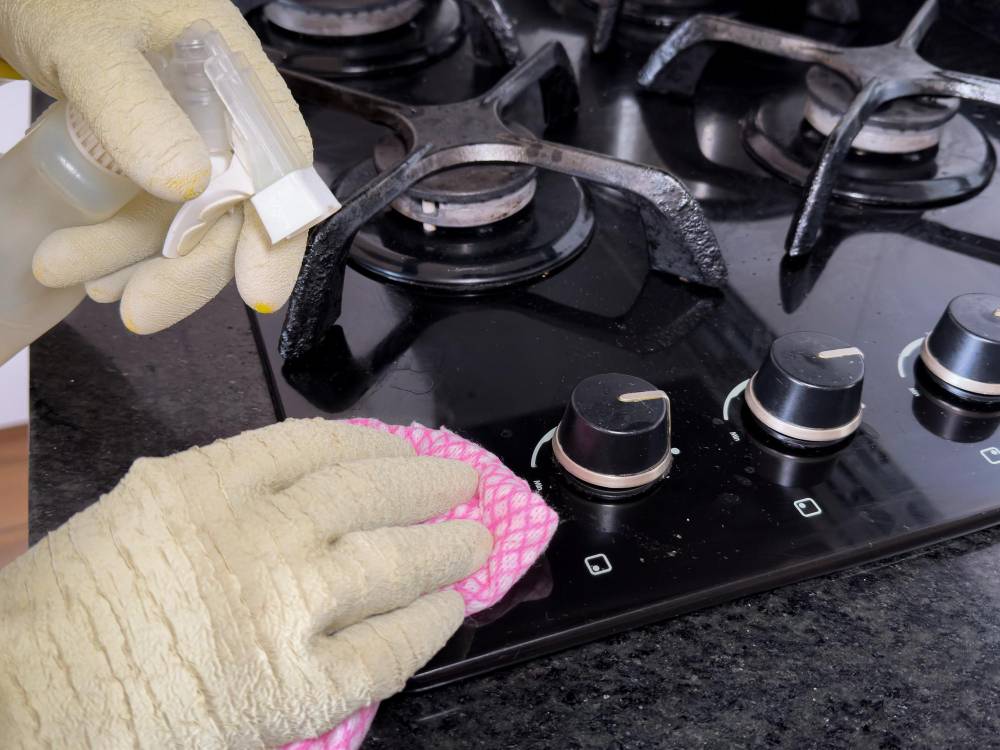

To clean cast iron stove grates, pick one of 5 methods by buildup level. Daily grease: hot soapy water with a nylon scrub. Caked residue: ammonia bag overnight in a sealed Ziploc. Baking soda paste handles medium grime and light rust. Vinegar lifts surface grease. Oven cleaner is last-resort for enameled grates only.
Cast iron stove grates take a beating. Daily spatter, boil-overs, the occasional sugar burn that welds itself onto the iron until you intervene. For a complete maintenance schedule, everyday cleaning tips, and long-term appliance care, see our complete gas and electric coil stove care guide. The right cleaning method depends on two things: how heavy the buildup is, and whether your grates are bare cast iron or enameled. Get those two right and the rest is easy. Get them wrong and you can strip the seasoning, void the warranty, or crack the metal.
This guide compares the 5 most-cited methods side by side, then covers rust removal, reseasoning, and what will actually damage your grates. I learned the coating-vs-buildup lesson the hard way: a set of grates I inherited with my first apartment had years of carbonized grease, so I went straight at them with oven cleaner. They were bare cast iron. By the time I rinsed them off, the seasoning was gone and they had flash-rusted in about an hour. That single mistake is what this article is built to prevent.
Key Takeaways
- Identify your grate type first. Bare cast iron and enameled cast iron need different methods. Magnet test plus visual plus fingernail scrape on a hidden edge takes 30 seconds.
- Match the method to the buildup. Hot soapy water for daily, baking soda for medium, ammonia bag for heavy, oven cleaner for enameled-only emergencies.
- Reseason after every deep clean on bare iron. 375-400°F oven, thin coat of high smoke-point oil, 45-60 minutes, repeat 2-3 times for best results.
- Skip vinegar for grease. It works on rust (pH ~2.4) but is less effective on grease compared to alkaline cleaners. Alkaline cleaners (baking soda pH ~9, ammonia) saponify grease. That’s the chemistry that actually breaks it down.
- Never use the dishwasher or self-cleaning oven cycle. Both cause irreversible damage and dishwasher use voids the warranty depending on brand.
- Dry immediately and re-oil bare iron. Flash rust can begin forming quickly, sometimes within hours on bare cast iron left damp.
Coated or Uncoated? The 30-Second Touch Test
Before you pick a method, figure out what your grates are. Modern gas stoves ship with one of three styles:
- Bare cast iron. Gray-black, slightly porous, develops a brown-black patina from seasoning. Surface feels matte and slightly rough.
- Porcelain-enameled cast iron. Glossy black (sometimes colored), looks ceramic. If your stove has enamel-coated grates, follow our guide to cleaning porcelain-coated stove grates for the safest cleaning methods..
- Coated cast iron (matte enamel). Flat black with a uniform finish. Surface feels smooth but not glossy.
Three quick checks:
- Magnet test. A fridge magnet should snap onto any cast iron grate. If it doesn’t, you have stamped steel or aluminum, and most of this guide doesn’t apply.
- Visual. Bare cast iron looks porous and dull. Enameled looks like glass.
- Fingernail scrape on a hidden edge. Bare iron marks slightly. Enamel won’t.
Why this matters: enameled grates survive harsh degreasers and oven cleaner. Bare cast iron doesn’t. Those products strip seasoning down to raw metal, and bare iron flash-rusts the moment it sits wet. Enamel never rusts but it chips if scoured aggressively. Wrong method on the wrong material is the most common way home cooks ruin a set of grates.
5 Cast Iron Grate Cleaning Methods at a Glance
Here’s the head-to-head. Use the table to pick a method, then jump to the step-by-step in the next section.
| S. No. | Method | Best For (buildup level) | Coating Safe On | Active Time | Total Time | Cost | Rating |
|---|---|---|---|---|---|---|---|
| 1 | Hot soapy water soak | Light / daily grease | Both (cap soak at 5-10 min for bare) | 5 min | 15-25 min | $0–$2 | ⭐⭐⭐⭐⭐ daily |
| 2 | Baking soda paste | Medium grease + light rust | Both | 10 min | 30-40 min | $1–$3 | ⭐⭐⭐⭐ |
| 3 | Vinegar soak (50/50) | Surface grease, rust spots | Both (must reseason after) | 5 min | 30-40 min | $2–$4 | ⭐⭐⭐ |
| 4 | Ammonia bag | Caked-on, heavy carbonized residue | Both (well-ventilated) | 5 min | 12-24 hr passive | $3–$6 | ⭐⭐⭐⭐⭐ heavy buildup |
| 5 | Oven cleaner / commercial degreaser | Last resort, severe buildup | Enameled only | 10 min | 30-45 min | $5–$10 | ⭐⭐⭐⭐ enameled, ⭐ bare |
A 4-method head-to-head test by “a popular kitchen-test publication” performed best in one comparison for enameled grates, but only after a 40-minute dwell time. Run that same method on bare cast iron and you strip the seasoning down to raw metal. That single distinction is why this comparison ranks methods by coating type, not just buildup.
What Is the Best Way to Clean Cast Iron Stove Grates?
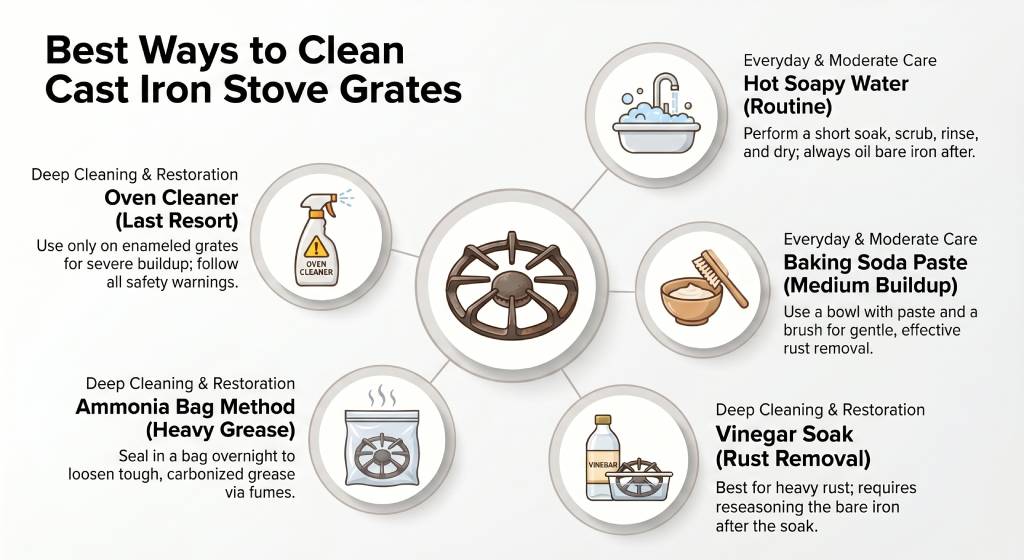
Hot soapy water for routine cleaning, ammonia bag for heavy buildup, baking soda for everything in between. Reach for vinegar only if rust is the issue, and treat oven cleaner as the last resort. Here’s how each method actually plays out.
If your entire cooktop also needs attention not just the grates follow our complete gas stove cleaning guide before tackling deep grate cleaning.
Method 1: Hot Soapy Water Soak (Light Buildup)
Best for: daily and weekly maintenance on both bare and enameled cast iron.
- Wait until grates are cool to the touch. Hot iron plus cold water means thermal shock and possible warping.
- Fill the sink with hot water. Add 1-2 tablespoons of dish soap.
- Submerge grates. Soak 5-10 minutes for bare cast iron “soak-time guidance from a major home publication“. Enameled grates can soak 15-20 minutes safely.
- Scrub with a nylon brush or non-abrasive pad. No steel wool on bare iron (strips seasoning). No abrasive pads on glossy enamel (scratches).
- Rinse, then dry immediately with a towel. Bare iron can flash-rust in under an hour if left damp.
- For bare iron only: rub a light coat of cooking oil with a paper towel before reinstalling. Before putting everything back together, make sure you’ve also learned how to clean gas burner heads and caps so the entire burner assembly performs properly.
This is the protocol “a major appliance manufacturer” recommends as the first-line method for both grate types.
Method 2: Baking Soda Paste (Medium Buildup + Light Rust)
Best for: stuck-on grease, light rust spots, post-spill cleanup.
- Mix baking soda with water to make a thick paste. About 3 parts baking soda to 1 part water.
- Spread paste across grates, coating heavy spots like frosting.
- Let sit 20-30 minutes (up to 1 hour for stubborn spots).
- Scrub with a damp nylon brush. The paste lifts grease as you work.
- Rinse, dry completely, re-oil bare iron.
Why it works: baking soda is mildly alkaline (pH ~9), which saponifies grease. That’s the same chemistry that lets soap do its job. It’s also abrasive enough to scour without scratching enamel.
Method 3: Vinegar Soak (Surface Grease + Rust Spots)
Best for: rust patches, surface grease, mineral deposits. Use with caution on bare iron.
- Mix equal parts white vinegar and water in a tub or sink.
- Submerge grates for 30 minutes maximum. Longer soaks etch the metal.
- Scrub with a nylon pad, rinse, dry immediately.
- Critical for bare iron: reseason the same day. Vinegar (pH ~2.4) strips seasoning along with rust, leaving the surface rust-prone.
Honest limitation: vinegar is the most overrated method for routine grease. It excels at rust but creates a follow-up problem. Community insights from “an active cleaning community” consistently flag this trade-off. Never combine vinegar with baking soda or ammonia. They neutralize each other and you lose all cleaning power.
Method 4: Ammonia Bag (Caked-On Heavy Buildup)
Best for: years of carbonized residue, blackened spots that won’t budge, the “I gave up on these grates” situation. This is the highest-rated heavy-buildup method across cleaning forums and “a major instructional reference“.
What you need: a gallon-size resealable plastic bag, 1/4 cup household ammonia per grate, a well-ventilated outdoor or garage space.
- Place one grate in the gallon bag.
- Pour in 1/4 cup ammonia. Do not add water. The fumes do the work. The grate doesn’t need to be submerged.
- Seal the bag and push out as much air as you can.
- Set the bag outside, in a garage, or on a porch. Never inside a closed room.
- Leave 12-24 hours (overnight is standard).
- Open the bag outdoors. Let fumes dissipate before bringing the grate near your face.
- Rinse thoroughly, scrub any remaining soft residue with a nylon brush.
- Dry completely. Re-oil bare iron.
The first time I ran the ammonia bag method, I almost didn’t believe it would work. I’d spent maybe 40 minutes scrubbing one of those grates with baking soda and barely made a dent. The next morning I opened the bag (outside, on the porch) and most of the carbonized layer just wiped off with a nylon brush. Total active time was about 5 minutes on each end. The trade-off is the smell, which is real, and the patience for a 12-hour wait. I do this once or twice a year and skip the multi-hour scrubbing in between. If you’re trying this technique for the first time, read our ammonia bag cleaning method guide for a complete step-by-step tutorial, safety precautions, and common mistakes to avoid.
Safety warnings (non-negotiable):
- Never mix ammonia with bleach. The reaction produces chloramine gas, which can be lethal in confined spaces.
- Never inhale directly. Open bags outdoors only.
- Keep pets and kids away from bagged grates.
- Wear nitrile gloves when handling spent ammonia.
Method 5: Oven Cleaner / Commercial Degreaser (Last Resort)
Best for: severe buildup on enameled grates only. Aerosol oven cleaners, heavy-duty degreasers, abrasive powder cleaners.
- Read the product label. Most oven cleaners contain sodium hydroxide (lye), which is extremely caustic.
- Wear nitrile gloves and eye protection. Work in ventilated space.
- Place grates on newspaper or in a contractor garbage bag.
- Spray a thick, even coat. Let sit 20-40 minutes per label.
- Wipe with paper towels (caustic residue, so bag and trash carefully).
- Rinse thoroughly. Repeat the rinse 2-3 times to remove all chemical residue.
- Dry. Do not use on bare cast iron. Lye strips every layer of seasoning down to raw metal.
Honest limitation: this method voids the manufacturer warranty on most enameled grates. Check your stove’s care instructions first. Most leading cast iron cookware brands explicitly warn against caustic cleaners in their product manuals.
How Do You Get Baked-On Grease Off Cast Iron Stove Grates?
The answer comes down to chemistry. Cooking grease is a long-chain fat. To break it down, you need:
- Heat plus agitation (hot water plus scrubbing, Method 1)
- Alkaline saponification (baking soda, ammonia, Methods 2 and 4). Turns grease into a soap-like compound that rinses away.
- Surfactant emulsification (dish soap, commercial degreaser, Methods 1 and 5). Wraps grease molecules so water can carry them off.
What does NOT work well on grease acid. Vinegar (pH ~2.4) is generally less effective on built-up grease compared to alkaline cleaners. Great for rust, terrible for fats. Every “best for grease” recommendation in this guide leans alkaline or surfactant-based, never acidic.
The rule of thumb:
- Light grease → hot soapy water (15 min)
- Medium grease → baking soda paste (30 min)
- Heavy carbonized grease → ammonia bag (overnight)
- Severe enamel-only grease → oven cleaner (last resort)
How Do You Remove Rust from Cast Iron Stove Grates?
Rust only happens on bare cast iron. Enameled grates are protected by their coating (chips excepted). For light surface rust, the baking soda paste from Method 2 works well. For heavier rust:
- Scrape loose flakes with a plastic scraper or stiff nylon brush. Avoid wire brushes. Broken bristles can lodge in the grate and end up in food.
- Apply a baking soda plus lemon juice paste “a major home reference“. Coat rusted areas, let sit 12-24 hours.
- Scrub with a nylon pad or pumice stone dampened with water. Pumice is safe on bare cast iron but scratches enamel. Never use it on coated grates.
- Rinse, dry immediately, reseason same day. Rust removal exposes raw iron. Without seasoning, it will rust again within hours.
For severe rust covering the entire grate, vinegar soak (Method 3) is faster, but plan on full reseasoning right after. Skip electrolysis and lye baths for routine rust. Those are restoration-tier methods.
Should You Reseason Cast Iron Grates After Cleaning?
Yes, every time you deep clean bare cast iron. Routine soapy cleanups (Method 1) only need a quick re-oil. But anything stronger (baking soda, vinegar, ammonia, oven cleaner) strips part of the seasoning, and bare metal rusts fast. For a complete walkthrough on how to season cast iron stove grates, including oil selection, oven temperatures, and step-by-step instructions, see our dedicated guide.
The reseasoning recipe (compiled from “a major home publication“):
- Wash and dry grates completely. Moisture under the oil layer causes spotting.
- Apply a thin coat of high smoke-point oil with a paper towel. Best options: flaxseed oil (highest polymerization), grapeseed, canola, or refined vegetable oil. Avoid butter, olive oil, and unrefined oils. They go rancid and turn sticky.
- Wipe off ALL excess. The grate should look almost dry. Excess oil pools and turns gummy.
- Bake upside down at 375-400°F for 45-60 minutes on a sheet pan or foil to catch drips.
- Turn off the oven and let grates cool inside with the door closed. Slow cool prevents thermal shock.
- Repeat 2-3 times for the best initial patina on freshly stripped iron.
Each cycle polymerizes the oil into a hard, plastic-like layer that bonds to the iron. After 2-3 cycles you have a usable seasoning. Daily cooking thickens it from there.
Preventing Future Buildup with a Stove Shield
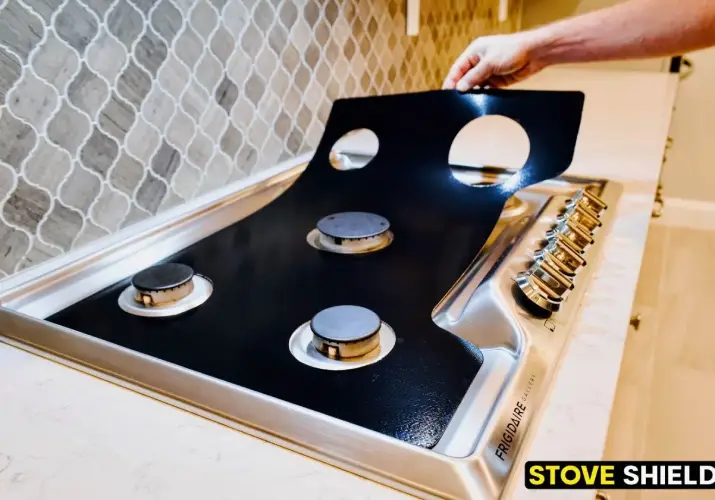
Even after deep cleaning and reseasoning cast iron grates, grease splatter and boil-overs can still lead to repeat buildup over time. Over time, these spills can bake onto the cooktop surface and make routine cleaning more time-consuming.
Some homeowners also use a heat-resistant cooktop liner placed under the grates to help reduce how quickly grease and boil-overs bake onto the stove surface. One example is StoveShield, which acts as a protective layer to make ongoing cleaning easier and help maintain a cleaner cooktop between deep cleans.
By limiting direct contact between spills and the cooktop, it can help:
- Reduce stubborn grease accumulation under and around grates
- Make daily wipe-downs faster and easier
- May help reduce how quickly residue builds up on and around grates
- Reduce how often deep cleaning is needed
What NOT to Do: Dishwasher, Self-Clean Cycle, and Other Damage Risks
Some approaches show up in viral videos and bad advice columns. Skip all of these:
- The dishwasher. High heat plus caustic detergent plus extended water exposure means stripped seasoning, surface rust, voided warranty. Most leading cast iron cookware manufacturers state that dishwasher use voids the warranty.
- The self-cleaning oven cycle reaches 800–900°F. At these temperatures, cast iron grates can warp, crack, or develop irreversible rust. Appliance manufacturers explicitly recommend removing grates before running the self-clean cycle.
- Torch / fire burnoff. Same outcome as the self-clean cycle: structural damage.
- Steel wool on bare cast iron. Strips seasoning down to raw metal in seconds. Save it for restoration projects, not routine cleaning.
- Wire brushes. Broken bristles can lodge in the grate and end up in food. Use nylon brushes or wooden scrapers.
- Cold water on a hot grate. Thermal shock can crack cast iron. Always wait until grates are cool before wet cleaning.
- Mixing cleaners. Vinegar plus baking soda neutralize each other. Bleach plus ammonia produces toxic chloramine gas. Never combine.
If your grate is far enough gone that you’ve considered any of the above, jump to the ammonia bag method (Method 4). Hands-off, overnight, no damage.
How Often Should You Clean and Reseason Cast Iron Grates?
A simple cadence keeps grates in shape without overthinking it:
- Daily: Wipe down with a damp cloth after grates are cool. 30 seconds.
- Weekly: Hot soapy water soak (Method 1). 15 minutes.
- Monthly: Baking soda paste (Method 2). 30 minutes. Run sooner after major spills.
- Every 3-6 months: Inspect for buildup. If grates feel sticky or look caked, run an ammonia bag (Method 4) overnight.
- Reseason: After every deep clean on bare iron, OR every 6-12 months. Enameled grates never need seasoning.
Honestly, my own rhythm drifts. I cook on a gas stove most nights and the daily wipe-down is the part that actually saves me. When I skip it for a week, the weekly soap-soak suddenly takes 25 minutes and a real scrub instead of 15 and a rinse. The cadence above is the version I land back at after every “I’ll clean them later” stretch. Heavy cooks (daily searing, frequent boil-overs) lean to the more-frequent end. Light cooks can stretch the cadence longer.
Frequently Asked Questions
How do you clean the cast iron grates on a gas stove?
Wait for grates to cool, then soak 10-20 minutes in hot soapy water for routine cleaning. For weekly maintenance, use a baking soda paste (let sit 30 minutes, scrub with a nylon brush). For caked-on buildup, run an ammonia bag overnight. Always dry immediately and re-oil bare iron to prevent rust.
How do you make cast iron stove grates look new?
For grates that look hopeless, use the ammonia bag method overnight (1/4 cup household ammonia in a sealed gallon Ziploc, 12-24 hours, well-ventilated). Then scrub off the loosened residue, dry completely, and reseason at 375°F for 45-60 minutes with a thin coat of flaxseed or grapeseed oil. Most grates come back to near-new condition in one cycle.
What is the best cleaner for cast iron grates?
For routine cleaning, dish soap and hot water. For medium buildup, a baking soda paste. For heavy carbonized buildup, household ammonia in a sealed bag (passive overnight). For enameled grates only with severe buildup, a commercial oven cleaner can work as a last resort. Match the cleaner to the coating type. Never use lye-based cleaners on bare cast iron.
How do you get baked-on grease off cast iron stove grates?
Use an alkaline cleaner: baking soda paste for medium buildup or an ammonia bag for heavy buildup. Alkaline saponification (pH ~9 baking soda, ammonia) breaks down fats; acidic cleaners like vinegar are nearly useless on grease. Skip the vinegar unless rust is also a problem, and never combine alkaline and acidic cleaners. They neutralize each other.
Can you put cast iron grates in the dishwasher?
No. Dishwashers strip the seasoning from bare cast iron, promote rust, and may void the warranty depending on manufacturer guidelines on most cast iron cookware. Even enameled grates can dull and chip over repeated dishwasher cycles. Hand-wash only: soak in hot soapy water, scrub with a nylon brush, dry immediately.
What is the best oil to season cast iron grates with?
Flaxseed oil produces the hardest, most durable patina because it polymerizes more completely than other oils. Grapeseed and canola oils are common second-choice options with high smoke points and easy availability. Avoid butter, olive oil, and unrefined oils. They go rancid and turn sticky on the grate surface.
Sources
- BHG: How to Clean Cast Iron Stove Grates soak time limits and reseasoning temperature ranges
- The Kitchn: 4-Method Stove Grate Test head-to-head test results for enameled grates
- Whirlpool: How to Clean Stove Burners and Grates manufacturer soak protocol
- KitchenAid: Burner Grate Cleaning manufacturer self-cleaning cycle warning
- The Spruce: How to Clean Stove Grates coated vs uncoated distinctions and rust paste recipe
- wikiHow: Clean Cast Iron Stove Grates ammonia bag method protocol
- r/CleaningTips community discussion community-sourced tool warnings (wire bristles, vinegar trade-offs)