

Fisher & Paykel gas stove care comes down to a daily wipe of the brushed-stainless deck with the mildest cleaner that works, a weekly wash of the cast-iron pan supports and burner caps in hot soapy water, and a monthly clearing of the flame ports. Always cool the cooktop and dry every part fully before refitting.
A Fisher & Paykel gas range is built around a brushed-stainless deck, flat cast-iron pan supports, and sealed burners, including a wok burner with its own cast-iron cap and ring. Those stainless surfaces and heavy supports require more careful cleaning than a painted range, and Fisher & Paykel’s manuals are specific about them. This guide covers the daily wipe, the weekly deep clean, monthly maintenance, the features that set a Fisher & Paykel apart, and a troubleshooting table. It applies to current Fisher & Paykel gas ranges and gas cooktops sold in the US, including both Minimal and Professional styles. Every brand-specific step traces to Fisher & Paykel’s user guides and support pages.
Key Takeaways
- Clean the brushed stainless-steel surface daily with warm, soapy water and a soft microfiber cloth, always wiping with the grain to prevent scratches and water marks.
- Wash cast-iron pan supports, burner caps, rings, and flame spreaders weekly, and dry every component completely before reinstalling to avoid rust and ignition problems.
- Keep burner flame ports clear using a stiff nylon brush or straight-ended paperclip to maintain even blue flames and reliable ignition.
- Clean the ignitor and flame-failure probe (where fitted) monthly with a toothbrush and methylated spirits if ignition becomes weak or inconsistent.
- The wok burner must be reassembled in its correct orientation if the cap or ring is misaligned, the burner may not light properly or produce an uneven flame.
- Avoid abrasive pads, chlorine-based cleaners, and steam cleaners, as they can damage the brushed stainless finish and burner components.
- If your model allows dishwasher cleaning for cast-iron grates, follow your specific owner’s manual; many older models recommend hand washing instead.
- Inspect the flame regularly. A steady blue flame indicates normal operation, while persistent yellow or sooty flames require cleaning or professional service.
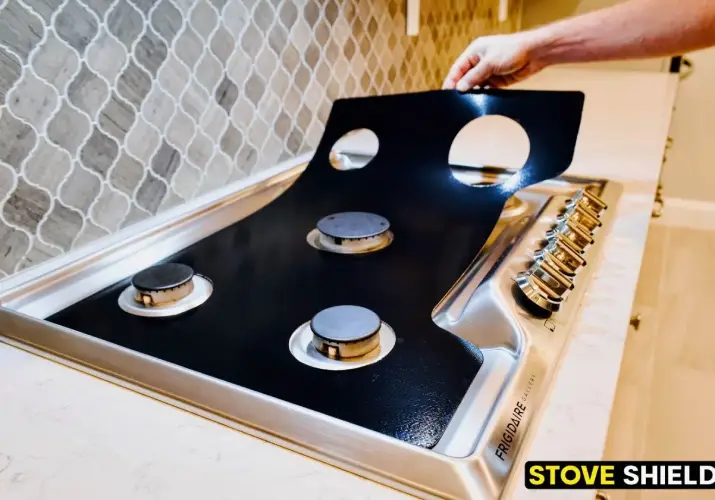
- Protect the brushed stainless surface between cleanings with a custom-fit stove protector placed only on the flat areas around the burners—never over burners or flame ports.
- Schedule a professional inspection of the gas system every 3–4 years, as recommended by Fisher & Paykel, to ensure safe and reliable performance.
How is a Fisher & Paykel gas range built?
Four build details decide how you clean one.
- A brushed-stainless deck with polished trim. It looks sharp, but it shows fingerprints and water marks, and it scratches if you scrub across the grain or reach for an abrasive pad.
- A flat cast-iron pan supports rubber feet. The trivets sit flat so you can slide a heavy pot between burners, and rubber feet keep them from scratching the deck. Bare cast iron rusts if it sits wet.
- Sealed burners, including a wok burner. Each burner has a removable cap, ring, and flame spreader over a spark ignitor. The wok burner’s cast-iron cap and ring have their own seating direction.
- Electronic ignition with a flame-failure safety device. Turn the dial and an electrode sparks the burner; on flame-failure models a probe shuts the gas off if the flame dies. Both the ignitor and that probe must stay clean and dry to work.
Before your first deep clean, check your manual to confirm your burner layout and whether your model has a self-cleaning oven.
How do you clean a Fisher & Paykel gas stove every day?
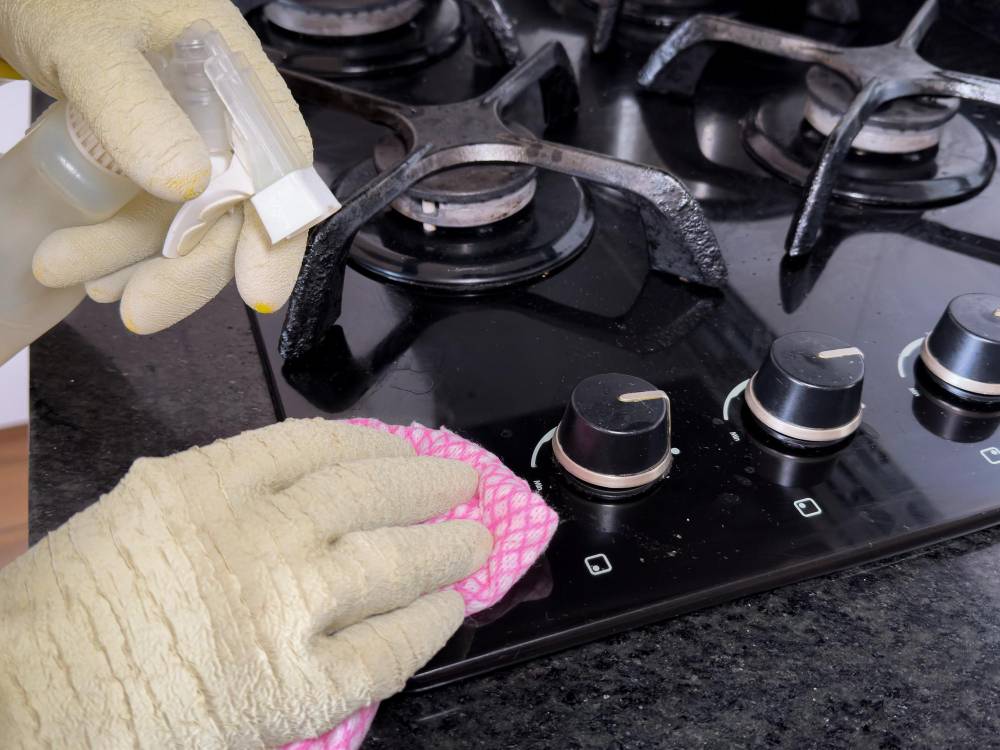
Daily Fisher & Paykel gas range cleaning is a two-minute job if you stay ahead of spills. First, turn every burner off, switch the cooktop power off, and let the surface cool. Fisher & Paykel warns that cleaning a hot cooktop can cause serious injury, and the cast-iron supports hold heat long after the flame is out.
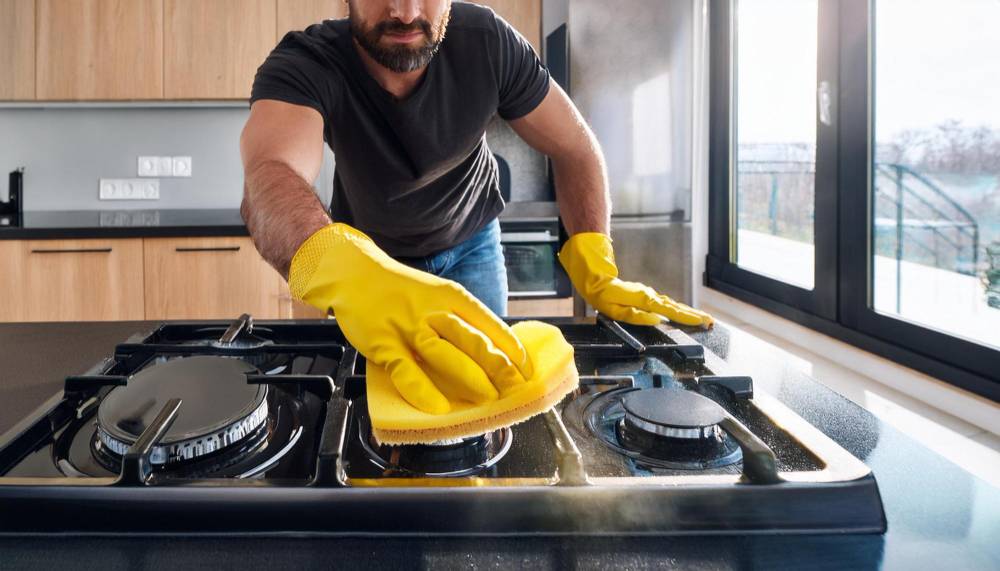
- Lift the pan supports off and wipe the brushed-stainless deck with warm water, a little dish soap, and a soft sponge or microfiber cloth, always moving with the grain of the steel, never across it.
- Rinse with a clean damp cloth so no residue is left behind; Fisher & Paykel notes residue can stain the stainless once it heats up. Then dry to stop water marks.
- Catch spills while they’re fresh. Burnt-on food can clog the flame ports and becomes much harder to remove later.
That quick wipe after dinner is what keeps the weekly clean short and the stainless looking new.
How do you deep clean a Fisher & Paykel gas range each week?
Once a week, take the cooktop apart. With the burners cool and the power off, lift off the pan supports, then the burner caps, rings, and flame spreaders.
Pan supports. Wash the cast-iron supports in hot soapy water, soak stubborn stains, then dry them thoroughly. Fisher & Paykel guidance varies by model. Some manuals allow dishwasher cleaning for the grates, while older manuals recommend washing burner parts by hand. Always follow your model’s user manual, and dry bare cast iron thoroughly either way to prevent rust. Our how to clean cast iron stove grates walkthrough covers the drying and light oil coat that helps prevent rust.
Burner caps, rings, and flame spreaders. Soak them in hot soapy water, then clear each flame port with a stiff nylon brush or a straight-ended paperclip. Fisher & Paykel is firm on two points: keep every port clear, because soiling causes ignition problems and uneven flames, and dry each part completely before it goes back, because a wet part burns with an irregular flame.
Reseat everything correctly. Set each flame spreader and cap back in place, and seat the wok burner’s cast-iron cap and ring the way the manual’s arrow shows, so the burner can’t rotate. Incorrect assembly is the top reason a freshly cleaned burner won’t light, and it can cause dangerous irregular flames.
The brushed stainless Wash the deck with mild detergent and hot water, rinse, and dry with a microfiber cloth, working with the grain. A non-abrasive stainless polish helps reduce fingerprints, but check the label because chlorine compounds in some cleaners can corrode stainless steel.
What monthly maintenance does a Fisher & Paykel gas stove need?
Monthly maintenance is a short inspection on top of the weekly clean.
- Pull and clean the burner parts. Once a month, remove all the caps, rings, and spreaders, wash them with a non-abrasive detergent, rinse, dry, and refit them. Even when the parts look clean, this process clears flame ports you can’t easily..
- Clean the ignitor. If a burner sparks weakly or not at all, the ignitor is usually dirty or damp. Fisher & Paykel’s instruction is specific: clean the ignitor and, on models equipped with one, the flame-failure probe carefully with a toothbrush and methylated spirits.
- Watch the flame and the gas line. A healthy flame burns steady blue with no yellow tipping and doesn’t flutter around the cap. Check the supply line behind the range for kinks, and treat any lingering gas smell as a reason to stop and call a professional.
Fisher & Paykel also recommends an authorised gas service agent thoroughly check all the gas components every three to four years. A full routine for any gas range lives in our gas stove maintenance checklist.
What’s different about caring for a Fisher & Paykel?
This is where a Fisher & Paykel parts ways with a standard painted range.
- Brushed stainless has its own rulebook. Clean with the grain, never with an abrasive pad or a chlorine-based cleaner, and rinse off every trace of cleaner so it doesn’t bake into a stain.
- The wok burner has a unique seating design. Its cast-iron cap and ring have a set orientation, and the burner shouldn’t be able to spin once seated a step the other burners don’t require.
- No steam cleaners, no self-clean shortcuts for parts. Fisher & Paykel says not to use a steam cleaner on the cooktop and not to clean cooktop parts in a self-cleaning oven. If your range has a self-clean oven cycle the OR30 and OR36 ranges offer both Standard and Light cleaning cycles that feature is for the oven cavity only, not the burner hardware.
What are common Fisher & Paykel gas stove problems?
Most Fisher & Paykel cooktop issues trace back to a wet or misseated burner part, a clogged port, or a dirty ignitor not a broken stove.
| Symptom | Likely cause | What to do |
|---|---|---|
| Burner won’t light after cleaning | Wet or misseated cap/spreader, clogged ports, damp ignitor | Dry every part fully, reseat the spreader and cap flat, clear the ports, confirm a clean spark. |
| Burner keeps clicking | Moisture in the ignition, misseated cap | Dry the cap and ignitor, reseat squarely, and let parts air-dry fully after washing. |
| Weak or no spark | Dirty or damp ignitor / probe | Clean the ignitor and flame-failure probe with a toothbrush and methylated spirits, then let them dry. |
| Yellow or fluttering flame | Clogged ports or a part out of place | Clear the ports and check the cap and spreader sit flat; if it stays yellow and sooty, see the safety note. |
Safety note A persistent yellow, sooty flame that cleaning doesn’t fix can mean incomplete combustion, which carries a carbon-monoxide risk. If you ever smell gas, don’t light any burner, don’t touch an electrical switch, leave the building, and call your gas utility or a qualified technician.
How do you protect a Fisher & Paykel stovetop between cleanings?
The fastest way to clean a Fisher & Paykel less often is to keep spills off the brushed stainless in the first place. A custom-fit stove protector, a thin, heat-resistant liner cut to your cooktop sits in the flat stainless areas around the burners and takes the splatter, so you wipe a liner instead of buffing the steel back to shine. Fit matters: a model-matched cut that follows the burner openings and pan-support positions sits flush, rather than bridging the deck the way a generic liner can.
One hard safety rule: nothing goes over the burners or ports. A liner placed over a burner may overheat and create a fire or carbon monoxide hazard. A proper protector clears the burners, never touches an open flame, and is not a substitute for the daily wipe.
To add one, explore Fisher & Paykel stove protectors, compare materials in our best gas stove protectors roundup, and read the stove protector safety guide first so you place it correctly.
How do you find your Fisher & Paykel model number?
You need the model number to order the right pan support, burner cap, ignitor, or a correctly cut protector. On a Fisher & Paykel gas range the rating label sits in one of two spots: inside the oven door frame, on the front edge, or behind the kickplate along the bottom of the range. If you can’t find it, locate your Fisher & Paykel model number using our complete guide, and Fisher & Paykel support can identify your model from the serial number.
Frequently asked questions
How do you clean a Fisher & Paykel gas stove top?
Cool the cooktop, switch the power off, and wipe the brushed stainless with mild detergent and a soft cloth, moving with the grain. Rinse off residue, dry to avoid water marks, and wash the burner caps in hot soapy water drying them fully before refitting.
Are Fisher & Paykel cast iron grates dishwashers safe?
It depends on your model. Some Fisher & Paykel guides list the grates as dishwasher safe, while older freestanding-cooker manuals say not to dishwasher burner parts. Check your model’s manual, and dry bare cast iron thoroughly either way to prevent rust.
How do you clean Fisher & Paykel burner caps and flame spreaders?
Soak them in hot soapy water, then clear each flame port with a stiff nylon brush or a straight-ended paperclip. Dry every part completely before refitting wet burner parts to cause an irregular flame.
Why won’t my Fisher & Paykel burner light after cleaning?
Almost always a wet or misseated part. Make sure the flame spreader and cap are bone-dry and seated flat, the ports are clear, and the ignitor is clean. The wok burner must be seated so it can’t rotate.
How do you clean brushed stainless steel on a Fisher & Paykel range?
Use the mildest cleaner that works, always rubbing with the grain, then rinse off residue and dry. A non-abrasive stainless polish reduces fingerprints, but avoids chlorine-based cleaners that corrode stainless.
Is a stove protector safe on a Fisher & Paykel gas range?
Yes, on the flat stainless deck only. A custom-cut protector sits in the areas around the burners, never over them, because nothing should cover a burner or its ports.
Sources
- Fisher & Paykel gas cooktop user guides (CG905DW; CG603/CG903 599276c; CG604DX/CG905DX 590446D) cool-and-power-off before cleaning, brushed-stainless “with the grain,” burner-port clearing, dry-before-refit, no steam cleaner.
- Fisher & Paykel freestanding range and cooker guides (OR30/OR36 591500D; 590575A; 599376b) daily/monthly/3–4-year cadence, ignitor cleaning with toothbrush and methylated spirits, two self-clean cycles, smell-gas safety steps.
- Fisher & Paykel support, “Care and Cleaning – Built-In Ovens and Ranges” (oven cavity, glass, dials, dishwasher-safe oven parts, no abrasives or chlorine).
- Fisher & Paykel USA “All Ranges” and a retailer spec sheet for a 90 cm 5-burner gas hob (Series lines, cast-iron pan supports with rubber feet, wok burner, flame-failure device).