Wipe spills after every cook, do a full gas stove wipe-down weekly, run a monthly deep clean of grates and burner caps, inspect burner ports and the range-hood filter quarterly, and book a professional gas-line service once a year. Some U.S. fire districts recommend a thorough stove cleaning every 4–6 weeks as part of kitchen-fire prevention.
If you’ve searched how often to clean gas stove and walked away more confused, you’re not alone. This complete stove care guide explains how often each task should be done. Published cleaning recommendations vary widely between manufacturers, home-care publications, and fire-safety guidance. Whirlpool says “after every single use.” Liberty Home Guard says “four times a year.” This guide reconciles that into a realistic gas stove cleaning schedule, anchored to U.S. fire-authority data and what real home cooks report.
For a household that cooks four to six dinners a week, here’s a realistic stove cleaning schedule:
| Cadence | Tasks |
|---|---|
| After every use | Wipe spills while the surface is warm; dry burner caps if anything boiled over. |
| Weekly | Pull knobs and wipe under them; clean the grease ring around each burner; wipe the control panel. |
| Monthly | Soak grates and burner caps in warm water with dish soap and baking soda; unclog burner ports; clean drip pans; degrease the cooktop. |
| Quarterly | Inspect burner ports for clogs; do a yellow-flame check; wash or replace the range-hood filter. |
| Twice a year | Pull the stove out and clean behind and underneath. |
| Annually | Book a professional inspection of gas connections and ignition. |
Across the eight competing gas stove cleaning articles we audited in May 2026, recommended cadences for a “full” clean range from after every use (Whirlpool), to weekly or biweekly (All recipe Across published appliance-care and home-maintenance guidance, recommended cleaning cadences vary widely for a “full” gas stove clean from after every use to quarterly or even a few times per year. These differences exist because each source is addressing different tasks rather than a single unified schedule. The tiered schedule above consolidates those approaches into a practical, layered routine), monthly (Spoon University, House Digest), quarterly with annual pro service (Liberty Home Guard), and “twice a year for behind the stove” (Consumer Reports, April 2025). Each recommendation is valid in its own context. They answer different questions about different tasks. The tiered schedule above just makes the layering explicit.
Two U.S. fire districts, “Santa Rita Fire District” and “Drexel Heights Fire District“, both recommend a thorough gas stove clean every 4–6 weeks as a fire-prevention measure. That advice slots neatly between the weekly surface routine and the monthly deep clean stove session described below.
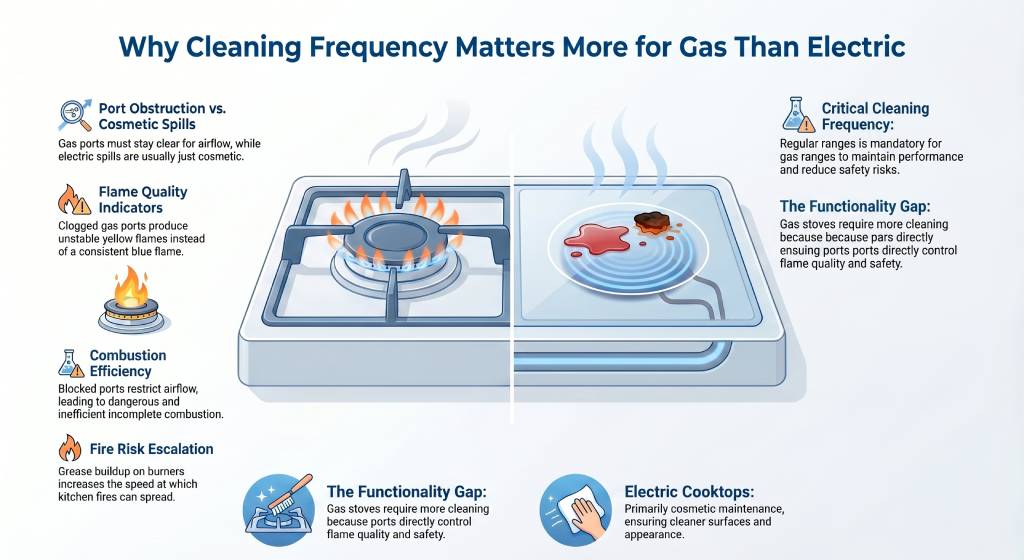
Two reasons: burner ports and combustion.
On an electric coil or glass-top, a missed spill is mostly cosmetic. A gas range is different. The small holes around each burner cap, the burner ports, feed the flame. When food residue or grease covers them, the flame can’t pull enough air. You get a yellow or flickering flame instead of a steady blue cone. Yellow means incomplete combustion: more carbon monoxide and more soot on the underside of cookware.
The “U.S. Consumer Product Safety Commission’s 2024 Avoid Kitchen Fires bulletin” is direct: cooking is the most frequent cause of house fires in the U.S., and households are instructed to “keep your oven and stovetop clean of grease and dust.” Appliance maintenance technician Edmund Augustin told “The Kitchn” in August 2023 that “accumulated grease on stovetops, range hoods, and cooking surfaces can ignite and make a fire spread faster.”
In poorly ventilated conditions, incomplete combustion can contribute to carbon monoxide buildup, which may cause dizziness. Severely clogged burners may contribute to incomplete combustion, which can increase carbon monoxide exposure risk in poorly ventilated kitchens. It’s also why the 4–6 week cadence from the fire districts lands where it does. That’s roughly when grease and burner-port debris may begin affecting flame quality in many households.
What Should You Do After Every Cook?
Daily stove care is the cheapest insurance policy in your whole gas stove cleaning schedule. Two minutes. And it’s the biggest reason monthly deep cleans stay easy or become miserable.
Once the burners cool to warm (not hot, not cold), wipe the cooktop with a damp microfiber cloth. If anything boiled over onto a burner cap, lift the cap, wipe underneath, dry it, and seat it back. Run a dry cloth over the knobs. That’s it.
Marla Mock, president of Molly Maid, put it bluntly in “Martha Stewart” in March 2025: “Fresh grease is much easier to clean compared to grease and stains that have been sitting for a long period of time.” Sugar and tomato splatters are the worst offenders. Sugar bonds to enamel as it cools. Tomato acid etches overnight.
Home cooks on Reddit describe a similar pattern: a quick wipe every night, then a weekend deep clean of anything missed. In a 210+ comment Facebook Homemaking Tips thread, the modal answer was “wipe after every use; monthly deeper clean.” Bakers on Baking-Forums report an end-of-day nightly wipe to keep residue from hardening. Across community discussions, a similar pattern appears: a quick wipe after cooking and a deeper clean later.
Skip ammonia, oven cleaner, and Clorox wipes here. They’re overkill for fresh spills, and bleach can dull burner-cap finishes over time. Plain dish soap on a damp cloth is enough for daily stove care.
Weekly is where the work shows up. Pick a day (Sunday afternoon and Friday night are the two patterns we see in community threads) and budget 15 minutes. Four pieces:
If you fry, sear, or wok-cook regularly, push to every five or six days.
This is the monthly deep clean stove session the rest of your schedule props up. Plan for 45 minutes to an hour. For a step-by-step walkthrough of deep cleaning a gas stove, follow our detailed guide. Doing it on the same calendar day each month (first Sunday, last day of the month, whatever sticks) is the only trick that reliably works.
The five-step monthly routine:
Sears Home Services “recommends cleaning gas stove burners at least every other month” alongside annual servicing. We land on monthly because the fire-district 4-6 week guidance is more conservative, and port-clogging risk compounds.
These are the easy-to-forget jobs that quietly turn a clean gas stove into a clean kitchen.
Quarterly (every three months):
Twice a year:
Annually:
Many published cleaning guides overlook quarterly and annual maintenance tasks. Hood-filter cleaning, behind-the-stove cleaning, and annual professional inspections are included inconsistently, even though they are important for long-term safety and performance.
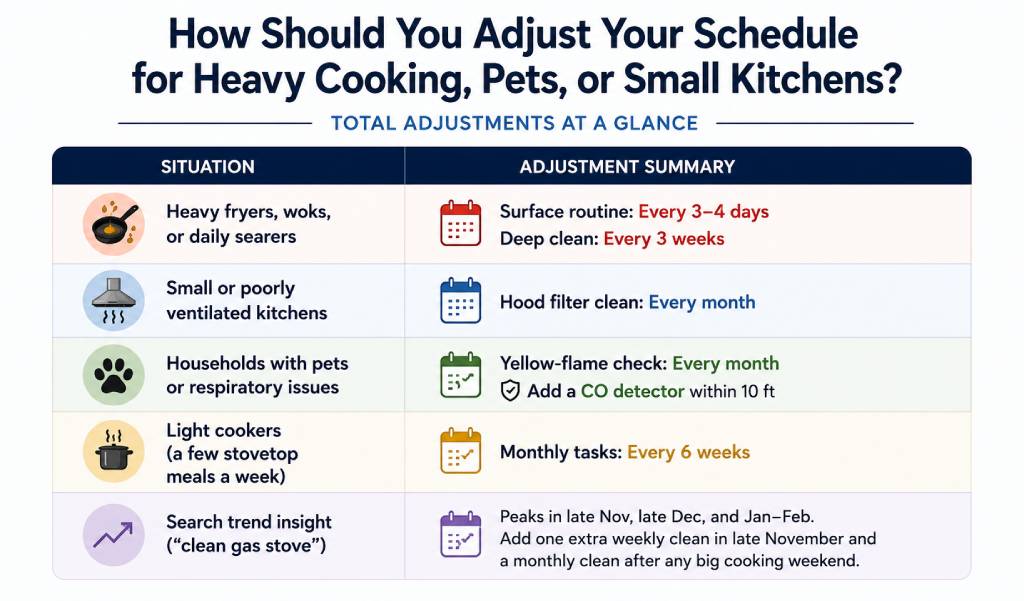
Honest limitation: every cadence here assumes a household cooking four to six home-cooked dinners a week with mixed-method cooking. Real kitchens aren’t that tidy. Common adjustments:
How often should I clean my gas stovetop?
Wipe it after every use, do a full surface wipe-down weekly, and run a deep clean of grates and burner caps once a month. That’s the cadence two U.S. fire districts and most appliance manufacturers converge on, even though they describe it differently.
Does a gas stove need to be cleaned more often than an electric one?
Yes. Gas stoves have burner ports that feed the flame, and food debris or grease in those ports causes incomplete combustion: a yellow flame instead of a clean blue one. Electric cooktops have no equivalent failure mode, so missed spills on electric are mostly cosmetic.
Can I use Dawn dish soap to clean my gas stove top?
Yes. Dawn or any standard dish soap on a damp microfiber cloth is the right tool for daily and weekly cleaning. For monthly grate soaks, combine dish soap with baking soda and warm water. Skip ammonia, oven cleaner, or bleach for routine cleaning.
Can I use Clorox wipes on my gas stove top?
You can, but it’s not the best choice. Bleach-based wipes can streak or dull burner caps and gradually damage some control-panel finishes. A damp microfiber cloth with a drop of dish soap handles the same job without the side effects.
How often should a gas stove be serviced professionally?
Once a year. A qualified technician should inspect gas connections, igniters, regulator pressure, and oven calibration annually. Most home-warranty providers and appliance manufacturers agree.
What is the 20/10 rule for cleaning?
The 20/10 rule is a general cleaning method (20 minutes of work, 10 minutes of rest) popularized for whole-home cleanup, not a stove-specific cadence. For a gas stove, the more useful rule is “two minutes after every cook.” Short, frequent, and tied to the moment grease is easiest to remove.
To care for a ZLINE gas range, wipe the porcelain enamel cooktop and sealed burners…
RV gas stove care means a quick wipe after every meal, a deep clean where…
Miele gas stove care means wiping the porcelain or stainless deck after every meal with…
Fisher & Paykel gas stove care comes down to a daily wipe of the brushed-stainless…
To care for a Tappan gas stove, wipe the cooktop and grates after each use…
Crosley gas stove care comes down to a daily wipe-down once the cooktop is cool,…