To replace a gas stove igniter, shut off the gas supply valve and unplug the range, lift the burner cap and grate to expose the ceramic spark electrode (cooktop) or remove the oven floor to reach the glow-bar igniter (oven), unclip the wire harness, swap in the OEM-matched part, then run a soap-water leak test before relighting.
That’s the short version. The long version is what keeps you from a delayed-ignition pop, a small gas leak, or a $300 service call you didn’t need. This guide walks through a gas stove igniter replacement for both cooktop spark electrodes and oven glow-bar igniters, with the safety steps the popular video tutorials skim past.
For most US homeowners, yes. A cooktop spark electrode swap is a 20-minute job, and an oven glow-bar igniter is usually under an hour once the oven is cool. The part runs $9 to $60 at Home Depot or RepairClinic, and which avoids the typical $150 to $300 service call. DIY replacement can significantly reduce labor costs compared to a full service visit.
You should not DIY this if any of these apply. You smell gas right now. Your supply line is corrugated stainless steel (CSST) and needs disconnection. You converted the range to propane and the orifices were swapped. The wiring connector you uncover looks burnt.
The job sits in the same DIY tier as replacing a dishwasher drain hose or a dryer heating element. Solidly intermediate. If you’ve ever tested an outlet with a multimeter, you have the skill set.
Before you remove a single screw, write down your model and serial number from the metal data plate (usually under the cooktop or behind the storage drawer) and check it against the active CPSC recall list. In March 2026, Electrolux Group recalled roughly 175,000 Frigidaire gas ranges over a burn hazard linked to the front-control knobs. “CPSC Frigidaire gas range recall (March 2026)” notice for the affected model list and the free remedy.
If your unit is on that list, do not disassemble it. The manufacturer remedy may include a free repair or refund, and self-repair can void the recall fix.
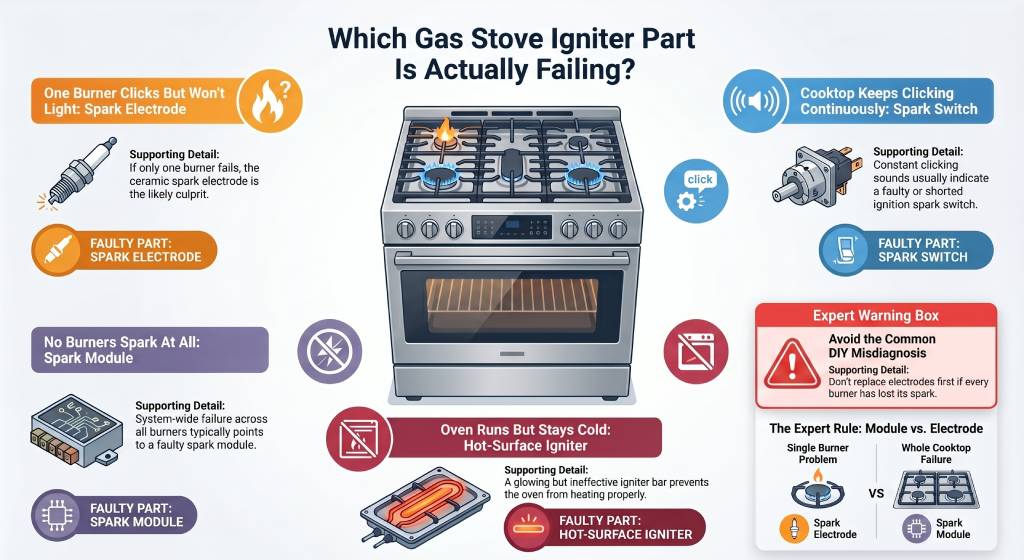
In many DIY repair cases, spark electrodes are replaced unnecessarily when the actual problem is a failing spark module, leading to wasted time and incorrect fixes.
Cooktop sparking on one burner points to an electrode issue. Sparking on every burner with no ignition usually indicates a failing module. Continuous clicking suggests a faulty switch. If the burner still won’t ignite after these checks, follow our gas stove won’t light troubleshooting guide before replacing parts.
The two-minute visual and audible test handles most cooktop diagnoses. Turn the burner knob to “light.” If you hear clicking but see no spark, the electrode is cracked or wet. If only one burner clicks while you turn another’s knob, the spark switch is shorted. If you hear nothing on any burner, the spark module is dead.
For the oven glow-bar igniter, iFixit’s GE bake-igniter guide documents the verifiable spec. A healthy igniter pulls 2.8 to 3.0 amps on the bake circuit. Below 2.5 amps, it has lost enough resistance to glow but not enough to open the safety gas valve, and it needs replacement.
To run that test, clamp a Fluke 323 (or any clamp meter that reads AC amps) around the white bake-circuit wire under the oven floor, set the oven to bake at 350°F, and read the meter once the igniter glows. Don’t remove the wire. The clamp meter reads the field around it.
If the reading is healthy and the oven still won’t heat, the gas safety valve or control board is the suspect, not the igniter. Buy the meter test before you buy the part.
Match the part number to your range. ANSI Z21.1, the voluntary standard for household gas ranges published by CSA and referenced by the “ANSI Z21.1 gas range parts standard”, requires that replacement parts be manufacturer-approved to keep the range compliant. Aftermarket “universal” igniters often fit but may pull the wrong amperage.
Common OEM part numbers:
| Brand | Cooktop spark electrode | Oven glow-bar igniter |
|---|---|---|
| GE | WB13K21 | WB2X9154, WB18K10098 |
| Frigidaire | 5304509706 | 316489403 |
| Whirlpool | 98005652 | 4342528 |
Cross-reference your model against the part number on RepairClinic, Home Depot, or the OEM parts portal. The part typically costs $8.85 (Seneca River Trading aftermarket electrode) to $58.96 (GE WB2X9154 from Appliance Warehouse), with a median around $26 across the five shopping listings we pulled.
This section is critical for safety. Skip a step here and you risk a delayed-ignition event the “CPSC delayed-ignition documentation” formally describes. Gas pools, then ignites all at once when the spark catches.
The new electrode tip should sit about 1/8 inch from the burner head, the same gap as the original. Too close and it will short to the burner. Too far and the spark won’t jump. If you’ve done this before, you know that gap is the part nobody tells you about.
Preventing future ignition problems
Grease buildup and liquid overflow around burner ports can interfere with ignition performance over time. Keeping up with a complete gas stove care guide helps reduce debris accumulation around burner assemblies and spark electrodes.
A note on touching the new igniter oils from your skin can shorten its life. Hold it by the bracket or wear cotton gloves. RepairClinic’s WB13K21 video walkthrough shows the correct grip.
Reconnect the gas, leave the range pulled out, and run the soap test on every joint you touched. Mix dish soap and water 50/50 in a spray bottle. Spray the appliance shutoff valve, the flexible connector at both ends, and any union you opened. Bubbles forming = leak. Shut the gas off again and call a licensed gas technician. Do not relight.
If you see no bubbles, plug the range back in and test ignition. Cooktop electrodes should spark within one second of turning the knob to “light.” An oven glow-bar should glow orange within 60 seconds, then the gas valve opens and the burner lights with a soft whoosh, not a pop. A pop means delayed ignition, the same hazard the CPSC report describes. Shut off and recheck.
Push the range back into position, settle the rear leg into the anti-tip bracket, and verify with a hand wiggle that it doesn’t tilt forward.
There are five conditions where this stops being a DIY job:
A service call often ranges between $150 and $300 depending on region, labor rates, and appliance type. Compared to the potential safety risks associated with gas appliance issues, many homeowners consider this a reasonable cost.
Can I replace a gas stove igniter myself?
Yes, for the common cases. A single cooktop spark electrode or a single oven glow-bar igniter is a job most homeowners with basic hand tools can finish in under an hour. Stop and call a pro if you smell persistent gas, the supply line is CSST, or the range was converted between natural gas and propane.
How can you tell if a gas stove igniter is bad?
On the cooktop, listen and look. Clicking with no spark on one burner = electrode. No spark on any burner = spark module. Non-stop clicking = spark switch. For the oven, clamp a multimeter on the bake-circuit wire. A healthy glow-bar igniter pulls 2.8 to 3.0 amps. Below 2.5 amps, replace it.
How much does it cost to replace a gas stove igniter?
The OEM part runs $9 to $60 at Home Depot, RepairClinic, or the manufacturer parts portal. Seneca River Trading lists an aftermarket spark electrode at $8.85, and a GE WB2X9154 oven igniter runs $58.96. A licensed appliance technician charges $150 to $300 for the same job, so DIY pays back on the first repair.
Do you need to turn off the gas to replace an igniter?
Yes. The 2024 NFPA 54 / ANSI Z223.1 National Fuel Gas Code requires an accessible appliance shutoff valve in the same room, within 6 feet, for exactly this reason. Close that valve, unplug the range, and verify a working CO alarm before you start.
What is the difference between a spark electrode and a hot surface igniter?
A spark electrode lives next to a cooktop burner and fires a high-voltage spark to ignite gas. A hot-surface igniter, also called a glow-bar, lives in the oven cavity and works by glowing orange. Its resistance drops as it heats, opening the gas safety valve. They are not interchangeable, and replacement part numbers are different even within the same range.
To care for a ZLINE gas range, wipe the porcelain enamel cooktop and sealed burners…
RV gas stove care means a quick wipe after every meal, a deep clean where…
Miele gas stove care means wiping the porcelain or stainless deck after every meal with…
Fisher & Paykel gas stove care comes down to a daily wipe of the brushed-stainless…
To care for a Tappan gas stove, wipe the cooktop and grates after each use…
Crosley gas stove care comes down to a daily wipe-down once the cooktop is cool,…