
The right cleaning method depends on grime severity, grate material, and how much time you’ve got. Use Dawn and hot water for routine cleans, baking soda paste for stuck-on food, white vinegar spray for light grease, and a commercial degreaser like Bar Keepers Friend for badly neglected stoves.
Most stove-cleaning guides pick one method and call it the answer. That misses what people actually ask. Google’s People Also Ask box shows “easiest,” “fastest,” and “without scratching” sitting side by side three different questions about the same problem.
This guide takes the 4 methods home cooks actually use Dawn and hot water, a 3:1 baking soda paste, a 50:50 white vinegar spray, and commercial degreasers like Bar Keepers Friend or Weiman and compares them on time, effort, cost, and surface risk. You’ll get a side-by-side decision matrix, steps for each method, a coated-vs-uncoated cast iron grate decision tree, and the safety watchouts (wet igniters, vinegar plus baking soda) most guides skip.
What Are the Key Takeaways?
- The best way to clean a gas stove top is method-dependent: Dawn for routine, baking soda paste for stuck-on, vinegar for light grease, commercial degreaser for neglected.
- Match the method to the grime, not the other way around. Start gentle and escalate.
- A 3:1 baking soda paste with a hot-towel cover (the ATK technique) is one of the most effective general-purpose deep-clean methods.
- Distilled white vinegar at 50:50 dilution dissolves fresh grease never mix it with baking soda.
- For severely neglected stoves, Bar Keepers Friend, Weiman, and Krud Kutter are the workhorses ventilate and glove up.
- Coated cast iron grates can be soaked. Uncoated cast iron grates can’t wipe only, then re-oil.
- Cover the igniter with foil before any wet cleaning to avoid continuous sparking.
What Is the Best Way to Clean a Gas Stove Top?
There isn’t one universal best way to clean a gas stove top. For a complete gas stove care guide, it’s important to match the cleaning method to your stove and maintenance routine. The right method hinges on three things: how bad the grime is, what your grates are made of (coated vs. uncoated cast iron), and how much time you’ve got. A weekly wipe-down with Dawn handles routine grease. A month of skipped cleans needs a baking soda paste. A truly neglected stove with carbonized food calls for a commercial degreaser.
Here’s how the four methods stack up side by side:
| Method | Time | Effort | Materials Cost | Surface Risk | Best For |
|---|---|---|---|---|---|
| Soap + Water (Dawn) | 30–45 min | Low | typically ~$5 | Lowest | Routine maintenance, weekly clean |
| Baking Soda Paste 3:1 | 45–60 min | Medium | typically ~$2 | Low | Stuck-on food, monthly deep clean |
| Vinegar 50:50 Spray | 20–30 min | Low–Med | typically ~$3 | Low | Light grease, daily wipe-down |
| Commercial Degreaser (Bar Keepers Friend / Weiman / Krud Kutter) | 15–25 min | Low | typically around $8–15 depending on retailer | Medium–High | Severely neglected, baked-on grime |
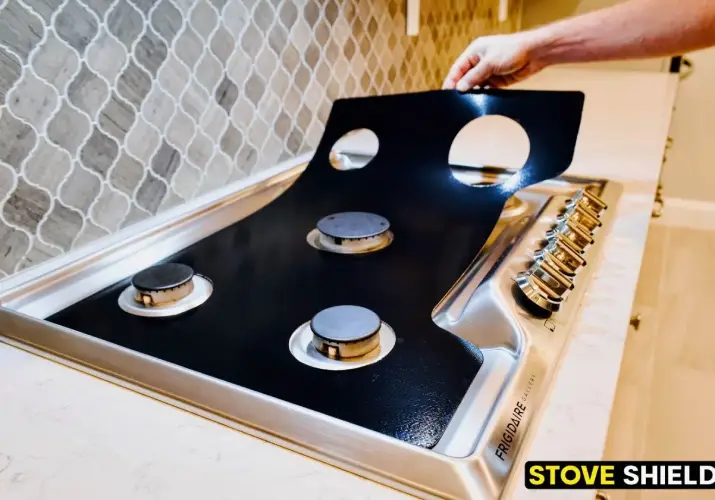
If you’re cleaning today and aren’t sure which method to use, start with the gentlest option that matches your grime level and escalate if needed. That’s the same logic guides from Whirlpool and KitchenAid follow. The easiest way to clean gas stove top surfaces between deep cleans is honestly just hot soapy water and a microfiber cloth on the same day you cook. If you use a stovetop protector, this daily wipe-down becomes even faster because most splatters land on the removable surface instead of the cooktop itself. Many households use protectors specifically to reduce how often deep-clean methods are needed. When you’ve waited too long, a commercial degreaser is often the quickest option.
How Do You Clean a Gas Stove Top with Soap and Water? (Method 1)
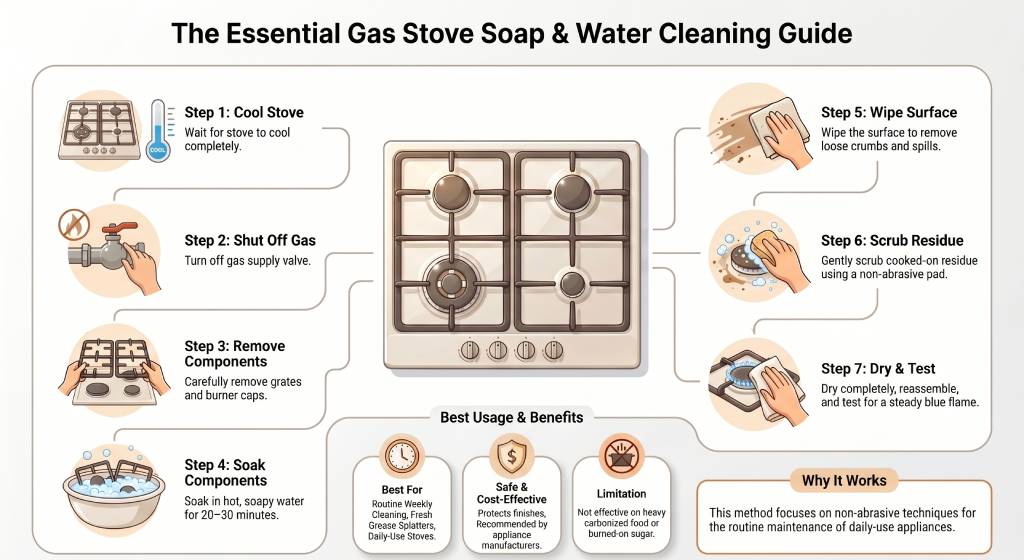
Our step-by-step gas stove cleaning guide, along with Whirlpool’s gas stove cleaning guide and KitchenAid’s 7-step burner walkthrough, all lead with hot water and dish soap (Dawn is the go-to brand) for the same reason:
What you need
- Dawn dish soap (regular or Powerwash; ~$5 for the 16 oz bottle)
- Hot water comfortably hot from the tap, not boiling
- A microfiber cloth or non-abrasive sponge
- A nylon-bristled brush or old toothbrush for burner caps
- Two bowls (one for soaking, one for rinsing)
Steps
- Cool the stove fully and shut the gas off at the control panel. If your range has a control lock, engage it.
- Lift the grates and burner caps off. Set them in the sink or a wide basin.
- Fill the basin with hot water. Add a tablespoon of Dawn. Submerge the caps and any coated grates. Don’t soak uncoated cast iron grates see the grates section below.
- Let everything soak for about 20 minutes. KitchenAid’s runs slightly longer at 30 minutes for badly soiled parts.
- While the parts soak, wipe the cooktop surface with a microfiber cloth dipped in the soapy water.
- After soaking, scrub each part with the brush. Rinse under warm running water. Dry completely with a clean towel before reinstalling wet burner caps cause yellow flames.
- Reinstall the parts in their original positions. Run the burners briefly to confirm a clean blue flame.
When to use it
Weekly maintenance, fresh splatters, and any stove that gets cooked on daily. This is also the starting point soap and water clears most build-up before you’d need paste or degreaser. Honest limitation: soap alone won’t shift carbonized food. If you’ve burned sugar onto enamel, jump to Method 2.
How Does the Baking Soda Paste Method Work? (Method 2)
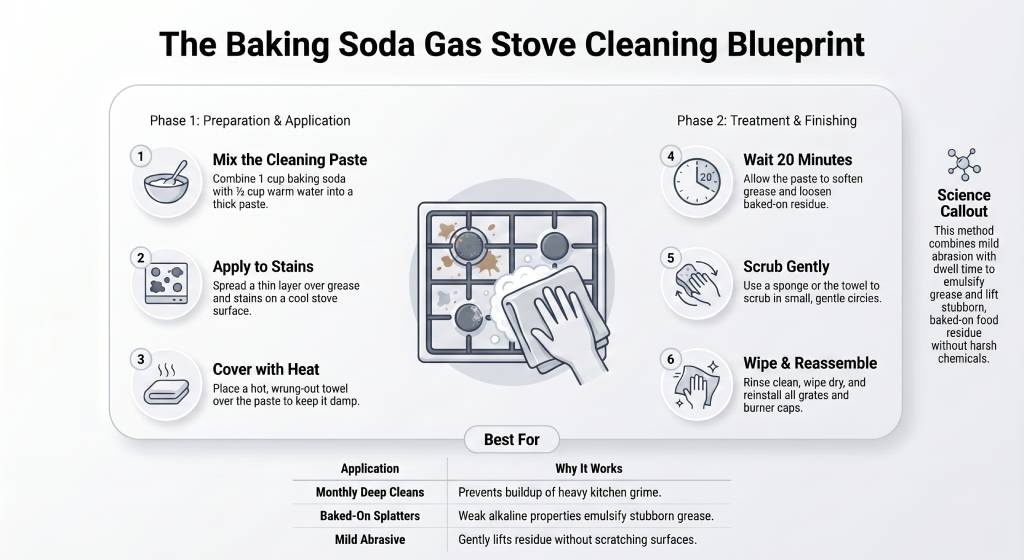
Baking soda is a mild abrasive (Mohs hardness ~2.5) and a weak base. The paste version of the method works because the abrasive lifts stuck-on residue while the alkalinity emulsifies grease. “America’s Test Kitchen’s baking-soda technique” adds a hot-towel cover step that’s smarter than the basic version: covering the paste with a wrung-out hot towel keeps it damp longer, and damp paste lifts grime that dry paste won’t. Bob Vila uses the same trick in their burner-cleaning walkthrough.
What you need
- 1 cup baking soda (~$1 for the box)
- ⅓ cup warm water (the 3:1 baking soda to water ratio is what Whirlpool recommends)
- A clean dish towel
- A non-abrasive sponge or microfiber cloth
- A spatula or plastic scraper for stubborn spots
Steps
- Mix 1 cup baking soda with ⅓ cup warm water in a small bowl. Stir to a thick paste it should hold its shape on a spoon, not run.
- With the stove fully cool, lift the grates and burner caps off and set them aside.
- Spread the paste on the cooktop surface in a thin, even layer. Cover the stained spots completely.
- Soak a dish towel in hot water, wring it out, and lay it flat over the paste. That’s the ATK hot-towel cover step.
- Wait about 20 minutes. The towel keeps the paste damp; the damp paste keeps working.
- Lift the towel. Use it to scrub the cooktop in small circles the towel itself is the scrubbing surface.
- Wipe clean with a fresh microfiber cloth dipped in plain water. Repeat once on any spot that’s still stained.
- Reinstall the grates and burner caps.
When to use it
Monthly deep cleans, baked-on splatters, and “I let this slide for three weeks” grime. The paste also works well on coated cast iron grates apply, wait 20 minutes, scrub with a soft brush, rinse, dry. For deep situations where paste won’t shift the carbon, escalate to Method 4. Honest limitation: this method is slow. If you need the stove clean in 15 minutes, pick another. After a deep clean like this, many households add a stovetop protector to help keep the surface cleaner longer and reduce how often heavy scrubbing is needed
Can White Vinegar Clean a Gas Stove Top? (Method 3)
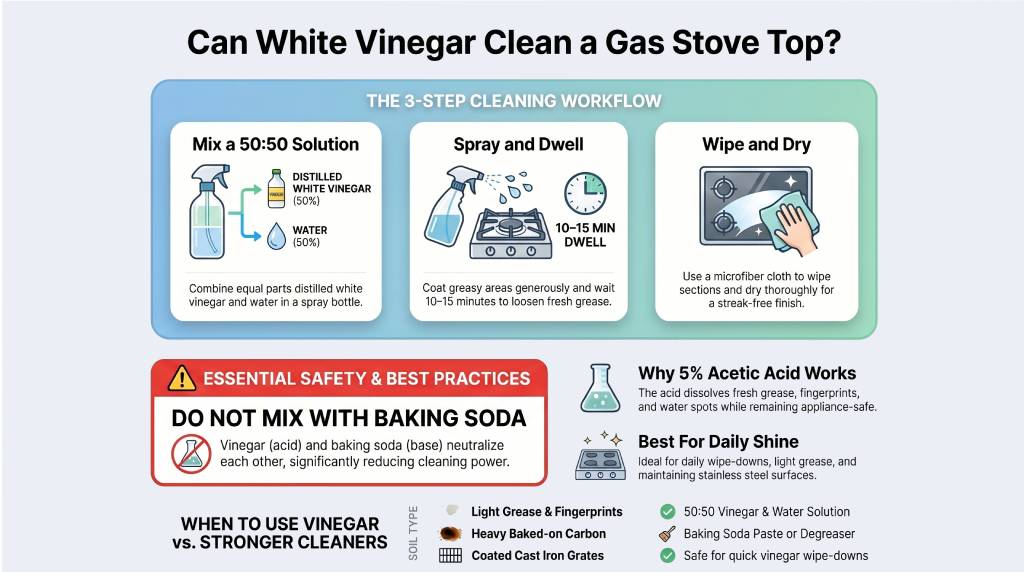
Yes distilled white vinegar (5% acetic acid) cuts through fresh grease the way any mild acid would. The standard application is a 50:50 vinegar-to-water mix in a spray bottle, sprayed on, left to dwell 10–15 minutes, then wiped with a microfiber cloth. It’s the cheapest method on the list, one of the milder cleaning options, and among the lowest-risk for finished surfaces. The trade-off? Vinegar struggles with anything carbonized for that, you want the paste or a commercial degreaser.
Critical safety note: never mix white vinegar with baking soda. Acid plus base neutralize each other. The fizz looks impressive, but what’s left is mostly water and sodium acetate neither of which cleans. Dr. Pamela Turner at “the University of Georgia Extension” has documented the chemistry, and Real Simple, The Spruce, Tom’s Guide, and Chowhound have all reproduced the same finding. Use vinegar OR baking soda. Never both at once.
What you need
- Distilled white vinegar (~$3 for a 32 oz bottle)
- Water
- A clean spray bottle
- A microfiber cloth
- A nylon scrubber for stubborn spots
Steps
- Mix equal parts distilled white vinegar and water in the spray bottle. Shake.
- With the stove cool and grates removed, spray the cooktop generously. Cover all greasy areas.
- Wait about 10–15 minutes. The vinegar smell fades within 10 minutes of wiping.
- Wipe with a microfiber cloth, working in sections. Re-spray any stubborn spot and wait another 5 minutes.
- Rinse the cloth often once it’s saturated with grease, it stops cleaning and starts smearing.
- Dry the surface with a clean towel.
When to use it
Daily wipe-downs, light grease, and any clean where you don’t want chemical residue especially for households that prefer low-residue cleaning methods. Vinegar also handles fingerprints and water spots on stainless steel surrounds, which is why it shows up in the roundups for households that prefer non-toxic options. Honest limitation: on heavily baked-on grease, vinegar dwell time alone won’t break the bond. You’ll wear out your wrist scrubbing what a paste or degreaser would dissolve in five minutes.
A community signal worth flagging the breakout query “cleaning cast iron stove grates with vinegar” is gaining popularity. The honest answer? Diluted vinegar is fine on coated cast iron grates as a wipe-down, but uncoated cast iron should never get acidic spray acid strips seasoning. See the grates section.
When Should You Use a Commercial Degreaser? (Method 4)
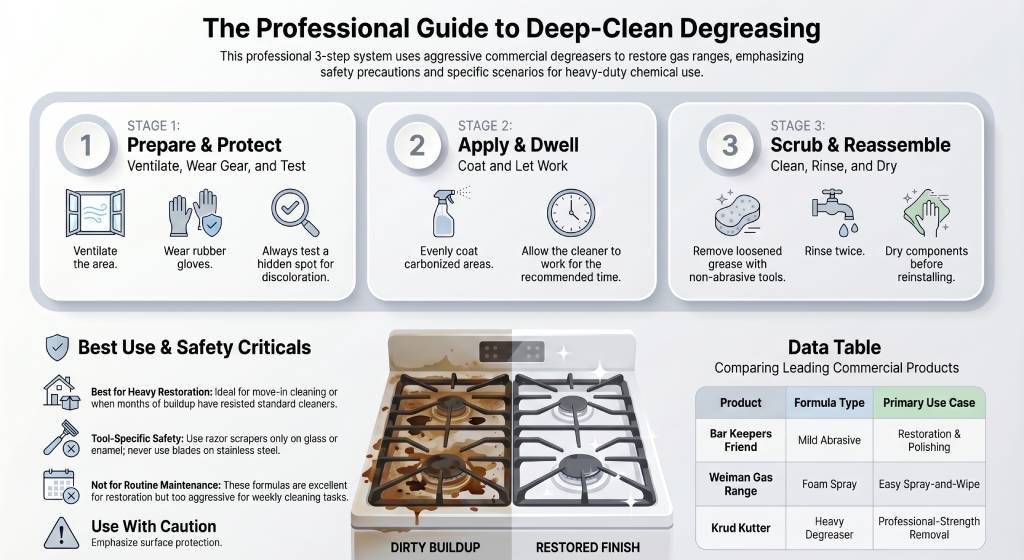
Commercial degreasers are the right call when soap, paste, and vinegar have all failed and you’re staring at a stove with months of carbonized residue. Three commonly-recommended options: Bar Keepers Friend (mildly abrasive cleanser, ~$3–5 for the 12 oz can), Weiman Gas Range Cleaner (foam, ~$8–10), and Krud Kutter Original Concentrated Cleaner Degreaser (spray, ~$10–15). – “Consumer Reports‘ tested cooktop cleaners” include Affresh, Bar Keepers Friend, and Weiman; “Reader’s Digest’s pro-tip roundup” adds the razor-blade scraper for fused residue. “HGTV’s 8-step degreaser walkthrough” is the most thorough published sequence.
This is often the fastest option when neglect is the actual problem. Trade-off: harsher chemistry and higher surface risk. Bar Keepers Friend can dull glossy enamel over repeated use; Easy-Off oven cleaner works on stainless surrounds but will etch enamel and discolor aluminum if it sits too long.
What you need
- A commercial degreaser (Bar Keepers Friend or Weiman are the safest defaults; Krud Kutter for grease-heavy jobs; Easy-Off for last-resort baked-on residue on stainless steel only)
- Rubber gloves
- Microfiber cloths (3 one for product, one for rinse, one for dry)
- A non-abrasive sponge
- Open windows or an exhaust fan
Steps
- Ventilate first. Open a window or run the range hood on high before you spray anything.
- Put on rubber gloves. Read the product label dwell times and surface compatibility differ across products.
- With the stove cool and grates removed, apply the product to a small test patch first. Wait the recommended time (Bar Keepers Friend: 1 minute; Weiman foam: 3–5 minutes; Krud Kutter: 5–10 minutes).
- Confirm no discoloration in the test patch. Then apply to the full surface.
- Let the product dwell for the recommended time. Don’t let it dry out re-mist if needed.
- Wipe with a non-abrasive sponge in small circles. For carbonized spots, a razor blade scraper held at a 30° angle on glass or enamel cooktops will lift residue cleanly (don’t use razor blades on stainless steel).
- Rinse twice with a damp microfiber cloth. Commercial degreasers leave a film that smokes on the next burner light if not fully rinsed.
- Dry. Reinstall grates and caps.
When to use it
Severely neglected stoves, move-in cleans, and any time methods 1–3 have failed. For routine work, the is still soap and water degreasers are the heavy artillery, not the daily driver. “Any tips for cleaning my gas stove?” repeatedly surfaces Bar Keepers Friend, Magic Eraser, Dawn Powerwash, and Krud Kutter commenter-aggregated opinion, not a survey, but the convergence is consistent. Honest limitation: Magic Eraser leaves micro-abrasions on glossy enamel after repeated use. Use it for restoration, not weekly upkeep.
How Do You Clean Gas Stove Grates Without Damaging Them?
Gas stove grates come in two flavors, and the cleaning rule flips based on which you have: coated cast iron can be soaked, uncoated cast iron absolutely can’t. Soaking uncoated cast iron strips the seasoning, and rust shows up within hours. Whirlpool, “Better Homes & Gardens” and The Spruce all converge on this rule.
How to tell which kind you have:
- Magnet test: Both coated and uncoated cast iron are magnetic only confirms it’s cast iron, doesn’t differentiate.
- Visual: Coated grates have a smooth, glossy black finish (porcelain enamel). Uncoated look matte gray-black, slightly rough. Run your thumb across coated feels glassy, uncoated feels gritty.
- Manual: Your range manual states the type explicitly. “Dishwasher-safe grates” = coated. “Season after deep cleaning” = uncoated.
For cleaning porcelain-coated stove grates, follow these steps:
- Soak in hot soapy water (Dawn) for 20 minutes.
- Scrub with a non-abrasive sponge or nylon brush.
- Rinse, dry completely, reinstall.
- For stubborn residue, apply baking soda paste, wait 20 minutes, scrub.
For uncoated cast iron grates (no soaking, ever):
- Wipe with a damp cloth while warm don’t submerge.
- For stuck-on food, sprinkle coarse salt and scrub with a damp cloth.
- Dry right away and completely.
- Apply a thin layer of vegetable oil with a paper towel to maintain seasoning.
If grates are already rusted, scrub with steel wool until the rust is gone, dry thoroughly, and re-season with oil at 350°F for an hour. That’s the Whirlpool-recommended fix.
The breakout query how to clean gas stove top without scratching shows clear demand for low-abrasion methods. Translation: keep steel wool off coated grates, skip aggressive scouring pads, and lean on dwell-time (paste, vinegar) over scrubbing pressure.
Safety Watchouts
- Cool the stove + power off + control-lock before starting. Don’t clean a hot stove. The igniter and surface materials respond differently to chemistry at temperature.
- Never mix vinegar + baking soda. Verified by Dr. Pamela Turner at the University of Georgia Extension and reproduced across Real Simple, The Spruce, and Tom’s Guide. They neutralize each other.
- Cover the igniter with foil before wet-scrubbing surrounds. This is a recurring tip on r/CleaningTips threads about continuous-sparking igniters after cleaning community signal, not survey data, but the failure mode is real and the workaround takes 10 seconds.
- Yellow or orange flame = clogged burner ports. Clear them with a paper-clip or straight pin (Whirlpool and KitchenAid both document this fix). Don’t use a toothpick it can break off inside the port.
- Uncoated cast-iron grates must NEVER be soaked. Submerging them strips seasoning, and rust forms within hours. BHG, The Spruce, and Whirlpool agree.
Frequently Asked Questions
Can I use Dawn dish soap to clean my stove top?
Yes. Dawn dish soap (regular or the Powerwash spray) is the manufacturer-canonical first choice on every gas stove cleaning guide from Whirlpool, KitchenAid, and Maytag. It cuts grease without damaging enamel, stainless steel, or coated cast iron. Use a tablespoon in a basin of hot water for soaking parts.
How do you clean cast iron grates on a gas stove?
It depends on whether the grates are coated or uncoated. Coated cast iron grates (smooth, glossy black finish) can soak in hot soapy water for 20 minutes, then scrub. Uncoated cast iron grates (matte gray-black) must never soak wipe with a damp cloth, dry right away, and re-oil to maintain seasoning.
Can I use Clorox wipes on a gas stove top?
Yes for occasional disinfecting on stainless steel or porcelain enamel, but not as your primary cleaner. The bleach derivatives in Clorox wipes can dull enamel over repeated use, and they don’t dissolve grease as well as Dawn, baking soda paste, or a dedicated degreaser. Reserve them for spot disinfecting.
How often should I clean my gas stove?
Wipe down after every cooking session a 60-second job that prevents most build-up. Homes using stovetop protectors often find daily cleaning takes even less time because splatters land on a removable surface instead of the cooktop. Run a full clean (Method 1 with the soak step) weekly. Deep-clean monthly with Method 2 paste or Method 4 degreaser if needed. Clean burner ports any time you notice a yellow or irregular flame.
What is the fastest way to clean a gas stove?
A commercial degreaser like Bar Keepers Friend or Weiman applied to a cool stove, dwelling 3–5 minutes,then wiped can take around 15–25 minutes depending on buildup. That’s the speed answer when the stove is genuinely dirty. For a fresh-cook wipe-down, hot soapy water and a microfiber cloth take under five minutes.
How do you clean clogged gas burner ports?
Cool the stove and remove the burner cap. Identify the port (the small hole around the burner head). Insert a straightened paper-clip or sewing pin into each port and gently work it in and out. Don’t use a toothpick wood can break off inside. Wipe the burner head with a damp cloth, dry completely, and reinstall. See our guide on cleaning gas burner heads safely before clearing the ports.
Sources
- Whirlpool How to Clean Gas Stove Top Grates and Burners
- KitchenAid How to Clean Gas Stove Burners in 7 Steps
- Maytag How to Clean Gas Stove Grates and Burners
- America’s Test Kitchen How to Clean Your Stovetop
- Consumer Reports 4 Best Cooktop Cleaners, Tested by CR
- Reader’s Digest How to Clean a Gas Stovetop
- HGTV How to Clean a Gas Stovetop
- The Spruce How to Clean a Stovetop
- University of Georgia Extension Vinegar and Baking Soda Chemistry
- Bob Vila How to Clean Stove Burners