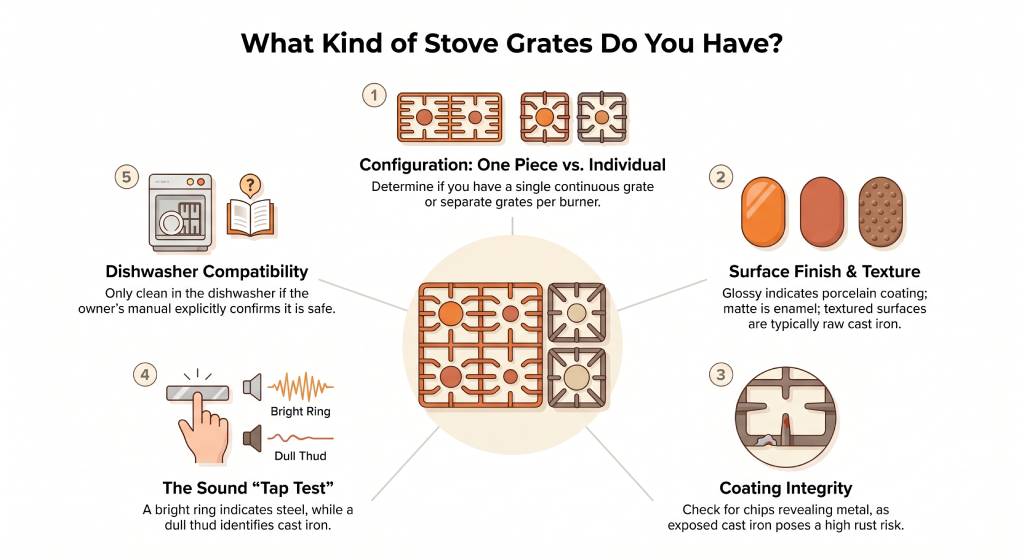
To clean stove grates, identify the material first. Cast iron tolerates a 5-10 minute soak in warm soapy water; porcelain-coated grates can soak 20-30 minutes. Matte black porcelain needs microfiber and mild soap only. Never mix bleach with ammonia, and never put uncoated cast iron in the dishwasher.
Most cleaning guides treat stove grates as one thing. They aren’t. Cast iron, porcelain-coated, matte black porcelain, continuous, and stainless steel grates each need different methods. The wrong soak time rusts cast iron. The wrong scrubber chips porcelain. The wrong cleaner strips matte enamel.
Here’s the thing most guides skip: this article compares editorial cleaning guidance with official manufacturer recommendations where published advice differs.
For broader maintenance schedules, everyday cleaning routines, and long-term appliance upkeep, see our complete gas and electric coil stove care guide.
Before you fill a sink, run through these five questions. They take thirty seconds and prevent finish damage that takes weeks to undo.
The rest of this guide branches by the material you just identified.
Uncoated cast iron is porous. Water that lingers inside those pores rusts the metal from the inside out. That’s why every editorial source we tracked tells you to soak briefly or not at all. For a more detailed walkthrough dedicated to cleaning cast iron stove grates, see our complete guide.
The method: Cool the grates. If you haven’t cleaned the cooktop itself yet, follow our complete gas stove cleaning guide before reinstalling the grates. Submerge in hot soapy water 5 to 10 minutes BHG’s published ceiling, with BHG explicit that exceeding 10 minutes risks rust. Maytag is more permissive on water exposure, calling its grates “mainly for heat conduction.” Side with BHG for uncoated grates: porous metal plus standing water plus oxygen equals iron oxide.
Scrub with a soft-bristle brush or non-scratch nylon sponge. For caked grease, paste three parts baking soda with one part water the ratio Maytag and Whirlpool both publish and let it dwell 20 minutes. Rinse hot. Dry immediately with a towel; never air-dry.
Honest limitation on older painted cast iron (some pre-2000 ranges), the ammonia-bag method removes paint where flames have contacted the metal. A ThriftyFun commenter flagged this in February 2017 and the warning still holds. In practice, if your grate is 25+ years old, test a hidden corner first.
Porcelain enamel is vitrified glass fired onto cast iron at the factory. It’s harder and more chemically resistant than the metal underneath, which means it tolerates longer soaks. But it chips when you bang it with pots, and once chipped, the exposed cast iron rusts.
The method: Cool, then soak in hot soapy water for 20 to 30 minutes. Most manufacturer guidance supports a 20–30 minute soak for porcelain-coated grates, though some editorial sources recommend slightly shorter times for lighter grease buildup. Some editorial sources recommend longer soaks for heavily caked grease. The range matters because thin oil films lift in 5 minutes but polymerized grease needs 30+. The Spruce recommends shorter soak times to avoid “water lock-in,” though the coating itself is non-porous and water intrusion is mainly a concern when the finish is chipped.
Scrub with a soft-bristle brush or nylon scrubber. For stubborn spots, the 3:1 baking-soda paste sits 20 minutes. Bar Keepers Friend works at low concentration, but test a corner first. Avoid steel wool, oven cleaner, and chlorine bleach. All three damage enamel.
Dishwasher check your manual. Whirlpool DuraClean Cast Iron Grates and Maytag’s DuraGuard line are dishwasher-safe by design. Most non-DuraClean / non-DuraGuard models are not.
Matte porcelain is the most delicate finish in this guide. In a 2022 Best Buy product response, a Cafe Appliances representative provided detailed care guidance explaining that matte finishes require very gentle cleaning methods and should not be cleaned with abrasive pads, bleach, harsh scrubbers, or aggressive cleaning products because the surface coating can become permanently damaged or unevenly polished.
The method: Soft microfiber cloth, warm water, a few drops of mild dish detergent. Wipe gently. For dried food, dampen the cloth and let it sit on the spot two minutes before wiping. No paste, no scrubber, no degreaser strong enough to dull paint. If residue persists, repeat. Abrasion polishes the matte texture into glossy patches you can’t undo.
This finish appears on many matte-black and black-stainless appliance lines. Not sure if yours is matte or glossy? Run a finger across it dry: matte feels velvety, gloss feels slick. “Cafe matte-finish care guidance”
Continuous grates are the single edge-to-edge grate design used on many premium-style gas ranges. They span all burners as one or two pieces and are heavier than standard grates. A single section can weigh 8-15 lb.
The method: Lift with both hands. The cast iron is heavy enough to chip a porcelain sink if dropped. Most continuous grates separate into 2 or 3 pieces with a lift-and-twist; Thermador’s owner’s manual is explicit about this. Once apart, treat each section as a porcelain-coated grate: 20-30 minute soak, 3:1 baking-soda paste for caked grease.
Disassembly is the part nobody covers. Editorial competitors mention continuous grates zero times in our tracked top-10. If your manual is missing, search the model number plus “service manual” before prying. The bathtub method works here too; lay a towel down to keep cast iron from scratching the tub.
Stainless rod grates appear on some premium and commercial-style ranges. They look industrial and clean up faster than cast iron, but they show fingerprints, water spots, and discoloration more easily.
The method: Hot soapy water and a non-scratch sponge handle daily grime. For burnt-on residue, Bar Keepers Friend (oxalic-acid formula designed for stainless) lifts deposits without scratching. Work with the grain, rinse, dry immediately to prevent water spots.
For mineral discoloration, white vinegar diluted 1:1 with water works fine on stainless even though it’s forbidden on cast iron. Avoid chlorine bleach (pits stainless over time) and steel wool (embedded particles rust).
| Method | Cast iron (uncoated) | Porcelain-coated | Matte black porcelain | Continuous | Stainless steel |
|---|---|---|---|---|---|
| Hot soapy soak (5-10 min) | YES | OK but short | NO | OK | YES |
| Hot soapy soak (20-30 min) | NO (rusts) | YES | NO | YES | OK |
| 3:1 baking soda paste | YES | YES | NO | YES | YES |
| Bar Keepers Friend | NO (strips seasoning) | Test first | NO | Test first | YES |
| Distilled white vinegar | NO (eats seasoning) | OK diluted | NO | OK diluted | YES |
| Ammonia-bag (overnight) | NO | YES | NO | YES | YES |
| Easy-Off oven cleaner | NO | NO (damages finish) | NO | NO | NO |
| Dishwasher | NO unless coated/seasoned | Check manual | NO | Check manual | YES |
| Steel wool | Rust removal only | NO | NO | NO | NO |
Chowhound is the only top-ranking competitor that covers this seriously, and the section deserves more.
OEM support pages are heavily cited in Google’s AI Overview. Here’s what each major manufacturer publishes.
Some grates can’t be saved. Replace, don’t keep scrubbing, when:
A Thrifty Fun community member put it bluntly: “would have been smarter to just replace.” Replacement grates from the OEM run $40-$120 for most consumer ranges as of 2026.
The contradiction: BHG publishes 350-400°F for 30-60 minutes. Southern Living publishes 450°F for one hour. Both sources are credible and the disagreement is real.
The chemistry: oil polymerizes (cross-links into a hard film) most efficiently slightly above its smoke point. Neutral oils (canola, vegetable, grapeseed) smoke around 400-450°F. Below 350°F, polymerization is slow and the seasoning ends up tacky. Above 500°F, oil burns to brittle carbon that flakes.
Practical resolution for routine reseasoning, BHG’s 350-400°F / 30-60 min is the lower-risk default. For a one-time deep recure after rust removal, Southern Living’s 450°F / 1 hr cures more thoroughly. Apply a thin coat of neutral oil. Thick coats pool, sticky-cure, and ruin the finish. For a detailed walkthrough, including oil selection and common seasoning mistakes, read our guide on how to season cast iron stove grates.
Can you use Dawn to clean stove grates?
Yes. Dawn (or any liquid dish soap) plus warm water is the default first-line method per Maytag, Whirlpool, BHG, and The Spruce. Use a 5-10 minute soak for uncoated cast iron and 20-30 minutes for porcelain-coated grates. For caked grease, follow with a 3:1 baking soda paste.
What should you not clean cast iron with?
BHG lists scouring powders, distilled white vinegar, oven cleaner, ammonia, chlorine bleach, and metallic scouring pads (except for active rust removal). Vinegar eats seasoning; lye damages coatings; bleach pits the metal. Stick to dish soap, baking-soda paste, and a soft-bristle brush.
How do you get baked-on grease off gas stove grates?
Use the 3:1 baking soda paste. Maytag and Whirlpool both publish that ratio. Dwell 20 minutes, then scrub with a non-abrasive pad. For grease that resists, GE Appliances officially permits the ammonia-bag method (1/4 cup in a sealed bag, 3 hours to overnight, ventilated room).
Can you put gas stove grates in the dishwasher?
Only if your manual explicitly says so. Some coated grate systems are dishwasher-rated when explicitly approved by the manufacturer. Uncoated cast iron rusts in the dishwasher’s hour-plus wet cycle. BHG recommends hand-washing even when the manufacturer permits the dishwasher.
How often should I clean gas stove grates?
Weekly for high-use kitchens, monthly for lighter cooking, plus immediate spot-cleaning after boil-overs. BHG and Maytag both publish this cadence. Carbonized grease left for months gets dramatically harder to remove and can affect flame quality if buildup reaches the burner ports
Do porcelain-coated grates need to be seasoned?
No. Seasoning is for uncoated cast iron only. Porcelain enamel is vitrified glass fired onto cast iron at the factory; it’s non-porous and doesn’t need oil. Apply oil only to bare cast iron after a deep clean or rust removal.
To care for a ZLINE gas range, wipe the porcelain enamel cooktop and sealed burners…
RV gas stove care means a quick wipe after every meal, a deep clean where…
Miele gas stove care means wiping the porcelain or stainless deck after every meal with…
Fisher & Paykel gas stove care comes down to a daily wipe of the brushed-stainless…
To care for a Tappan gas stove, wipe the cooktop and grates after each use…
Crosley gas stove care comes down to a daily wipe-down once the cooktop is cool,…