
GE gas stove care comes down to three habits: wipe the cooktop and grates daily with hot soapy water, deep-clean the cast iron grates and burner caps weekly (dishwasher-safe only if they’re enamel-coated underneath and the rubber bumpers come off), and clear the burner ports monthly so the igniter keeps lighting. Always dry everything before cooking.
GE is one of the most widely sold range brands in the United States, and the care routine is roughly the same whether you own an entry-level JGB range, a mid-tier GE Profile, a premium Café, or a luxury Monogram. The differences are in the finishes and a handful of quirks brass burner caps, continuous cast iron grates, and a spark-ignition system that complains loudly the moment it gets wet. This guide walks through the daily, weekly, and monthly routine, the GE-specific things that trip owners up, a troubleshooting table for the two most common complaints (a clicking igniter and a yellow flame), and how to protect the cooktop between cleanings. For broader maintenance routines that apply across brands and stove types, see our general stove care reference.
Key Takeaways
- Clean your GE gas stove daily with hot, soapy water to prevent grease and food buildup.
- Deep-clean grates and gas burner cap cleaning guide weekly, and always dry them completely before reinstalling.
- Check and clear burner ports monthly to maintain even flames and reliable ignition.
- Only place enamel-coated grates in the dishwasher (after removing rubber bumpers); hand-wash bare cast iron grates to prevent rust.
- Keep water away from burner ports and igniters, as moisture is the most common cause of continuous clicking.
- Café and Profile models require extra care for brass burner caps to preserve their finish.
- A steady blue flame indicates normal operation; persistent yellow flames require professional inspection.
- Apply a light coat of cooking oil to cast iron grates after cleaning to reduce rust formation.
- Use a gas-range-specific stove protector with proper clearance around burners and igniters to reduce cleanup time.
- Always verify your exact GE model number before purchasing replacement parts, accessories, or stove protectors.
Know your GE gas stove
Before you clean anything, it helps to know what you’re looking at. GE gas ranges fall into four lines: standard GE (model prefixes like JGB, JGBS, JGS), GE Profile (PGB, PGS), Café (the premium line with customizable hardware), and Monogram (luxury, pro-style). Most sell in 30-inch and 36-inch widths. Many GE Profile ranges use model prefixes beginning with ‘P’, while many standard GE ranges begin with ‘J’. Always verify the exact model using the appliance rating plate.
A few parts you’ll be handling constantly:
- Grates. Recent GE gas ranges use heavy cast iron continuous grates the kind that span the whole cooktop so you can slide a pot from burner to burner. Older lines used lighter porcelain-coated grates. The material changes how you clean them, which matters below.
- Burner caps and heads. Each burner has a removable cap on a head with the flame ports. On Café models you may have brass caps, which need their own care. The white ceramic piece beside each burner is the spark electrode the part that clicks.
- Sealed vs. open burners. Newer GE models use sealed burners, where the base is closed off so spills can’t run down inside. Cleanup is far easier, but it also means the air-fuel mixture usually isn’t user-adjustable.
Knowing whether you have sealed burners and cast iron or porcelain grates tells you most of what you need for the routine below.
Daily cleaning
Daily care is less about deep cleaning and more about not letting spills bake on. Once the cooktop has cooled:
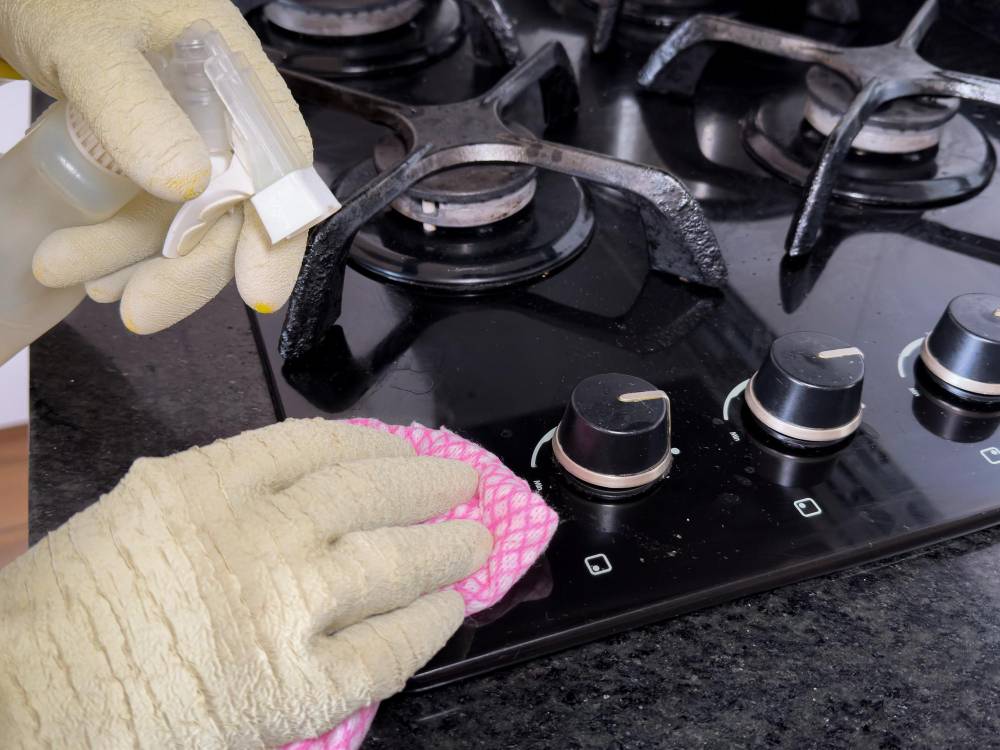
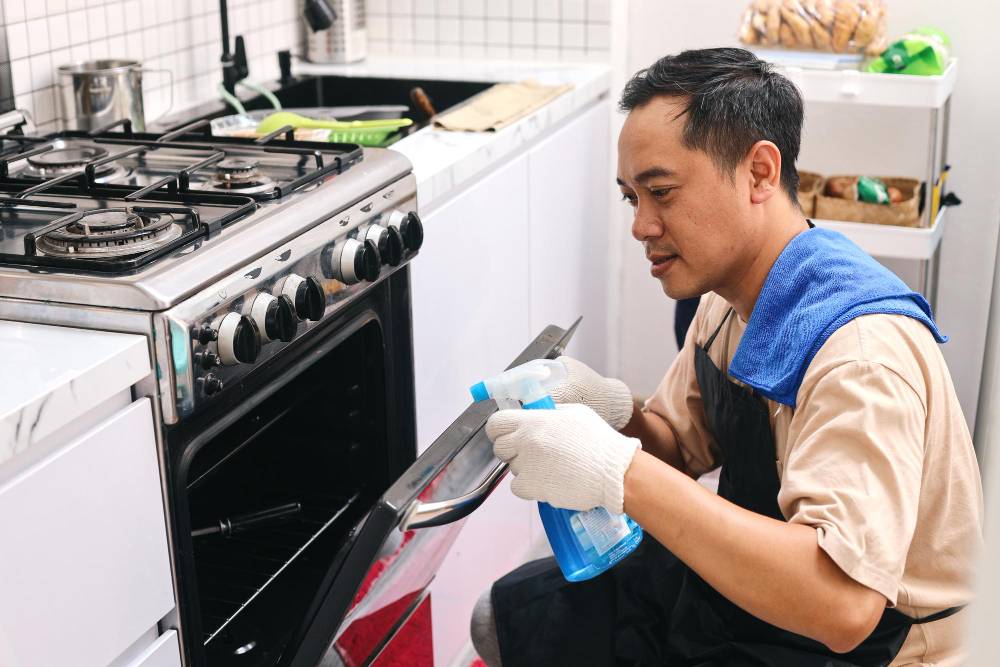
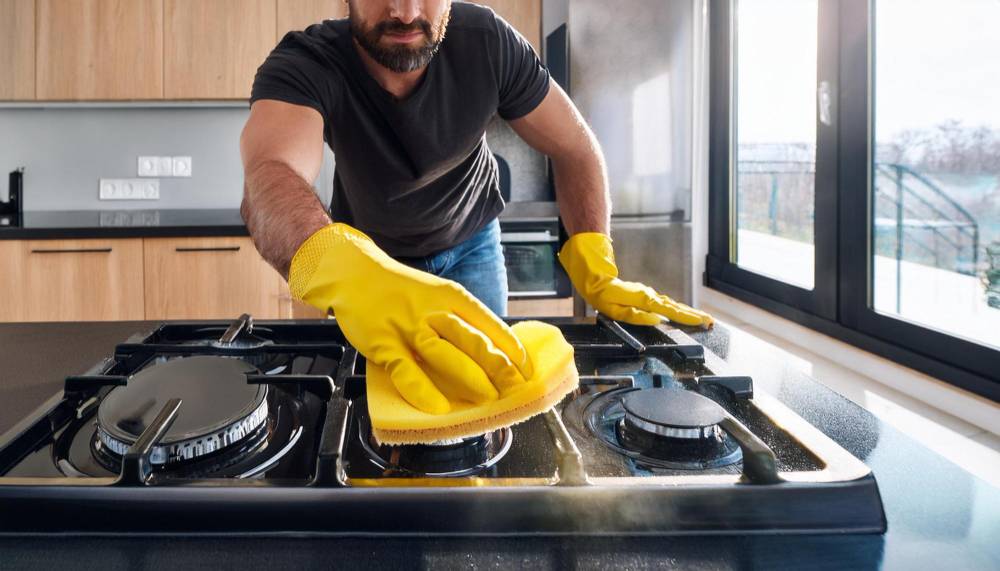
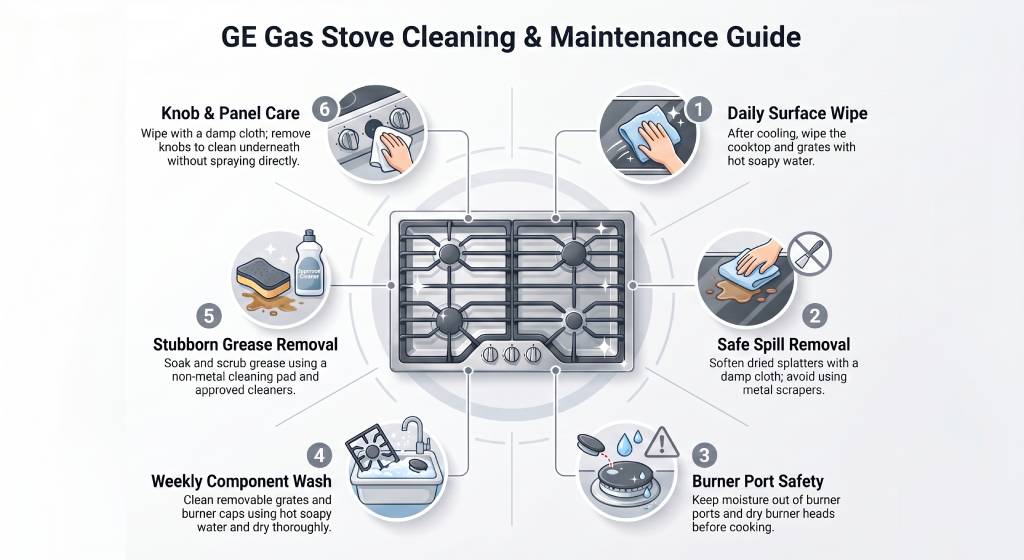
- Wipe the cooktop surface and the tops of the grates with a cloth and hot, soapy water. Dish soap is fine; GE points to plain hot soapy water for grates and caps.
- For dried-on splatter, lay a warm, damp cloth over the spot for a minute to soften it before wiping and skip the metal scrapers, which scratch porcelain and the cooktop finish.
- Lift the grates if anything ran underneath, and wipe the surface beneath them. On sealed-burner models this is quick; nothing has run down into the burner itself.
The one rule that saves the most grief: keep water out of the burner ports. If you splash the burner heads while wiping, dry them before you cook.
Weekly deep clean
Once a week or right after any boil-over give the removable parts a real wash.
Grates and burner caps. GE’s official guidance is to wash grates and caps in hot soapy water, rinse in clean water, and dry them before putting them back. For the dishwasher question that comes up constantly: GE says grates and caps can go in the dishwasher as long as they’re enamel-coated on the bottom, and if they have rubber feet (bumpers), you should remove the bumpers first. Some GE cooktops, like the JGP5036SLSS, are even marketed with “dishwasher safe grates.” If your grates are bare cast iron underneath rather than enamel-coated, hand-wash them the dishwasher can strip the finish and invite rust. For a complete step-by-step process covering the entire cooktop, including the surface, burner caps, grates, and safe cleaning products, follow our full gas stove top cleaning method and see our cast iron grate cleaning guide for the safest cleaning methods.
Burned-on soil. For baked-on grease, soak the grates and caps in a slightly diluted liquid cleanser and scrub with a non-metallic pad. GE also documents an ammonia method: seal the grates in a bag or covered container with about ¼ cup of ammonia for three hours up to overnight, then rinse and dry. (Work in a ventilated space, and never mix ammonia with a bleach-based cleaner.) GE’s own CeramaBryte Gas Grate Kit (part WX10X10021) is built for baked-on deposits if you’d rather use a purpose-made option.
Brass caps (Café and some Profile models). Don’t attack brass with the scouring you’d use on cast iron. GE recommends soaking brass caps in a vinegar-and-water solution to lift black discoloration, and using Brasso or Bar Keepers Friend for shine accepting that polishing can soften the brushed look a little.
Control panel and knobs Wipe with a damp cloth only. Don’t spray cleaner directly onto the panel; over the years, harsh sprays are a known cause of the printed labels wearing off (a complaint you’ll see on owner forums). Pull the knobs straight off to clean behind them, and dry the area before sliding them back moisture around the knob switches is another clicking culprit.
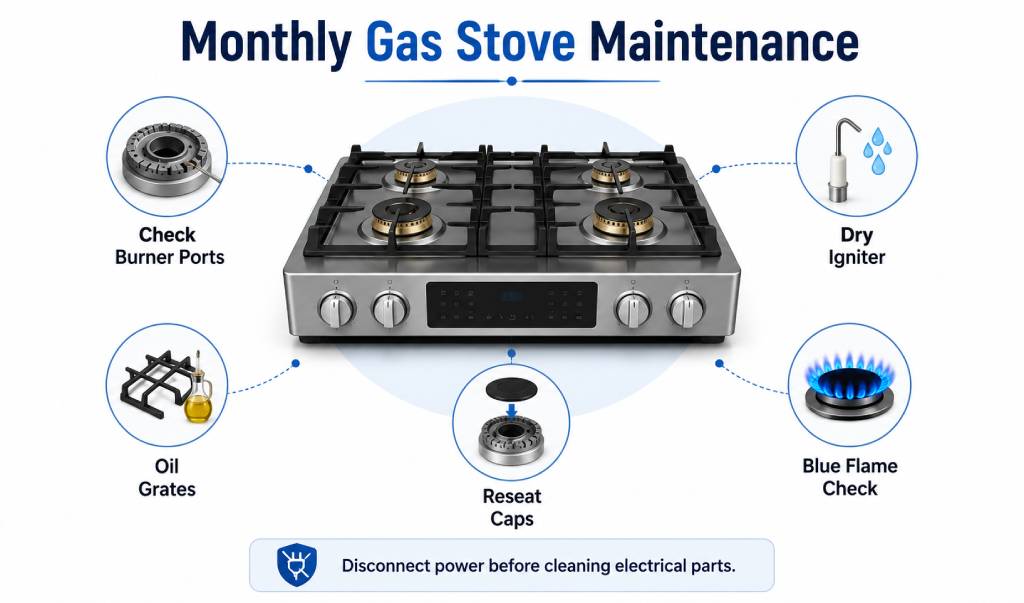
Monthly maintenance
Monthly care is where you prevent problems instead of reacting to them.
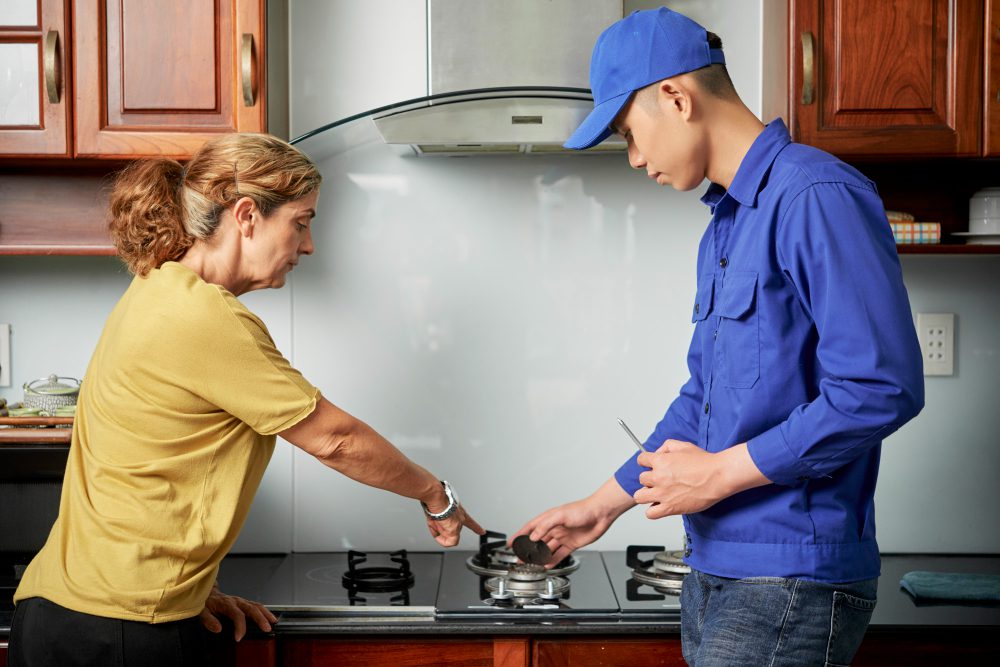
- Check the burner ports. With the burners off and cool, lift each cap and look at the flame ports the small holes around the burner head. Clear any clogged port with a straightened paperclip or a pin, not a toothpick (which can snap off inside). Clogged ports cause uneven flames and slow lighting.
- Dry-test the igniter. If a burner has been clicking, remove the cap and head, let them air-dry (or set them in a warm oven for about 30 minutes), then reseat them. A few ignition clicks during startup can be normal. Persistent clicking after ignition or when the burner is off may indicate moisture, debris, or a component issue.
- Re-oil cast iron grates. GE’s trick for preventing rust on cast iron grates is a light coat of cooking oil on the bottom of the grate. Do this after a deep clean.
- Reseat anything you removed. Make sure each burner cap matches its head and lays flat. A cap that’s off by a few degrees throws off ignition and flame shape.
- Confirm a blue flame. Light each burner and look. A steady blue flame is healthy. A yellow or orange flame means incomplete combustion flag it for the troubleshooting section.
Disconnect power to the range before you deep-clean any of the burner electrical parts, then restore it once everything is dry. For the broader monthly checklist that fits any gas range.
GE-specific quirks
This is where a GE gas range differs from a generic one:
- The dishwasher-safe grate nuance. Unlike brands that say a flat “no,” GE allows the dishwasher conditionally enamel-coated bottom, bumpers removed. The owners who end up with rusty grates are usually the ones who skipped the “enamel-coated” part and tossed bare cast iron in. Know which kind you have.
- The Café/Profile platform shares GE’s ignition system. Café (CGS/CGB series) and Profile use the same spark-ignition design as standard GE ranges, just with premium finishes. So a clicking fix that works on a JGB works the same way on a Café the hardware underneath is the platform GE uses across the lineup.
- Continuous grates are heavy and awkward in a sink. The full-width cast iron grates are great for cooking but don’t fit a standard sink well. A large flat tub or a bathtub with a towel down works better for the weekly soak.
- A self-clean oven isn’t a grate-cleaning shortcut. GE says only grates without rubber bumpers may go through a self-clean cycle, and only if your Owner’s Manual specifically lists it; if the manual doesn’t mention it, don’t. When it is allowed, the grates sit on the oven rack, never on the oven floor.
- Control-panel printing wear. A fair number of owners report the silk-screened labels around the knobs fading after years of cleaning. Damp cloth only, no abrasive sprays, is the prevention.
Common problems
The two complaints that dominate GE gas owner forums are a clicking igniter and a yellow flame. Here’s the quick diagnostic table; the universal deep-dives are linked below it.
| Symptom | Most likely cause | What to try first | When to call service |
|---|---|---|---|
| Burner clicks but won’t light | Moisture or food in the burner ports after cleaning or a boil-over | Disconnect power, remove the burner cap and head, dry fully, clear the burner ports, and reseat the components correctly. | No spark on any burner after drying, or clicking continues dry |
| Clicking when the burner is OFF | Knob not fully off, or moisture around the electrode | Turn the knob fully off until it pops out; let the area dry a few hours | Clicking persists after everything is dry |
| Yellow or orange flame | Incomplete combustion improper air-to-gas mixture, or an incorrect LP (propane) conversion | Confirm clean, dry, correctly seated burner parts | Sealed-burner models (air shutter not user-adjustable) call your gas supplier or service |
| Grate finish wear / rust | Dishwashing bare cast iron, or no rust prevention | Hand-wash, dry fully, re-oil the bottom of the grate | Heavy pitting or flaking |
| Control-panel labels fading | Abrasive sprays over time | Switch to damp-cloth-only cleaning | Cosmetic only |
If your GE burner won’t ignite even after drying and reseating the burner components, follow our diagnostic walkthrough to troubleshoot burner caps, igniters, spark modules, and gas supply issues step by step.
If your GE stove continues clicking during or after ignition, use our clicking diagnostic to identify common causes such as moisture, a misaligned burner cap, a faulty ignition switch, or a failing spark module.
A word on the yellow flame, because it’s a safety item: a mostly yellow flame signals incomplete combustion, which is inefficient and can produce soot and carbon monoxide. GE’s documentation ties it to too much air in the mix; repair sources tie persistent yellow flames most often to an incorrect LP conversion. On newer sealed-burner GE models the air shutter generally isn’t something you can adjust yourself, so this is a “call the gas supplier or schedule service” item, not a DIY tweak. If you ever smell gas, stop and treat it as an emergency.
Protecting your GE stove between cleanings
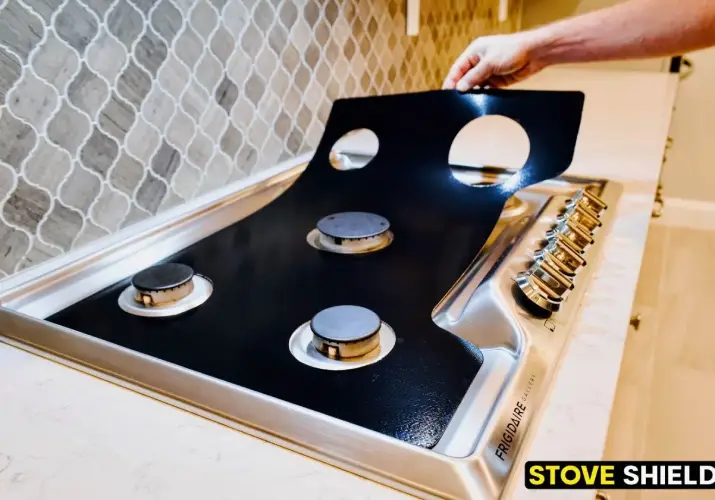
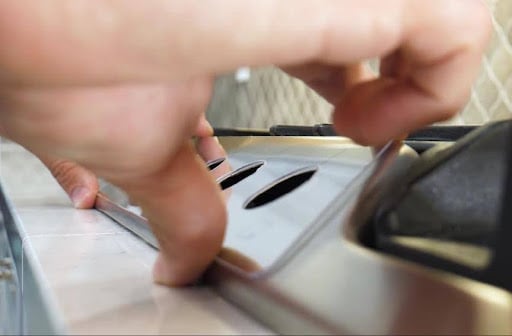
The fastest way to cut your cleaning time is to stop spills from reaching the cooktop in the first place. Explore GE stove protectors designed for your model to help catch spills before they bake onto the cooktop. A few habits help using slightly larger pots on the back burners, keeping a lid handy for anything that spatters but the most direct tool is a stove protector: a heat-tolerant liner that sits under the grates and catches spills before they bake onto the enamel.
In our protector testing, the products that performed best were those specifically designed for gas ranges and installed with proper clearance around burners and ignition components.
How to find your GE model number
Almost every care or parts decision starts with the exact model number. On a GE gas range, check these spots, in order:
- Behind the storage drawer. Tilt the bottom drawer down (or pull it out) and look on the inside of the frame.
- On the back of the frame. If you can pull the range out, the rating plate is often on the rear.
- Along the oven door frame or oven floor edge. Open the oven door and check the front frame and the floor edge.
The number usually starts with J or P, for example, JGBS66REKSS or PGS930YPFS. Once you have it, you can match the right grates, burner caps, and a correctly sized protector. If you own a model like JGBS66REKSS, you can explore GE stove protectors designed specifically for your range.
Frequently asked questions
How do you clean a GE gas stove?
Let it cool, then wipe the cooktop and grates with hot soapy water. Weekly, wash the removable grates and burner caps in hot soapy water (or the dishwasher if they’re enamel-coated on the bottom with bumpers removed), clear the burner ports, and dry everything fully before cooking.
Are GE gas stove grates dishwasher safe?
Conditionally, yes. GE says grates and caps can go in the dishwasher as long as they’re enamel-coated on the bottom, and you should remove any rubber bumpers first. Bare cast iron grates should be hand-washed and dried to avoid rust.
Why does my GE gas stove keep clicking?
The most common cause is moisture or food debris in the burner ports after cleaning or a boil-over. Disconnect power, remove and dry the burner cap and head, clear the ports, and reseat them making sure the cap matches the head and sits flat. If it still clicks while dry, the switch or spark module may need service.
Why is the flame on my GE gas stove yellow?
A yellow flame means incomplete combustion, usually from too much air in the mix or an incorrect LP (propane) conversion. A healthy flame is blue. On newer sealed-burner GE models the air shutter isn’t user-adjustable, so call your gas supplier or schedule service rather than attempting an internal adjustment.
Can you use Dawn Powerwash on a GE gas stove top?
A standard dish soap like Dawn in hot water is fine for the cooktop surface and grates. Spray it onto a cloth rather than directly onto the control panel, keep any spray away from the burner ports and igniters, and dry before cooking.
How often should you deep clean a GE gas range?
Wipe daily, deep-clean the grates and caps weekly (or right after a boil-over), and run the monthly checks burner ports, igniter dry-test, and re-oiling cast iron grates. Consistency beats intensity; weekly upkeep prevents the baked-on messes that need an ammonia soak.
Where is the model number on a GE gas stove?
Most often behind the storage drawer on the inside of the frame, on the back of the frame, or along the oven door/floor edge. It usually begins with J (standard GE) or P (Profile).
Sources and how we researched this guide
The GE-specific cleaning and troubleshooting steps in this guide are drawn from GE Appliances’ own support documentation the “Cleaning Your Grates and Burner Caps” support page , plus GE’s gas-burner clicking and ignition support articles and corroborated against independent appliance-repair sources for the clicking and yellow-flame sections. Brand-line and model-prefix details reflect GE’s current product listings.
A protector fit on a GE gas range should match your exact stove model.