
Kenmore gas stove care follows the same fundamentals covered in our general stove care reference: a quick wipe after every meal, a weekly soak and scrub of the grates, caps, and burner ports, and a monthly flame check. The Kenmore-specific part: decode your model-number prefix to learn who actually built the range, and never put the grates in the dishwasher or the self-clean oven.
Caring for a Kenmore is a little different from caring for any other gas range, because Kenmore doesn’t build its own stoves. Sears has historically sold ranges manufactured by Frigidaire, GE, Whirlpool, LG, and others under the Kenmore, Kenmore Elite, and Kenmore Pro brands, Kenmore Elite, or Kenmore Pro. So the most useful move in Kenmore gas stove care is the one no generic cleaning guide mentions: find out who made yours. This guide covers the daily, weekly, and monthly routine, the brand quirks that trip owners up, and how to read your model number. For the universal cleaning process, see our full gas stove top cleaning method.
Key Takeaways
- Wipe the cooktop, grates, and burner caps after each use with mild soap and water to prevent grease buildup and stains.
- Deep-clean burner caps, grates, and burner ports weekly to maintain proper ignition and even flame performance.
- Always dry and properly reseat burner caps after cleaning to prevent clicking and ignition issues.
- Kenmore gas ranges may be manufactured by different companies such as Frigidaire, GE, Whirlpool, or LG, so identifying the model-number prefix can help with maintenance and replacement parts.
- Never clean Kenmore grates in a dishwasher or self-cleaning oven unless your specific owner’s manual explicitly permits it.
- Check burner flame color monthly; a steady blue flame indicates normal operation, while persistent yellow flames may require service.
- Older Kenmore ranges with lift-up cooktops require different cleaning procedures than newer sealed-burner models.
- Confirm the anti-tip bracket remains properly installed and inspect gas connections regularly for safety.
- Most burner-lighting problems are caused by wet burner caps, clogged ports, or improper cap alignment rather than failed components.
- A custom-fit stovetop protector can help reduce grease and spill buildup between cleanings, but compatibility should be verified for your exact Kenmore model.
What’s actually inside your Kenmore gas range?
Before you clean anything, figure out what you’re cleaning. On a Kenmore, that starts with the model number.
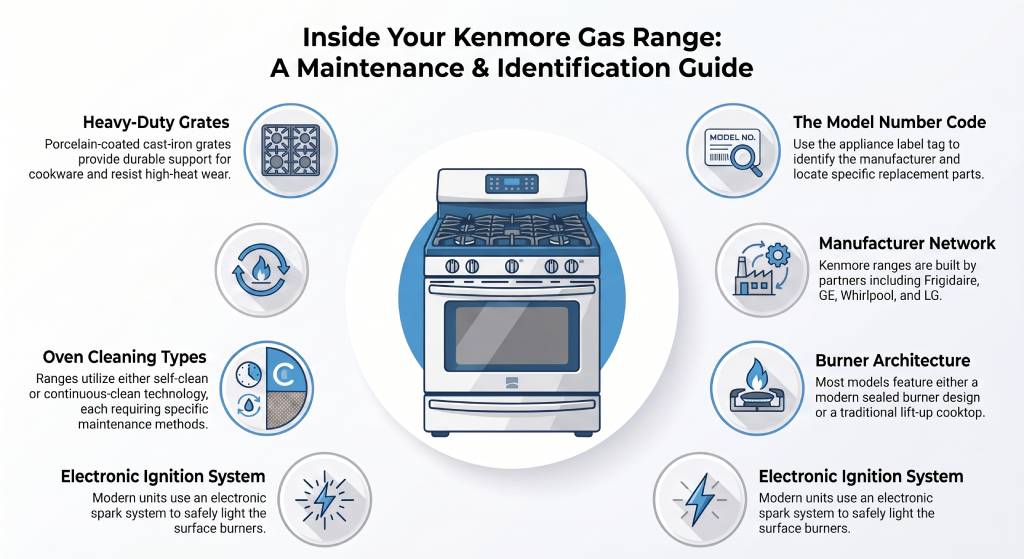
- Who built it? The first three digits of a Kenmore model number, before the decimal point, are commonly used as a manufacturer’s “source code.” Commonly reported codes include 790 for Frigidaire/Electrolux, 362 and 363 for GE, 110, 664, and 665 for Whirlpool, and 795 for LG. For example, a model beginning with 790 is often associated with a Frigidaire-built range. Knowing the original manufacturer can help when researching parts, manuals, and maintenance information. Because manufacturer-code references can vary between repair databases and community-maintained sources, always verify the full model number through Sears PartsDirect or the official parts documentation for your appliance before ordering parts or relying on a source-code lookup.
- Burners Kenmore uses one of two systems. Newer models have sealed surface burners, a removable cap and base over an igniter, with spills staying on top. Older ones have standard twin burners under a Lift-Up Cooktop you raise to clean underneath. Which you have changed the weekly routine.
- Grates Many modern Kenmore ranges use cast-iron continuous grates, usually porcelain-coated. The coating is tough but chips, and acidic spills mark it.
- Ignition. Electric igniters light the burners. Turn any knob to LITE and you’ll hear clicking on most Kenmores, every burner sparks even though only the one you turned lights.
- The oven Some Kenmore ovens are self-clean; older ones are continuous-clean, with a rough, textured interior. They’re cleaned in opposite ways, so confirm yours before reaching for a cleaner.
How do you clean a Kenmore gas stove after each meal?
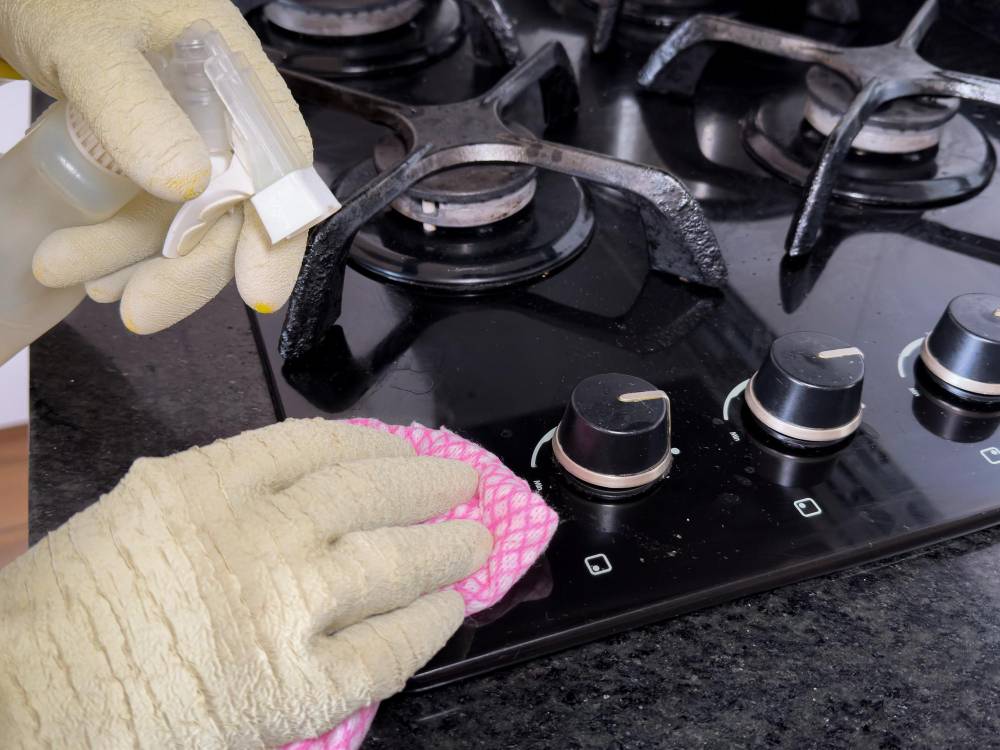
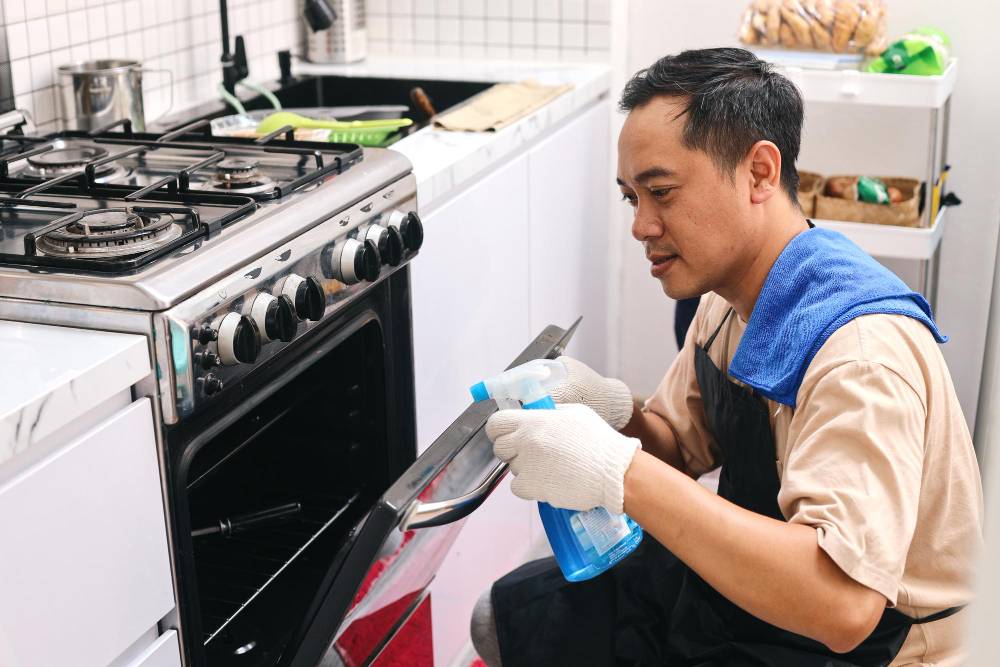
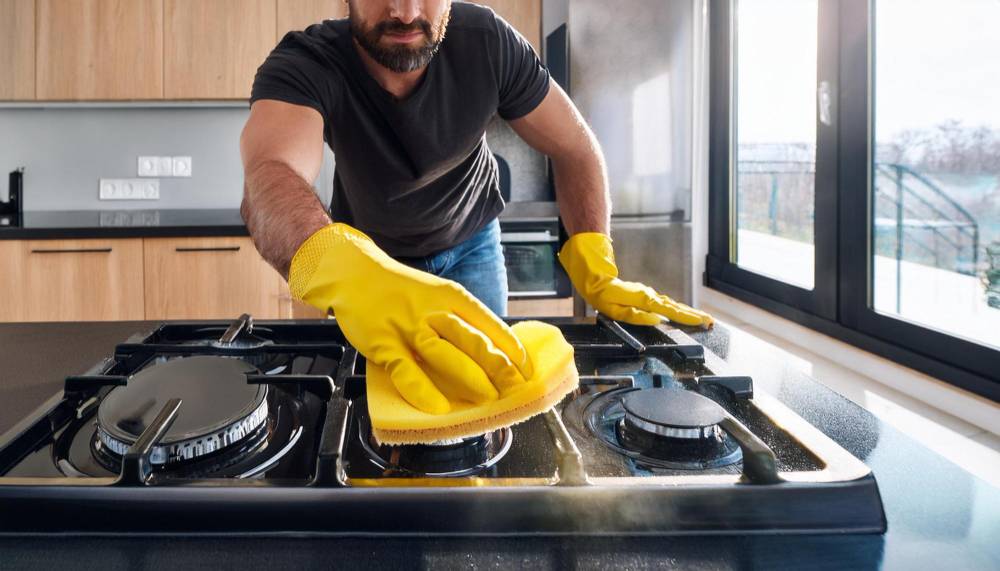
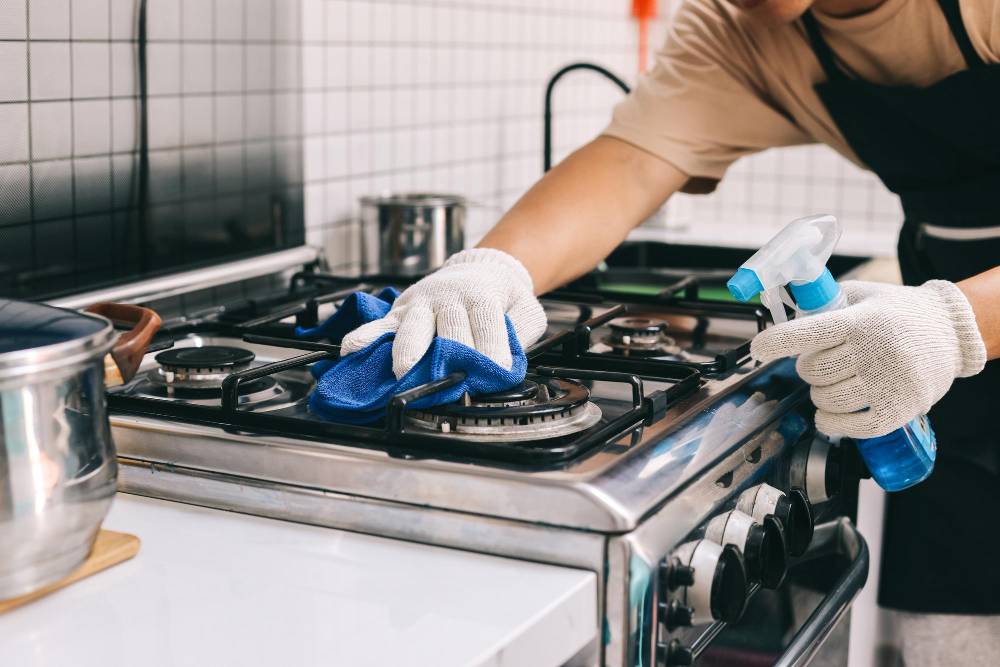
The daily job is short. Once the cooktop is cool, wipe the surface, grates, and caps with a soft cloth, warm water, and a mild dish soap. Manufacturer guidance typically recommends starting with mild soap and water for routine cleaning.
Two rules protect the finish from day one. Wipe acidic spills tomato, citrus, vinegar as soon as the surface cools, because they can mark a porcelain-coated grate. And match the cleaner to the surface: the Kenmore manual says to clean metal parts with soap and water and keep steel wool, abrasives, ammonia, acids, and commercial oven cleaners off them; glass and painted parts can be cleaned with a 50/50 vinegar and hot water mix. The knobs pull straight off so you can wipe behind them.
How do you deep clean Kenmore grates and burners each week?
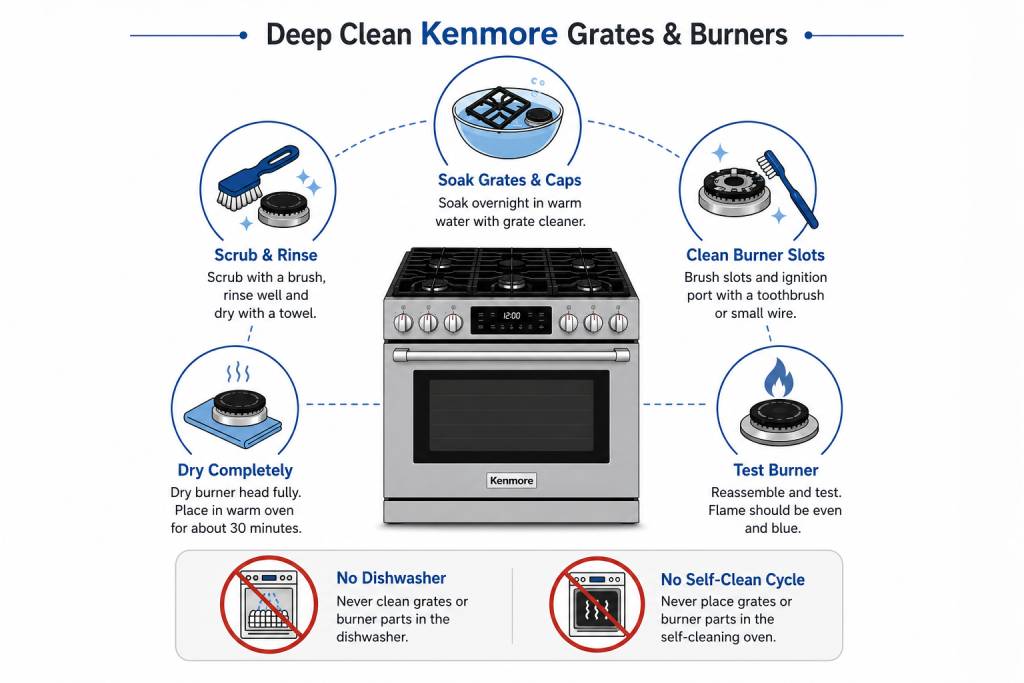
About once a week the grates and caps come off for a real clean, using the soak method Sears (which services Kenmore) publishes.
- Cool everything, then lift off the grates and burner caps. On an older Lift-Up Cooktop model, raise the top to reach the well underneath.
- Soak the grates and caps overnight in about two gallons of water with roughly three tablespoons of gas grate cleaner stirred in; wear gloves, since it’s strong. One exception: don’t use gas grate cleaner on enamel-coated grates or caps if you’re unsure, check your manual and use hot soapy water instead.
- Scrub and rinse the next day with a brush or non-abrasive pad, then dry with a towel.
- Clean the burner-head slots and the ignition port. Wipe the head with a damp cloth, then clear each slot with a toothbrush; for stubborn spots use a paper clip, a sewing needle, or a small-gauge wire. A clean ignition port is what lets the burner light evenly.
- Dry the burner head completely before it goes back. The manual’s trick is to set it in a warm oven for about 30 minutes. Replace each cap on its correct-size burner and seat it flush.
- Test the burner. A cap that went back wet or crooked is the usual reason a clean burner won’t light.
One caution unique to Kenmore the manual is explicit that you should never clean the grates in a dishwasher or in a self-cleaning oven, stricter than some brands allow. The drip pans on older models are different and can be washed by hand or in the dishwasher. For long-term maintenance and rust prevention, see our cast iron grate cleaning guide.
What monthly maintenance does a Kenmore gas range need?
Cleaning keeps the stove looking good; maintenance keeps it safe and accurate. Once a month:
- Read the flame. A healthy gas flame burns bluish, not yellow. The Kenmore manual is specific: yellow flames mean it’s time to call for service, yellow tips on the outer cones are normal on LP (propane), and a soft blue flame is normal on natural gas.
- Inspect the gas connection. Look over the supply line for kinks or wear. If you ever smell gas, don’t troubleshoot, don’t light anything, don’t touch a switch, leave, and call your gas utility from outside.
- Confirm the anti-tip bracket. Kenmore ranges ship with an anti-tip device that must be installed; give it a tug test once in a while.
A professional gas-line and ignition inspection once a year is the one job worth handing to a technician.
Which Kenmore-specific quirks should every owner know?
This is where a Kenmore stops behaving like a generic stove.
- The badge changes your parts order. Because your range is really a Frigidaire, Whirlpool, GE, or LG underneath, the same igniter or burner cap is often cross-listed under both the Kenmore number and the OEM model and the OEM version can be cheaper or in stock when the Kenmore-branded one isn’t.
- Two burner systems, two routines. Sealed-burner models clean from the top; older Lift-Up Cooktop models open up so you can wipe the well. Don’t try to pry up a sealed cooktop and never hit a continuous-clean oven’s rough interior with oven cleaner.
- Grate discoloration is usually cosmetic. Porcelain-coated cast iron grays with high heat; if it isn’t chipped or rusting, that’s age, not failure. Per the manual, don’t run a burner for long with no cookware on the grate; the finish can chip without a pot to absorb the heat.
What are the most common Kenmore gas stove problems (and fixes)?
Most Kenmore gas issues are cleaning or seating problems in disguise. Here’s where to start.
| Problem | Most likely cause on a Kenmore | First fix |
|---|---|---|
| Burner clicks and won’t light | Wet or misaligned cap, debris in the port | Dry and reseat the cap flush; clear the port with a pin. |
| Burner won’t light at all | Cap not seated, clogged port, or no spark | Reseat the cap, clean the port and igniter; if there’s spark but no flame. |
| Can’t find the right part | Ordering by the Kenmore number alone | Decode the prefix, then search the OEM equivalent (e.g. a 790 part under Frigidaire) |
| Self-clean won’t start or disappoints | It may be a continuous-clean oven, or soil is heavy | Confirm your oven type; never use oven cleaner on a continuous-clean surface |
| Grate finish looks dull or chips | Normal aging, abrasives, or heating an empty grate | Use non-abrasive pads; keep cookware on the burner in use |
A brief click when you turn a knob is just the igniter working. Clicking that won’t quit after the flame lights is the real fault and is almost always a cap that went back wet or crooked.
If the clicking continues after drying and reseating the burner cap, follow our clicking diagnostic for a complete troubleshooting process.
How do you protect a Kenmore gas stovetop between cleanings?
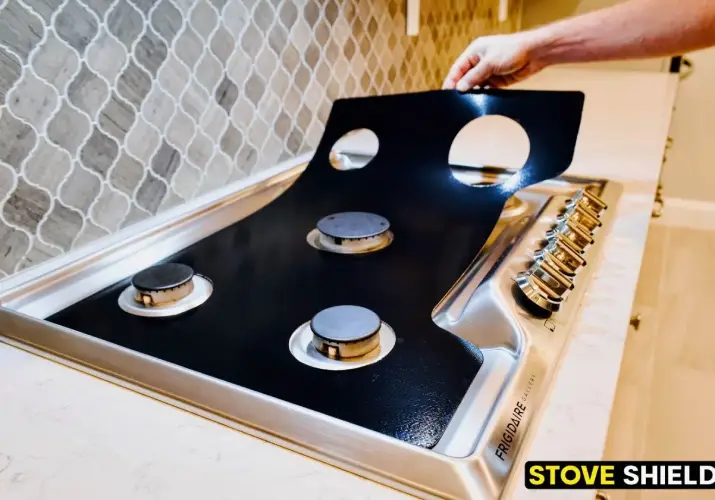
Even a sealed-burner range collects boil-overs and grease in corners a daily wipe misses. A custom-cut stovetop protector, a thin, heat-tolerant liner cut around the burners catches that mess so you lift out a sheet instead of scrubbing. On compatible 30-inch Kenmore models, it lies flat and pulls out for cleaning; keep it clear of the flame.
A liner is a between-cleaning convenience, not a substitute for clearing the burner ports. Because fit is model-specific, confirm the cutout against your exact model first. Compatible options are available for popular Kenmore models such as 79074233311, 79074233310, 79073433312, and 79075233310. If you’re unsure which appliance you own, locate your Kenmore model number before ordering.
Many modern Kenmore gas ranges use sealed-burner designs that can accommodate stovetop protectors similarly, but fit and compatibility vary by model. Always verify product compatibility before ordering.
Where is the model number on a Kenmore gas range?
You’ll want the model number for parts, manuals, and warranty checks and, on a Kenmore, to decode who built it. The rating plate sits on the front frame of the range, in one of a few spots:
- Behind the storage or broiler drawer open or remove the bottom drawer and look at the frame.
- Inside the oven door frame along the edge with the door open.
- On the kick panel at the bottom of the range.
The plate may read “Sears Kenmore.” Read the three digits before the decimal to identify the maker, then use Sears PartsDirect to confirm the full number and pull your manual and parts list. If you’re still having trouble locating or identifying the model number, follow our diagnostic walkthrough with photos of the most common locations.
Kenmore gas stove care FAQs
How do you clean a Kenmore gas stovetop?
Let it cool, then wipe the surface, grates, and caps with dish soap, warm water, and a soft cloth. Weekly, lift the caps and grates, soak them, clear the ports with a pin, and dry everything before reinstalling. Skip steel wool, ammonia, acids, and commercial oven cleaners on metal parts.
How can I tell who actually made my Kenmore gas range?
Read the first three digits of the model number before the decimal point. Commonly reported manufacturer codes include 790 for Frigidaire/Electrolux, 362 and 363 for GE, 110/664/665 for Whirlpool, and 795 for LG. Because source-code references can vary between repair databases and community-maintained sources, confirm the full model number through Sears PartsDirect or the official parts documentation for your appliance.
Are Kenmore gas stove grates dishwashers safe?
No. The Kenmore owner’s manual says not to clean the grates in a dishwasher or in a self-cleaning oven. Hand-wash them instead. Drip pans on older models can go in the dishwasher.
How do I use self-clean on a Kenmore gas oven and what if it doesn’t have it?
If your oven is self-clean, remove the racks and run the high-heat cycle per your manual. But some older Kenmore ovens are continuous-clean, with a rough textured interior that is clean during normal use and must never get oven cleaner. Check your model first.
Why does my Kenmore burner keep clicking?
A short click on ignition is normal. Clicking that continues after the flame lights almost always means a burner cap went back wet or off-center. Dry it, set the correct cap on the correct base, and seat it flush.
How we put this guide together
The cleaning steps, flame guidance, grate cautions, and burner-port method come from Kenmore’s own gas-range owner’s manual published through Sears PartsDirect, plus Sears PartsDirect and Sears Home Services cleaning guides, all captured. The model-prefix decode is drawn from established appliance-repair references iFixit, ApplianceAssistant, and Electrical-Forensics cross-checked across sources; where those tables disagree, we tell you to verify the full model number, not the prefix. The protection section draws on our hands-on, six-month protector review across gas, electric-coil, and glass-top ranges. Where Kenmore behavior is model-specific and on a badged brand it often is your manual and model number that have the final word.
Sources
- Sears PartsDirect Kenmore Gas Range Owner’s Manual (L0709189.pdf), use & care, grate/burner and flame guidance.
- Sears PartsDirect How to clean grates and burners on a gas cooktop.
- Sears Home Services How to Clean Gas Stove Burners.
- Ifixit How to identify who made your Kenmore appliance.
- ApplianceAssistant Who Made What: Kenmore manufacturer codes.
- Electrical-Forensics Kenmore Who Manufactured It.