
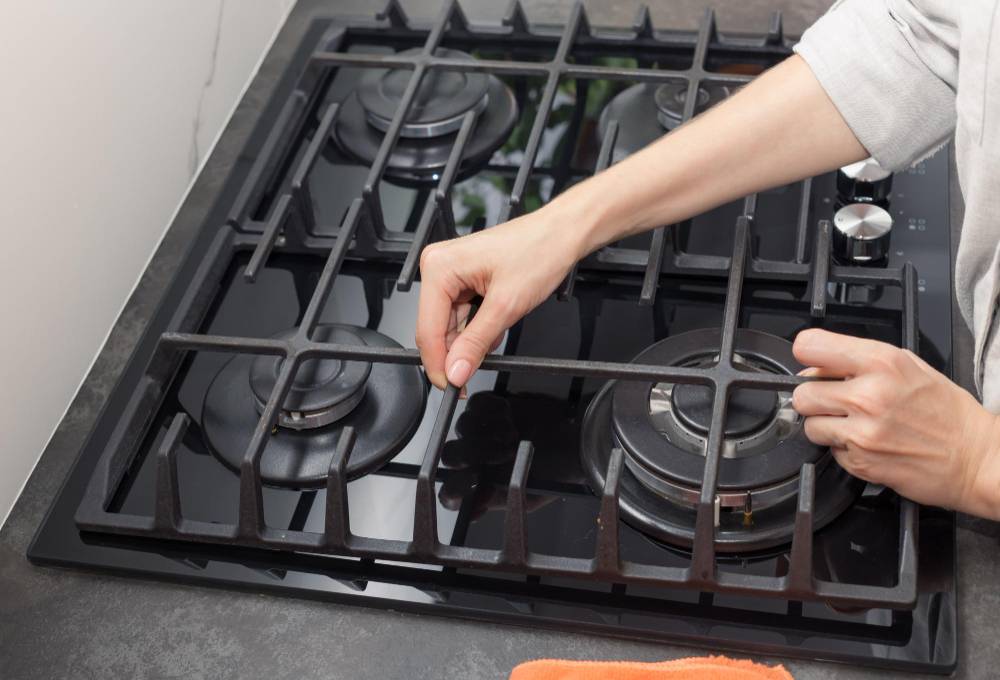
Viking gas stove care means wiping the porcelainized top after every meal, hand-washing the grates and burner caps weekly in hot soapy water with a blue Scotch-Brite pad, and checking the flame monthly. The Viking-specific rule: brass trim gets warm soapy water only, never a brass or abrasive cleaner, and dry every part fully, or it rusts.
A Viking range is built like commercial equipment, and it asks for commercial-style upkeep in return. The heavy cast-iron grates, the brass burner hardware, and the high-output burners that made Viking the original pro-style range for the home all reward a steady routine and can be damaged by improper cleaning products. This guide covers daily, weekly, and monthly care for Viking gas ranges across the Professional, 5 Series, and 7 Series lines, from 30-inch models up to the 60-inch, plus the brand-specific quirks that trip owners up, a troubleshooting table, and how to read your model number. For broader maintenance advice, see our general stove care reference, while the sections below cover the Viking-specific details.
Key Takeaways
- Clean the porcelainized cooktop with a soft damp cloth after cooking to prevent stains and baked-on residue.
- Hand-wash grates and burner caps weekly using hot soapy water and a blue Scotch-Brite pad; dry all parts completely before reinstalling.
- Clean brass trim and brass burner components with warm soapy water only never use brass polish, abrasive cleaners, or all-purpose sprays.
- Keep burner ports clear with a straight pin when needed, but never use toothpicks or tools that can enlarge the openings.
- A healthy Viking flame should burn blue and steady; yellow or weak flames usually indicate clogged ports or improperly seated burner components.
- Open-burner and sealed-burner Viking ranges require different cleaning routines, so identify your model before performing maintenance.
- Prevent grate rust by thoroughly drying cast-iron components after washing and occasionally conditioning them with a light coat of mineral or vegetable oil.
- Only certain Viking 5 Series VGIC models have dishwasher-safe burner bowls and grate supports; always verify your owner’s manual before using a dishwasher.
- Avoid pouring cold water onto a hot cooktop or griddle, as sudden temperature changes can warp metal surfaces.
- A properly fitted stovetop protector can reduce grease buildup and simplify routine cleanup, but it should never replace regular burner and cooktop maintenance.
What’s actually inside your Viking gas range?
Before you clean anything, it helps to know what you’re cleaning, because Viking builds its cooktops two different ways.
- Open burners vs. sealed burners. Viking started home “commercial-type” cooking with a stainless open-burner design, the kind used in restaurant kitchens. On open-burner ranges the grates, burner bowls, and grate supports all lift off, so you can carry them to the sink and soak them. Viking’s sealed-burner models use the exclusive VSH Pro Sealed Burner System instead: a one-piece, porcelainized top that contains spillovers, with separate collection areas that each hold up to about 1.5 quarts.
- High-output burners. On a 5 Series gas range, most surface burners run 15,000 BTU, and the front-right TruPower Plus burner delivers 18,500 BTU. Professional and 7 Series models push higher, so check your model’s spec.
- VariSimmer. Every Viking burner has the VariSimmer setting, a variable low range for gentle, even simmering rather than a single fixed “low.”
- SureSpark ignition. Viking’s ignition system relights automatically, so a burner that’s blown out by a draft or a spill re-sparks on its own.
- Brass and porcelain hardware. Viking uses brass sealed burners with porcelain or cast-iron caps, heavy continuous cast-iron grates, and, on many ranges, optional brass trim. That brass is the single most important thing to clean correctly, and we’ll come back to it.
How do you clean a Viking gas cooktop after every meal?
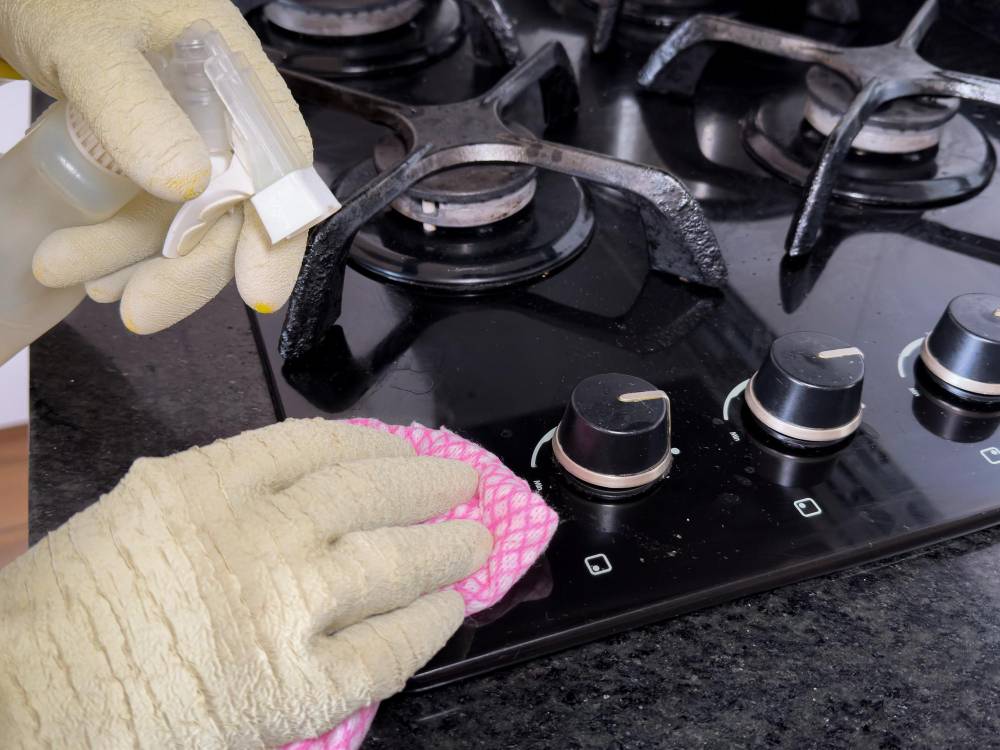
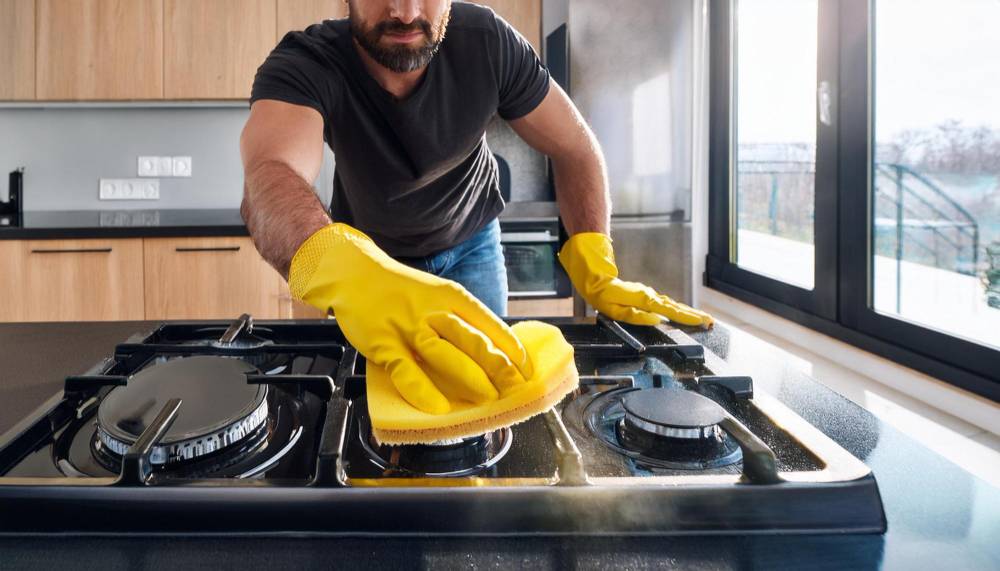
The daily job is quick. Once the cooktop is fully cool, wipe the surface with a soft, damp cloth to lift spills before they bake on. On a sealed top, that one-piece porcelainized surface keeps most spills where you can reach them.
Two habits protect the finish from day one. Wipe acidic and sugary spills (tomato, citrus, wine, jam) as soon as the surface cools, since they’re hardest on porcelain enamel. And if your range has brass trim, clean it with warm, soapy water on a soft cloth and nothing else. Viking coats its brass parts with an epoxy finish, and brass polishes or all-purpose sprays strip that coating and discolor the metal. For a complete step by step process that applies to most ranges, see our full gas stove top cleaning method.
How do you deep clean Viking grates and burner caps each week?
About once a week the grates and caps come off for a real clean. Viking’s own cleaning guidance is specific, and the order matters.
- Cool and remove. Let everything cool, then lift off the grates and burner caps. On open-burner models, lift the grate supports and burner bowls too.
- Wash. Clean grates and caps in hot, soapy water with a soft sponge or a blue Scotch-Brite pad. For stuck-on grease, Viking approves Soft Scrub without bleach. Stubborn, baked-on spots can take Bon Ami, or Easy-Off Fume Free Max worked outdoors and off the appliance.
- Soak the tough ones. For grates that won’t come clean, soak them in hot soapy water for 15 to 20 minutes. Viking’s support team suggests adding a cup of sudsy ammonia to the water for the worst stains.
- Clear the burner ports. If the small ports on a burner head are clogged, clear them with a straight pin. Never use a toothpick, which can snap off in the port, and never enlarge or reshape the openings.
- Dry completely, then condition. This is one of the most commonly overlooked maintenance steps. Dry every part fully, especially the undersides, or the cast iron rusts. Viking suggests a light coat of mineral or vegetable oil on the bottoms, left to soak for about 15 minutes, to condition the metal. If rust has already started, Bar Keeper’s Friend on a blue Scotch-Brite pad takes it off. For more rust-removal and seasoning tips, see our cast iron grate cleaning guide.
- Reseat. Put the caps and grates back so every part is secure and level. When you reset a burner head, line up its two tabs with the outside edge of the base, keep them clear of the igniter, and make sure the cap sits flat.
What monthly maintenance does a Viking gas range need?
Cleaning keeps the range looking right; maintenance keeps it safe and accurate. Once a month:
- Read the flame. A healthy Viking flame is blue and steady. If flames lift off the ports, burn yellow, or get noisy, the burner needs cleaning, so clear the ports and reseat the cap. If a good cleaning doesn’t fix it, the burner may need a technician’s adjustment.
- Check the aluminum base (open burners). On open-burner ranges, wipe the aluminum burner base with hot soapy water. Skip steel wool, abrasive cloths, and powders. To lift encrusted soil, soak it with a hot towel and scrape gently with a wooden or nylon spatula, never metal.
- Inspect the gas connection and anti-tip bracket. Look over the supply line for kinks or wear, and confirm the anti-tip bracket is doing its job. If you ever smell gas, don’t troubleshoot. Don’t light anything, don’t flip a switch, leave, and call your gas utility from outside.
One job a year is worth handing to a professional: a gas-line and ignition inspection.
Which Viking-specific quirks should every owner know?
This is where a Viking stops behaving like a generic stove.
- Brass should be cleaned only with warm soapy water. It bears repeating because it’s the most common Viking finish mistake. Brass trim and brass burner parts are epoxy-coated, and brass cleaners and abrasives ruin them. Warm, soapy water and soft cloth only.
- Dishwasher rules are model-specific. Viking says the burner bowls and grate supports are dishwasher-safe, but only on 5 Series VGIC models. On every other range, hand-wash. Check your model before you load anything.
- Open vs. sealed changes the whole routine. Open-burner owners break the burner down and soak the parts; sealed-burner owners wipe the contained top and remove only the grates and caps. Know which one you have before you start.
- Never shock a hot surface with cold water. Flooding a hot griddle or cooktop with cold water warps the metal over time. Let it cool first.
- The grates are heavy. Viking’s continuous cast-iron grates have real mass, especially on 36 inch and wider ranges. Lift with two hands and set them on a towel, not bare counter top, so you don’t chip either surface.
What are the most common Viking gas stove problems (and fixes)?
Most Viking gas issues are cleaning or seating problems in disguise. Here’s where to start.
| Problem | Most likely cause on a Viking | First fix |
|---|---|---|
| Burner won’t light | Clogged port, wet or off-seated cap, debris from a spill | Cool the burner, clear the ports with a straight pin, dry and reseat the cap level; if there’s spark but no flame. |
| Burner keeps clicking | A burner cap that went back wet or crooked | Dry the cap and base fully, reseat the cap flush. |
| Yellow or lazy flame | Clogged ports or a misaligned cap | Clean the burner head, clear the ports, reseat the cap; if it persists, call a technician |
| Grates rusting | Put away damp after washing | Dry fully (run the burner 10–15 seconds to finish), remove rust with Bar Keeper’s Friend, condition with light oil |
| Brass trim discolored | A brass or all-purpose cleaner was used | Stop using it, switch to warm soapy water, and contact Viking about replacing badly stripped parts |
A brief click when you turn the knob is just the SureSpark igniter doing its job. Clicking that won’t stop after the flame lights is the real fault, almost always a cap that went back wet or crooked. If the burner still won’t ignite after cleaning and reseating the cap, follow our diagnostic walkthrough for a complete step-by-step troubleshooting process.
How do you protect a Viking gas stovetop between cleanings?
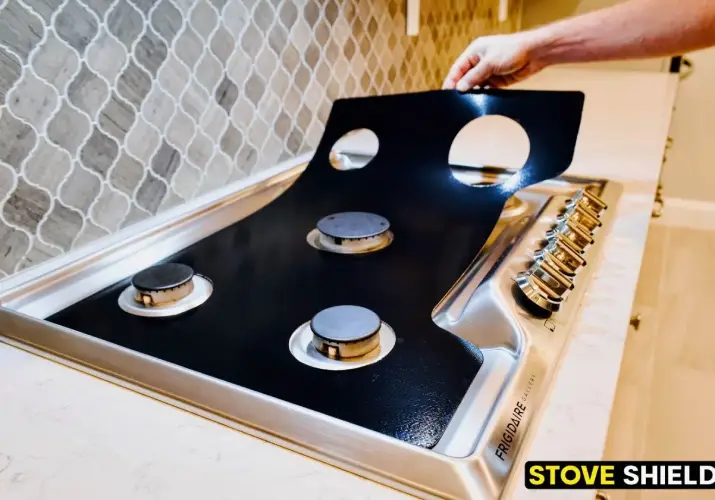
Even a contained sealed top collects boil-overs and grease in the corners that a daily wipe misses, and open-burner ranges have more nooks still. A custom-cut stovetop protector, a thin, heat-tolerant liner cut around the burners, catches that mess so you lift out a sheet instead of scrubbing porcelain and brass. Keep it clear of the flame and off the burner caps, and treat it as a between-cleaning convenience, not a substitute for clearing the ports.
Fit is model-specific on a pro-style range, so confirm the cutout against your exact Viking model, since layout varies a lot from a 30-inch to a 60-inch. Some homeowners choose a custom-cut stovetop protector to help reduce the amount of grease, spills, and food debris that reaches the cooktop surface. When properly fitted and used according to manufacturer instructions, these protectors can make routine cleanup easier between deeper cleaning sessions. Always keep the protector clear of open flames and burner caps, and verify compatibility with your specific Viking model before use.
Where is the model number on a Viking gas range?
You’ll want the model and serial number for parts, manuals, and warranty service, because Viking asks for both. Check these spots:
- Inside the lower panel open or remove the bottom panel and look at the frame.
- Around the oven door frame along the edge with the door open.
- Behind the kickplate on some ranges the rating plate sits low on the body.
Once you’ve identified your appliance, you can also explore Viking stove protectors designed for popular Viking models such as VDSC3054BSS, VGSU1616BSS, VGIC3654G , and VGRC4854GQDSS. If you’re still having trouble finding the rating plate, locate your Viking model number using our illustrated guide showing the most common model-number locations.
Viking gas stove care FAQs
How do you clean a Viking gas range?
Let it cool, then wipe the porcelainized top with a soft, damp cloth. Weekly, lift off the grates and burner caps, wash them in hot soapy water with a blue Scotch-Brite pad (Soft Scrub without bleach for grease), clear the ports with a straight pin, dry every part completely, and reseat each cap level. Clean any brass trim with warm soapy water only.
What should you not use to clean a Viking gas stove?
Don’t use brass cleaners, abrasive cleaners, or all-purpose sprays on brass parts; they’re epoxy-coated and will discolor. Skip bleach, steel wool, and abrasive powders on the cooktop and grates. And never flood a hot surface with cold water, which warps the metal.
Are Viking gas range grates and burner bowls dishwasher safe?
Only on some models. Viking lists the burner bowls and grate supports as dishwasher-safe on 5 Series VGIC ranges. On other models, hand-wash the grates and caps and dry them fully. Check your model’s use-and-care guide before loading anything.
Why won’t my Viking burner light, or why does it keep clicking?
Why won’t my Viking burner light, or why does it keep clicking? If the clicking continues after the burner is lit, follow our clicking diagnostic for a complete troubleshooting guide. Usually a burner cap that’s wet, off-center, or seated wrong, or a clogged port. Dry and reseat the cap level on its base, clear the port with a straight pin, and confirm the gas is on. The SureSpark system clicks briefly to light; clicking that won’t stop after the flame catches points to a wet or crooked cap.
Why is my Viking burner flame yellow or weak?
A proper Viking flame is blue and steady. Yellow, lazy, or noisy flames usually mean a dirty or clogged burner, so clean the head, clear the ports with a straight pin, and reseat the cap. If it continues after a thorough cleaning, have a technician check the burner adjustment.
Where do I find my Viking model number?
Look inside the lower panel, around the oven door frame, or behind the kickplate. You’ll need the model and serial number for parts and warranty, and Viking Customer Care can match them to your range.
How we made this guide
The cleaning steps, brass and porcelain cautions, approved cleaners, port-clearing method, flame guidance, and dishwasher rules come from Viking’s own use and care manuals, Cleaning Tips Sheets, and owner support FAQ. The protection section reflects general stovetop protector usage guidance and manufacturer cleaning recommendations. Where Viking behavior is model-specific, and across a lineup from the open-burner Professional to the sealed 5 and 7 Series it often is, your owner’s manual and model number should be considered the final authority.
Sources
- Viking Range Support FAQs for Owners: grate soaking, sudsy-ammonia tip, 5 Series VGIC dishwasher-safe bowls, open vs. sealed burner design.
- Viking Range Professional 5 Series Gas Ranges Use & Care: VSH Pro Sealed Burner System, 15,000 / 18,500 BTU TruPower Plus, VariSimmer, SureSpark.
- Viking Range Cleaning Tips Sheet: grates and burner caps (Soft Scrub, Bon Ami, Easy-Off Fume Free Max, Bar Keeper’s Friend, mineral-oil conditioning), brass “warm soapy water only” rule.
- Viking Range Gas Range Use & Care manual: burner-head port clearing with a straight pin, tab alignment, aluminum base care, flame-health guidance.
- Viking Range Warranty & Customer Care: model serial requirement.