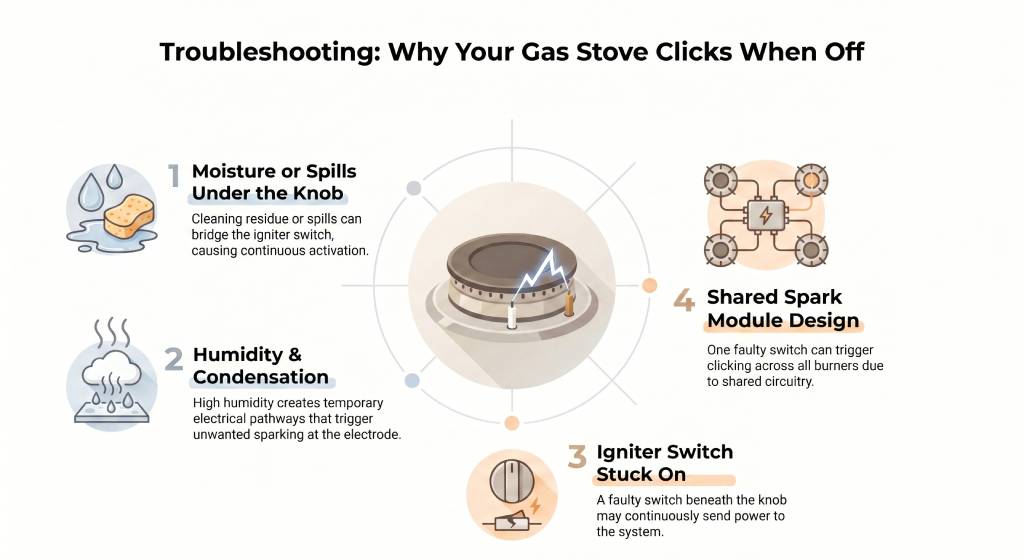
If you’re wondering why your gas stove keeps clicking, it’s usually the spark electrode firing because it hasn’t detected a stable flame yet. The most common causes are moisture or food debris around the electrode, a misaligned burner cap, or a stuck igniter switch. A few clicks before ignition can be normal, but if the clicking continues or you smell gas, stop using the stove and contact your gas utility.
The clicking sound is your stove’s spark electrode firing repeatedly, trying to ignite gas. The real question is why it isn’t stopping when it should. That depends on whether the burner is on, off, or failing to light.
Use this three-branch decision tree before you touch anything:
Branches A and B cover most cases across the seven appliance-repair pages reviewed for this guide. Branch C is rarer and harder to self-diagnose. If you’re in Branch C and the cleaning steps below don’t help, skip to the technician section.
One safety check before you proceed: do you smell gas? Mercaptan the rotten-egg additive explained by Con Edison is added so you can detect leaks. If yes, At this point, troubleshooting should stop. Leave the home, don’t flip switches or use phones inside, and call your gas utility from outside. Many ignition problems can be avoided by following our complete gas stove care guide, including routine cleaning, drying burner components thoroughly, and keeping the ignition system free of debris.
Clicking when no burner is on can feel alarming, but the most common cause is a wet or stuck igniter switch beneath the knob.
When you turn a knob to the Lite position, a small switch closes an electrical circuit.
That circuit powers the spark module.
The module sends rapid electrical pulses to the igniter electrodes near each burner.
Each pulse creates a small spark that lights the gas.
On most stoves, all burners spark at the same time. This shared system is why clicking can continue even when only one burner is being used.
Many ranges use a single spark module for all surface burners. This is largely a manufacturing cost decision.
Because of this shared design, a fault in one switch can make every burner click at the same time.
Ambient moisture can also trigger clicking. Running a dishwasher, mopping the floor, or high humidity can allow condensation to collect on the electrode tip or inside the switch housing.
In many cases, simply turning off the breaker and allowing the range to air-dry resolves the issue.
This is the gas stove flame won’t start and gas stove clicks but won’t ignite case. It has four common causes, ranked roughly by how often they show up across the seven competitor pages reviewed:
If none of these four resolve the clicking, the issue is deeper in the ignition system: a failed spark module, a worn electrode, or a defective igniter switch. That’s the next section’s territory and, beyond it, a licensed technician.
One nuance worth flagging A recurring observation in appliance-repair forums, some flame-sensing ranges keep clicking on an adjacent burner when the controller can’t read flame-voltage feedback. Corroded connections inside the range body are the suspected mechanism. Treat this as a community signal, not a generalizable diagnosis. But if the clicking only happens when burner X is on yet you hear it from burner Y, this pattern points toward a technician visit.
This is the DIY fix order. Stop at any step where the clicking ends no need to continue. Total time: 15–45 minutes for steps 1–5. Costs in the table below.
Tools you’ll need:
Safety preconditions before touching anything:
Step 1 Realign the burner cap. Lift the cap off the burner head. Check that the alignment notches are clear and the cap sits flat with no rocking. Reseat. A meaningful share of clicking issues across community threads end here.
Step 2 Clean the burner port and head. Use the paperclip to clear the small flame ports on the side of the burner head. Wipe the head with a damp cloth. Don’t push debris into the gas-supply tube clear it outward.
Step 3 Clean the spark electrode tip. The electrode is the small ceramic-insulated probe next to the burner. Dip a cotton swab in isopropyl alcohol and gently wipe the metal tip and the ceramic insulator. Don’t bend it. Air-dry for at least 15 minutes.
Step 4 Dry the burner well and front-knob area. Use a dry microfiber cloth. If water may have seeped under the front control panel (the click-when-off cause), this is the high-leverage step. Per PG&E, some cases need 24+ hours of air-dry with the breaker off.
Step 5 Reassemble and test. Restore power and gas. Turn the knob to lite. Per GE Appliances, up to 10–12 clicks is normal before ignition. If it lights within that window and the clicking stops once flame is established, you’re done.
Step 6 — Multimeter test on the igniter switch (optional). If clicking persists with one specific knob, the switch under that knob may be stuck. If cleaning doesn’t solve the issue, learn about replacing a faulty gas stove igniter. Honest limitation: this step needs you to remove the front control panel and read 0Ω closed / OL open with a multimeter, per the iFixit method. If you don’t have a multimeter, stop here and call a technician.
Repair cost ladder (call-out for the PAA “is it expensive to repair?” question):
| Tier | Fix | Typical cost |
|---|---|---|
| 0 | Clean + dry + realign (steps 1–5) | $0 |
| 1 | Replace one igniter switch | $30–$60 part |
| 2 | Replace spark module | $60–$150 part |
| 3 | In-home service call | Varies by region and labor rates |
DIY ends where electrical, gas-line, or safety-rated work begins. Stop and call a licensed appliance technician if any of the following apply:
ANSI Z21.1 / CSA 1.1 are among the governing safety standards referenced for household gas cooking appliances, referenced by CPSC. Ask your technician whether they’re certified under the standard your jurisdiction recognizes. The 2025 GAO report on gas stove safety also flagged ventilation and indoor-air-quality gaps useful context if you’re already calling someone out.
Never bypass safety switches, tape ignition switches in the lite position, or run a burner with a disabled spark module. These aren’t ways to “stop the click.” They’re ways to turn a nuisance into a fire or carbon-monoxide hazard.
In most cases, usually no with one critical qualifier: unless you smell gas.
Under normal operation, the ignition system is designed to operate safely. The clicking sound itself does not usually indicate an electrical shock hazard, but it does signal that the ignition system is actively sparking.
Clicking does cross into dangerous when gas flows without ignition for more than a few seconds. Two failure modes matter:
Gas-leak protocol memorize this. If you smell mercaptan (rotten egg):
A faint gas smell for a second or two after ignition is normal. A steady smell, or one that doesn’t clear after the burner lights, isn’t. Treat it as a leak until proven otherwise.
Is it safe to use a gas stove that keeps clicking?
Generally yes, as long as you don’t smell gas and the burner lights within roughly 10–12 clicks. Persistent clicking after ignition, clicking with no flame, or any rotten-egg odor changes the answer. Turn the stove off and troubleshoot or call a pro.
Why is my gas stove clicking but no gas smell?
The most likely causes are a wet or dirty spark electrode, a misaligned burner cap, or a stuck igniter switch under one of the knobs. None are immediately dangerous, but they should be cleaned, dried, or repaired so the spark module isn’t running constantly.
How long should it take for a gas burner to light?
GE Appliances notes that several clicks before ignition can be normal.
A clean burner with a dry electrode and seated cap typically lights quickly. If ignition takes noticeably longer than usual, begin troubleshooting..
How do I stop my gas stove from clicking when off?
Push every knob firmly to off a knob sitting partly in the lite zone keeps the switch closed. If clicking continues, turn off the breaker for the stove and let the front control panel and electrode area dry for 24 hours. If it still clicks, the igniter switch may need replacement.
How do you reset a gas stove?
There’s no universal reset button. Unplug the range or trip the breaker for 5–10 minutes, then restore power. This clears latched fault state in the control board. If clicking returns right away, the cause is mechanical, not a control glitch.
Should I call a professional for a clicking stove?
Yes if you smell gas, if clicking persists past a full clean-and-dry pass, if no spark fires on any burner, if multiple burners fail at once, or if the next step is replacing the spark module or working on gas piping. NFPA 54 governs gas-piping work.
So, why is my gas stove clicking? In most cases, it’s moisture, debris, or a misaligned cap fixable in under an hour with a paperclip, a cotton swab, and isopropyl alcohol. In a smaller share of cases, it’s a stuck switch or a failing spark module, where the multimeter comes out and a licensed technician often takes over.
The most important safety rule: if you smell gas, stop and follow the leak protocol. Otherwise, work the decision tree, ladder through the six steps, and stop the moment the clicking does. A healthy gas stove should light in a handful of clicks, run cleanly, and stay quiet when the burners are off.
To care for a ZLINE gas range, wipe the porcelain enamel cooktop and sealed burners…
RV gas stove care means a quick wipe after every meal, a deep clean where…
Miele gas stove care means wiping the porcelain or stainless deck after every meal with…
Fisher & Paykel gas stove care comes down to a daily wipe of the brushed-stainless…
To care for a Tappan gas stove, wipe the cooktop and grates after each use…
Crosley gas stove care comes down to a daily wipe-down once the cooktop is cool,…