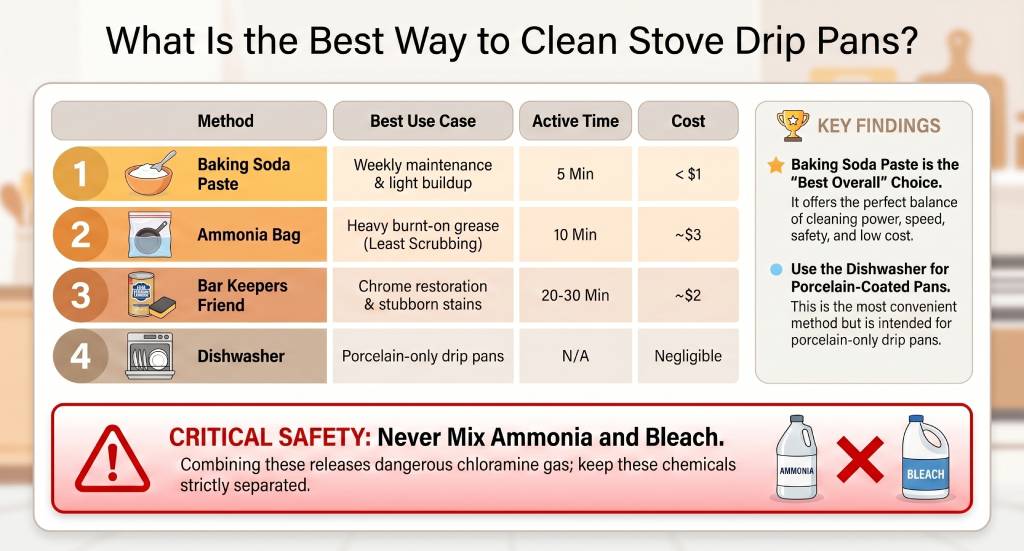
For light buildup, scrub stove drip pans with a baking soda and dish soap paste. That’s about 15 minutes of active work. For burnt-on grease, seal each pan in a Ziploc with a quarter cup of household ammonia overnight, then wipe. Bar Keepers Friend handles chrome restoration. The dishwasher works only on porcelain-coated pans.
Most “how to clean stove drip pans” articles list a dozen methods without ranking them. If you’re maintaining your entire stove not just the drip pans start with our complete stove care guide. This one narrows the field to four (the methods that show up repeatedly in manufacturer guides, editor tests, and cleaning discussions) and ranks them using published manufacturer guidance, editorial testing, and homeowner reports, comparing effort, cost, and which pan material they best preserve.
Set expectations first. In a 2020 blind test of three popular methods, the editor noted that the best result “looks most improved,” adding that she was “very much not spotless.” If your pans have years of baked-on residue, even the best method may still leave some staining.
The best way to clean stove drip pans depends on how bad the buildup is and what the pans are made of. Here is the ranked decision summary, with realistic time ranges drawn from manufacturer protocols (GE Appliances, KitchenAid), AARP’s published method, and recurring cleaning reports cited below:
| Rank | Method | Best for | Active time | Soak / wait time | Cost |
|---|---|---|---|---|---|
| 1 | Baking soda + dish soap paste | Light to moderate buildup, weekly maintenance | 15 min | 20 min | < $1 |
| 2 | Ammonia bag overnight | Heavy burnt-on grease, no scrubbing | 5 min setup + 5 min wipe | 8–12 hours | ~$3 |
| 3 | Bar Keepers Friend + non-scratch pad | Chrome restoration, stubborn rings | 20–30 min | None | $2 per use |
| 4 | Dishwasher | Porcelain-coated pans only, hands-off | 2 min loading | One cycle | $0 marginal |
The ammonia bag method generally requires the least active scrubbing. Baking soda paste wins on speed and cost. Bar Keepers Friend wins on cosmetic restoration. The dishwasher wins on convenience, but it disqualifies itself for chrome and aluminum.
One safety rule before you start never combine ammonia with bleach or any chlorinated cleaner. The reaction releases chloramine gas, which is genuinely dangerous in a kitchen. Pick one method and finish it before switching.
If you want the simplest answer to how to clean stove drip pans, this is the method to learn first. It uses things already in your kitchen, takes about 35 minutes start to finish, and works on every common drip pan material: chrome, porcelain, aluminum, and the small drip bowls under electric coil burners.
You’ll need: baking soda, liquid dish soap (Dawn or any degreaser), hot water, a non-scratch scouring pad, and a microfiber cloth.
Realistic outcome: pans go from grimy to genuinely clean. Old, deeply burnt-on rings will lighten but probably won’t disappear. AARP’s published version of this method (linked in sources) notes the same thing.
When to skip it: if grease has been baking onto the pan for more than six months, you’ll spend longer scrubbing than the soak saves you.
When people ask how to clean stove drip pans overnight, this is the answer. Our ammonia bag cleaning trick explains this method in more detail. It’s the method GE Appliances publishes on its own support site, which surprises most people. The fumes do the work overnight, so you wake up to pans you can wipe clean. It’s one of the lowest-scrub cleaning methods available for heavily burnt drip pans and it’s also a frequently suggested method for cleaning burnt stove drip pans without ruining the finish.
You’ll need: one gallon-size Ziploc bag per drip pan, household ammonia (the cheap clear kind from the cleaning aisle), and a well-ventilated spot. A garage, porch, or a kitchen with an open window and the range hood running all work.
Safety never combine ammonia with any bleach-based product (toilet cleaner, mildew spray, some all-purpose sprays).The reaction can release harmful chloramine gas. Pregnant people, asthmatics, and anyone with respiratory conditions should skip this method.
Realistic outcome: this is the method that comes closest to “spotless” for grease-heavy pans. For ancient carbonized rings, it still won’t fully restore. See the chrome conversation in the next section. “GE Appliances‘ official drip pan cleaning instructions”
If you have chrome drip pans (the shiny silver kind that came with most older electric stoves) and they’ve gone dull or pitted, this is the method that helps restore them. Many cleaning guides recommend Bar Keepers Friend with a non-scratch pad as a go-to option for chrome restoration.
You’ll need: Bar Keepers Friend powder (the original, not the spray), a non-scratch scouring pad, warm water, and rubber gloves. The powder contains oxalic acid, which is what does the lifting on chrome plating.
Honest limitation Bar Keepers Friend revives surface chrome. It does not undo deep pitting from years of acidic spills. Even strong cleaning methods like ammonia soaks followed by Bar Keepers Friend may not fully restore heavily pitted chrome. At that level of damage, it is better to move to the replacement section.
The dishwasher is the one method where what your pans are made of decides everything. KitchenAid’s published guidance is direct: porcelain-coated drip pans can usually go in. Chrome cannot. Aluminum cannot.
Safe in the dishwasher:
Not safe (will damage the finish):
If your pans pass the porcelain test, scrape off loose debris with a wooden spoon, place them upside down on the top rack, and run a normal cycle. Skip the heated dry, since heat plus dried detergent residue is what creates streaking. Glass-top ranges have a different toolset (no drip pans, similar boil-over residue). If you’re working with a gas range instead, see our guide on cleaning a gas stove top.
Reality check: even on porcelain, the dishwasher handles surface grease but not carbonized rings. Use it for maintenance, not as a rescue method. “KitchenAid’s guidance on chrome vs porcelain drip pans”
There isn’t one universal answer to how to clean stove drip pans. Match the method to the material and the buildup level. This matrix consolidates the manufacturer guidance that’s currently scattered across KitchenAid, GE Appliances, and the editorial coverage. For an electric coil range, the same matrix applies. The question of how to clean electric stove drip pans comes down to what the pans are plated with.
| Pan material | Light buildup | Burnt-on buildup | Avoid |
|---|---|---|---|
| Chrome (shiny silver) | Baking soda paste | Ammonia bag, then Bar Keepers Friend | Dishwasher, oven cleaner, steel wool |
| Porcelain (glassy white/black) | Baking soda paste or dishwasher | Ammonia bag | Steel wool, aggressive abrasives |
| Aluminum (matte gray) | Baking soda paste | Baking soda paste, repeated | Oven cleaner (etches aluminum), dishwasher, ammonia in some cases |
| Electric coil drip pans | Pull coils first, then baking soda paste | Ammonia bag overnight | Putting coils in any liquid |
A common mistake worth flagging oven cleaner like Easy-Off on aluminum drip pans. The lye reacts with aluminum, etches the surface, and turns it black in patches. The Spruce and Chowhound both flag this. If you don’t know what your pans are made of, hold a magnet against one. Chrome and most porcelain over steel will hold it; aluminum won’t.
There comes a point where cleaning costs more than replacing. Here’s the rough math based on typical drip-pan replacement pricing (single-source estimate; check current prices with your retailer):
Replace instead of clean when:
Keep cleaning when:
The honest answer: the longer you wait, the harder it gets. A pattern that holds up across manufacturer guidance is wiping pans down with hot soapy water every one to two weeks, plus a baking-soda-paste deep clean roughly once a month. At that cadence, you rarely need the ammonia bag.
Heavy cooks who sear, fry, or boil often should bump the deep clean to every two or three weeks. Catching drips while they’re still soft is the entire game. Pair this cadence with a for the in-between wipe-downs.
What is the best thing to clean stove drip pans?
For most home cooks, a baking soda and liquid dish soap paste handles weekly buildup in about 35 minutes total. For heavy burnt-on grease, the overnight ammonia bag method requires almost no scrubbing. For chrome that has gone dull, Bar Keepers Friend is often recommended as an effective restoration option. There is no single best method; the right one depends on the buildup level and the pan material.
Can you use Easy-Off on stove top drip pans?
Easy-Off and similar oven cleaners work on porcelain and steel, but they will damage aluminum drip pans by etching the surface. The lye in the formula reacts with aluminum, leaving black patches that don’t come out. The Spruce and Chowhound both flag this. If you don’t know your pan material, default to the baking soda paste or ammonia bag method instead.
Can I use Bar Keepers Friend on stove drip pans?
Yes, especially on chrome and stainless steel. Bar Keepers Friend’s oxalic acid lifts surface oxidation and dulling. The label is specific: rinse within one minute of application, since longer contact can dull the chrome you’re trying to restore. It’s not effective on baked-on grease alone. Pair it with a soap-paste pre-clean or an ammonia soak for the heaviest jobs.
How often should I clean stove drip pans?
A weekly wipe with hot soapy water plus a monthly baking-soda-paste deep clean keeps pans from ever reaching the burnt-on stage. Heavy cooks who sear, fry, or boil often should bump the deep clean to every two or three weeks. Once buildup hardens past three months, expect to use the ammonia bag method or budget for replacement.
Can chrome drip pans go in the dishwasher?
No. Dishwasher detergent is highly alkaline, and the high-pH wash dulls and pits chrome plating, sometimes after one cycle. KitchenAid’s published cleaning guidance is direct on this. Only porcelain-coated drip pans are dishwasher-safe. For chrome, hand-wash with a baking soda paste or use Bar Keepers Friend for restoration.
To care for a ZLINE gas range, wipe the porcelain enamel cooktop and sealed burners…
RV gas stove care means a quick wipe after every meal, a deep clean where…
Miele gas stove care means wiping the porcelain or stainless deck after every meal with…
Fisher & Paykel gas stove care comes down to a daily wipe of the brushed-stainless…
To care for a Tappan gas stove, wipe the cooktop and grates after each use…
Crosley gas stove care comes down to a daily wipe-down once the cooktop is cool,…