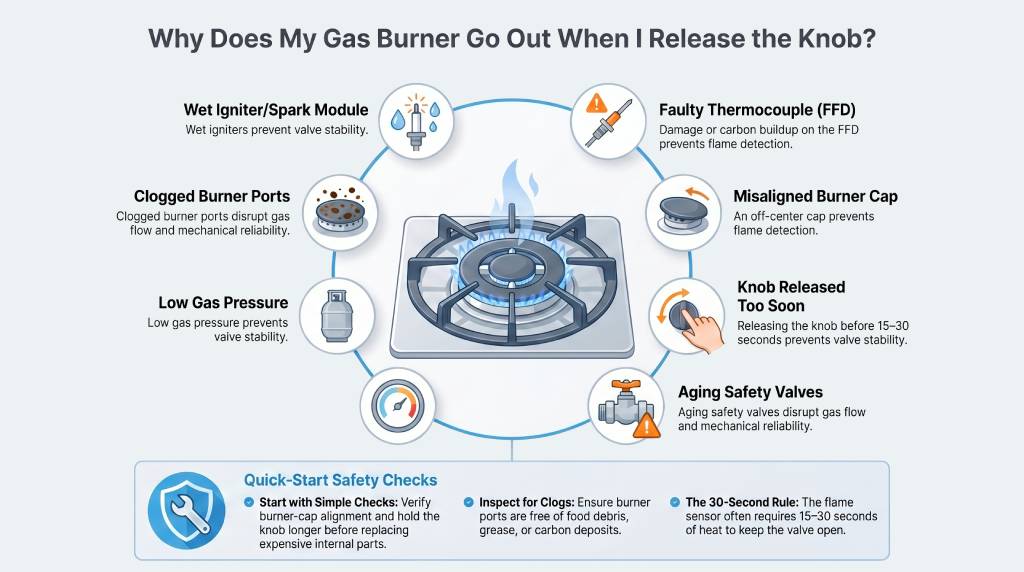
If your gas burner lights but dies the second you let go of the knob, the cause is almost always a failing thermocouple, an off-center burner cap, or not holding the knob long enough (5 seconds) to heat the flame-failure sensor. For broader maintenance and troubleshooting, see our complete stove care guide. Clean the sensor, reseat the cap, then test the thermocouple with a multimeter before swapping parts.
Safety first. Read this before you start.
Most modern US gas ranges include a safety interlock called a flame-failure device, or FFD. On most surface burners, the FFD is a small probe known as a thermocouple. Some brands use a flame-rectification rod instead. The job is the same either way: prove there’s a flame, or shut the gas off.
Here’s what happens when you turn the knob:
A burner that won’t stay lit usually means the flame-failure safety system is doing its job and shutting off unsafe gas flow.
Here are the seven causes in rough order of how commonly they appear in appliance repair discussions, manufacturer troubleshooting guides, and technician reports. Thermocouple-related faults are frequently reported as one of the leading causes when a burner lights but goes out after the knob is released.
A sooty, oxidized, or burned-through thermocouple can’t produce the millivolt signal the safety valve needs. This is the single most common cause. The probe is short, usually 3 to 6 inches, and it sits right in the burner flame, where carbon from spills builds up over months.
A surface burner cap that’s seated a few millimeters off-center can push the flame away from the FFD probe. The tip stays cool, the millivolt drops, and the valve closes. This is the most common “fix in 60 seconds with no parts” outcome.
Owner manuals from GE, Whirlpool, Frigidaire, and Samsung commonly recommend holding the knob pressed for 15 to 30 seconds after ignition. Some older Beko and Neff units may require 30 to 45 seconds. If the thermocouple does not heat fully before the knob is released, the flame-failure device may shut the gas supply off. Before disassembling anything, try lighting the burner again and hold the knob in for a slow count to 30.
Cleaning sprays, boil-overs, and food debris can block the small flame ports or restrict gas flow inside the burner head. Technicians frequently report carbon buildup inside burner ports as a cause of unstable flames and ignition problems. Check for debris or carbon deposits that may be clogging the gas delivery path.
The electromagnet inside the safety valve weakens with age. Even a brand-new thermocouple may not pull enough current to hold the valve open if the magnet spring is fatigued. Gas safety valve failure is less common than thermocouple-related issues, but it can still occur on older ranges. Valve replacement is a gas-fitter job in most US jurisdictions.
Samsung’s own “Samsung gas cooktop support page” flags this case directly. If your burners light but don’t stay lit, especially when another burner is on, the cause may be low gas pressure, and the fix is to call your gas supplier. On LP, a near-empty tank can vaporize unevenly and starve the burner during the FFD heat-up window.
A partly failing spark module can ignite weakly, leaving an under-temperature flame on the FFD tip. Common trigger: someone wipes the cooktop with a wet cloth, water wicks under the burner head, and the next ignition fires at half strength until everything dries out. Pull the cap and head, air-dry for 30 minutes, and try again. If ignition problems persist, continue with our ignition troubleshooting guide before replacing components.
Work through these in order. Stop when the burner stays lit. Turn off the burner and the gas supply at the shut-off valve before you touch the burner assembly. If the problem continues after these checks, follow our gas stove diagnostic guide for a complete troubleshooting workflow.
This is a millivolt (DC) test, not a continuity test. You’ll need a digital multimeter with a 200 mV DC range. A Fluke 117 or a Klein MM400 both work well, and any meter with a 0-200 mV DC scale is fine.
Honeywell’s VS8510 and VS8520 combination gas valves are the platform many residential ranges use, and Honeywell’s published service data anchors the PASS thresholds below. Read the Honeywell VS8510/VS8520 service data sheet
If your loaded reading is below 9 mV after cleaning, don’t keep relighting and hoping the probe warms up. Replace the thermocouple. The behavior will only get worse, and running a marginal FFD partly defeats the whole gas-safety system.
If the new thermocouple delivers 18+ mV no-load but the burner still drops out on knob release, the gas valve electromagnet is weak. That’s a gas-fitter job, not a DIY one.
For a residential surface burner, yes, in most US jurisdictions, with a few caveats. The thermocouple is a low-voltage signal cable. It carries no fuel. Swapping it does not involve opening the gas piping. An OEM-equivalent part runs about $15-$25. The labor portion of a pro call is typically $95-$175 in 2026.
Caveats:
This guide does not cover wall-mounted regulator service or supply-line repair.
The physics is the same across brands, but the part names, service steps, and recall status differ. Before any brand-specific troubleshooting, run the CPSC recall lookup on your serial number.
GE’s surface burners usually use a sealed-style burner cap and head with a co-located spark electrode and FFD probe. GE’s “GE appliance burner troubleshooting” documentation tells you to check cap alignment first. Multiple repair discussions involving GE ranges frequently mention carbon buildup and burner-cap misalignment as common causes of unstable flames.
Whirlpool gas cooktops: Whirlpool (including KitchenAid, Maytag, and JennAir models) recommends checking the gas supply before moving on to ignition troubleshooting. This includes confirming that the gas shut-off valve is fully open and, for LP-powered units, verifying that the propane tank has sufficient fuel. Gas-supply issues are often one of the first things to rule out when none of the burners will light.
“Samsung gas cooktop support” flags a scenario worth memorizing. If your burners light but don’t stay lit, especially when you ignite another burner, the cause is most likely low gas pressure, and the fix is to call your gas supplier, not your appliance technician. Samsung also issued a recall in August 2024 covering roughly one million units for an unrelated pets-can-activate-burners hazard. Verify your model isn’t on that list.
As of May 2026, Frigidaire owners should run the CPSC lookup before any DIY work. In March 2026, the “CPSC Frigidaire gas range recall” covered about 174,000 Frigidaire gas ranges sold through Home Depot and Lowe’s, citing a burn hazard. If your unit is affected, follow Electrolux Group’s remedy instead of pushing on with DIY troubleshooting. For non-recalled units, the “Frigidaire gas range cooktop support” follows the same physics: cap, thermocouple, gas supply, in that order.
Brand recall status changes. Re-check the CPSC database before you assume your unit is in the clear.
Stop the DIY work and call a licensed gas technician (or your utility) in any of these cases:
A diynot.com user reported that a British Gas engineer declined to strip down a cooktop for a thermocouple swap. Not every service tech does cooktop FFD work, so confirm scope when you book. NFPA 54 also recommends an annual licensed inspection of gas appliances no matter the symptoms.
A gas burner that won’t stay lit after you release the knob is almost always a flame-failure-device issue, and that’s by design. The FFD can’t prove a flame is there, so it shuts the gas off. Walk the DIY checklist top-down: recall check, hold time, cap alignment, burner-port cleaning, thermocouple cleaning, then the multimeter test. Most cases get solved at one of the first five steps with no parts at all. If the thermocouple fails its millivolt test, a $15-$25 replacement plus a soapy-water leak check usually restores normal operation. If a new thermocouple still can’t hold the valve open, DIY ends and licensed gas work begins.
Why does my gas hob burner go out when I release the button?
The button (or knob) you’re holding manually overrides the flame-failure safety valve while gas flows. When you release it, the valve relies on the thermocouple’s millivolt signal to stay open. If the probe is dirty, mispositioned, or failed or you release the button before the probe is heated to roughly 18 mV no-load the valve closes and the flame dies.
Why does my gas turn off when the knob is released?
This is the flame-failure device working as designed. The thermocouple in the burner flame must generate at least 9 mV loaded to hold the gas safety valve open. Below that threshold, the valve electromagnet releases and gas shuts off. Clean the thermocouple, reseat the burner cap, and confirm you’re holding the knob for 15 to 30 seconds.
How do you clean a thermocouple on a gas stove?
Shut off gas to the appliance, let the burner cool, and lift off the cap and head. Use 320-grit emery cloth or fine sandpaper to scrub carbon and oxidation off the thermocouple tip (the small probe positioned in the flame). Wipe with a clean dry cloth, reinstall, and retest. Do not bend or reposition the probe it must sit directly in the flame.
Why is my gas oven igniting but not staying on?
A gas oven uses a hot-surface igniter or glow bar rather than a thermocouple on most modern US ranges. If it lights then dies, the most common cause is a weakening igniter that no longer draws enough current to open the safety valve. See our guide on replacing a gas stove igniter for the complete replacement procedure. The fix is typically a glow-bar replacement, which is a separate procedure from the surface-burner thermocouple work in this guide.
Why is my gas stove not holding a flame?
A burner that lights and then immediately dies is almost always failing the flame-failure-device test: thermocouple dirty, burner cap off-center, knob released too soon, low gas pressure, or a weak safety valve. Work the DIY checklist in order. If the thermocouple’s loaded multimeter reading stays below 9 mV after cleaning, replace it.
To care for a ZLINE gas range, wipe the porcelain enamel cooktop and sealed burners…
RV gas stove care means a quick wipe after every meal, a deep clean where…
Miele gas stove care means wiping the porcelain or stainless deck after every meal with…
Fisher & Paykel gas stove care comes down to a daily wipe of the brushed-stainless…
To care for a Tappan gas stove, wipe the cooktop and grates after each use…
Crosley gas stove care comes down to a daily wipe-down once the cooktop is cool,…