A gas stove should not smell like gas when off. A faint odor right behind the appliance for a few minutes after a service visit can be normal, but a persistent or strong smell points to a leak. Leave the building, call your utility’s emergency line from outside, then book a licensed plumber.
If the smell is strong, you hear hissing, or anyone feels dizzy, nauseous, or short of breath:
These five DON’Ts come straight from the “American Gas Association’s Smell Gas? Act Fast! protocol“.
You walk into the kitchen and catch that unmistakable rotten-egg smell even though the stove is off. If you’ve ever smelled a gas leak before, you recognize it instantly. Now you want two answers, fast: are you in danger right now, and what should you do next?
This guide gives you both. We’ll walk through what’s normal, what’s not, and how to check for a real gas leak without putting yourself at risk. For broader maintenance and safety advice, see our complete stove care guide. Every safety recommendation here is sourced from the AGA, CDC, NFPA 54, or major US utility guidance not appliance-brand marketing pages.
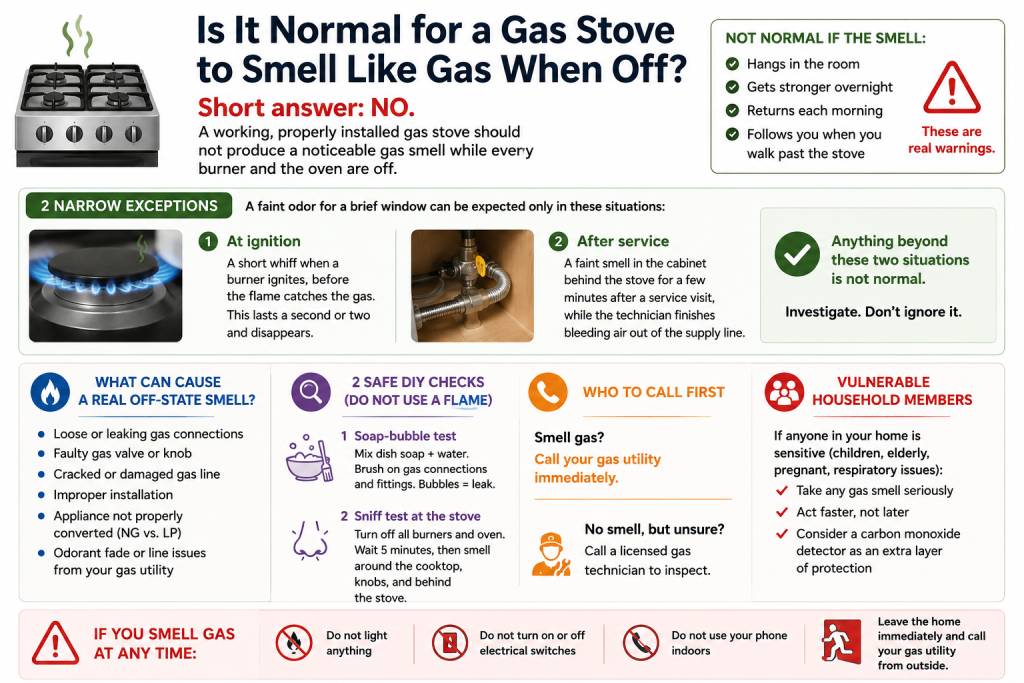
Short answer: no. A working, properly installed gas stove should not produce a noticeable gas smell while every burner and the oven are off.
There are two narrow exceptions where a faint odor for a brief window can be expected:
Anything beyond those two situations is not normal. A smell that hangs in the room, gets stronger overnight, returns each morning, or follows you when you walk past the stove is a real warning.
The rest of this article walks through what causes a real off-state smell, two safe DIY checks, who to call first, and what to do for vulnerable household members.
Pure natural gas (mostly methane) and pure propane are both odorless. Utilities add a sulfur compound called mercaptan, usually ethanethiol or tert-butyl mercaptan, for one reason. So humans can detect a leak before the gas concentration becomes dangerous.
The smell is usually described as:
Humans can detect mercaptan at extremely low concentrations. FortisBC notes that the odor additive may be noticeable at roughly 0.8 parts per billion, well below the lower explosive limit of natural gas in air. That early warning threshold is one reason utilities add odorants to otherwise odorless fuel gases.
Two counterintuitive facts most articles skip:
Olfactory fatigue. Your nose adapts to a constant odor in 5 to 15 minutes. If you’ve been sitting in a kitchen with a faint gas smell, the smell stops registering. Step outside for 10 minutes, walk back in, and you’ll notice it again.
Mercaptan can be absorbed by old steel pipe. SoCalGas warns that mercaptan odor can fade in some pipe systems, particularly older corroded steel piping. The leak may still be present even when the smell becomes weaker. That’s one reason a UL 1484-listed natural-gas detector is useful as a second layer of protection rather than a replacement for your sense of smell. Con Edison Gas Safety Guidance notes UL 1484 as the residential detector benchmark.
If anyone in your home has anosmia, a head cold, COVID-related smell loss, or is older with a diminished sense of smell, a gas detector becomes strongly recommended as an added layer of safety.
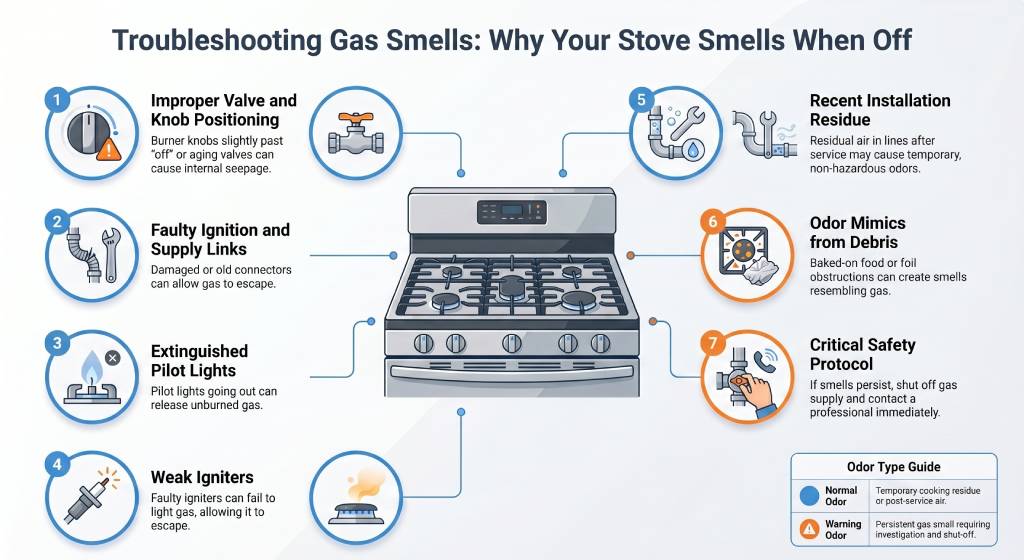
Most articles on this topic talk about ovens. We’ll focus on the stove top first, because that’s where the off-state leaks usually start. Here are eight causes ranked by how often we see them in the field, drawn from licensed-plumber editorial and appliance-repair guidance, not brand FAQs.
It’s easy to push a knob past the click-off detent without noticing. The valve cracks open by a fraction. Gas seeps without ignition. You get the smell within minutes.
Check: with the stove cool, push every knob fully into the panel and rotate firmly to off. Wiggle each knob. A loose knob spindle can make the off detent unreliable.
Each surface burner has its own valve in the manifold behind the control panel. Over years of cycling, a valve can develop a slow internal seep. Not enough to ignite, enough to smell.
Check: this one is not DIY. If your bubble test (next section) shows no leaks at the visible fittings but the smell returns after the source-isolation test, the leak is inside the manifold. Call a licensed plumber.
The yellow- or stainless-coated flex line that connects your stove to the wall shutoff is rated for a finite number of bend cycles. Appliance repair guidance notes that flex connectors over 10 years old or connectors repeatedly kinked when the stove is pulled out for cleaning are a common source of small gas leaks.
Check: turn off the wall shutoff. Pull the stove out gently. Inspect the line for kinks, fatigue marks, or visible corrosion at the brass fittings on either end.
If the stove was installed, moved, or serviced in the last 24 hours, a small amount of air in the supply line is normal. The smell should clear within a few hours of the technician leaving.
“NFPA 54, the National Fuel Gas Code (TIA section 8.2.3)”, requires a leak check after any service interruption. Ask your installer whether they ran one. If not, call them back.
Stoves built before the early 1990s may still use a standing pilot. A draft, a spilled pot of water, or an aggressive cleaning session can blow it out. Gas keeps flowing to the pilot port. You smell it without seeing the flame.
Check: shut the gas off at the wall. Open windows. Follow the manufacturer’s relight procedure exactly. If you can’t find a relight label, call the utility.
On modern stoves, an igniter that doesn’t reach temperature fast enough lets gas flow before ignition. “DIY Repair Clinic’s spec is a surface igniter within 3 to 4 seconds and an oven igniter within 90 seconds”. Beyond that window, the igniter is failing and should be replaced.
A spillover that landed inside the burner cap or oven bottom can produce a smell during reheating that lingers after shutoff. This is a smell, not a leak. But it can mimic gas if it includes sulfur-rich ingredients (eggs, garlic, brassicas).
How to tell them apart: soil smells reduce with time and ventilation. Mercaptan does not.
Aluminum foil placed on the burner pan or oven floor can deflect heat back into the burner assembly. That can melt insulation around gas tubing and create a real smell. Manufacturer manuals universally prohibit it.
| Cause | Frequency | DIY-checkable | Repair tier |
|---|---|---|---|
| Knob bumped past off | very common | yes | none |
| Recent service air bleed | common after service | wait + ventilate | none |
| Flex connector aging | common | yes (visual) | plumber |
| Faulty igniter | situational | yes (timing) | plumber/tech |
| Soiling | situational | yes | clean |
| Burner valve seepage | uncommon | source-isolation only | plumber |
| Pilot light out (older) | situational | yes | relight |
| Foil on burner | preventable | visual | remove |
Two safe DIY checks every home cook can do, provided the smell is faint and the room is ventilated. If the smell is strong, you hear hissing, or anyone feels symptoms, skip both checks. Leave the home. Call the utility from outside.
The bubble test is the same procedure utility technicians use as a first-pass check. It’s endorsed implicitly by every utility safety page we reviewed and aligned with the “AGA’s Using Natural Gas Safely guidance”.
You’ll need: dish soap, water, a small container, a soft brush or rag.
Never use an open flame or a match to test for leaks. Open-flame leak testing remains a documented cause of small-gas-leak ignition incidents.
This one is rarely covered in brand FAQs but is standard among plumbing professionals. “Terry Alexander’s editorial at The Plumber O describes it clearly“.
The point: figure out whether the leak is inside the stove unit, or upstream on the supply line.
Utility companies are typically the first call for suspected gas leaks. Emergency leak inspections are usually available 24/7, and technicians can determine whether the leak is coming from the utility supply line or the appliance itself. They can also shut off gas safely if needed. Once the area is declared safe, a licensed plumber or appliance technician can complete any necessary repairs to the stove or internal gas components.
Use this matrix to triage:
| Signal | Call utility first | Then call plumber |
|---|---|---|
| Strong smell anywhere in home | Yes-leave first | After utility clears scene |
| Hissing sound at the stove | Yes-leave first | After |
| Faint smell only behind stove, no other symptoms | After ventilating + bubble test | Yes-for repair |
| Smell after service appointment | Yes-service tech may have left air in line | If utility confirms no main leak |
| Audible gas at burner valve when off | Yes | After |
A short list of US utility 24-hour emergency lines (these are illustrative look up your own provider before there’s an emergency):
The Massachusetts state government keeps a “consolidated list of 11 utility emergency numbers and the official protocol”. Useful even outside Massachusetts as a model.
Once the utility confirms no main-line leak and your stove is the source, expect a licensed plumber to charge in the $150 to $300 range for a typical leaking-valve or tubing repair. Costs vary by region.
Two distinct hazards live inside the question “can this make me sick?” and they get conflated in most online articles.
Gas leak (mercaptan + methane/propane). The smell you detect is the warning. At low concentrations, you may experience headache, dizziness, nausea, fatigue, or eye irritation. At high concentrations the risk shifts from health symptoms to ignition.
Carbon monoxide (CO). Produced by combustion when a stove is running, not from an off-state leak. CO is odorless and colorless. “The CDC’s CO basics page is unambiguous: gas-fired stoves and furnaces are CO sources, and CO has no warning signs without a detector”. The CDC has a separate PSA: “don’t heat your home with a gas oven“. That practice produces dangerous CO concentrations.
The practical implication: install both. A UL 1484 natural-gas detector for off-state leaks. A UL-listed CO alarm for combustion safety. They protect against different risks. A single combination unit can do both, but check the listing.
Google autocomplete surfaces “smelling gas from stove while pregnant” with high search relevance. It’s a real, recurring concern with very little dedicated published guidance.
The honest answer: any persistent indoor air pollutant exposure during pregnancy warrants more caution, not less. The same five DON’Ts and the same evacuate-call-utility protocol apply. But the threshold for evacuation should be lower. If you smell gas at all and you’re pregnant, leave, ventilate, and call the utility. Don’t run the bubble test yourself. Ask your prenatal provider whether to follow up clinically. This article cannot replace medical advice.
The same heightened caution applies to infants, elderly household members, anyone with respiratory disease (asthma, COPD), and pets. Birds especially. They’re exquisitely sensitive to combustion gases.
A note on the broader debate: the “AGA’s industry fact sheet on gas ranges” discusses indoor air quality in detail and contests some of the recent academic findings on chronic exposure. We mention this for transparency. The point of this article is leak detection and acute response, not the chronic IAQ debate. Both communities agree on one thing: use a range hood vented outside whenever you cook.
This is one of the most commonly misunderstood parts of gas-leak detection. It’s why “I don’t smell it anymore” is not a finish line.
Three things can make a leak smell less without the leak getting smaller:
1. Olfactory fatigue. Your nose adapts. Within 5 to 15 minutes of constant exposure, the smell stops registering, even at the same concentration. Walk outside for 10 minutes and you’ll notice it again immediately when you return.
2. Mercaptan absorption by older steel pipe. SoCalGas explicitly warns about this. In some installations, particularly older corroded steel piping, the mercaptan binds to the pipe wall and is stripped out of the gas before it reaches the leak point. The methane keeps flowing. The warning compound does not.
3. Smell migration. Natural gas is lighter than air and tends to rise, while propane is heavier and can collect closer to the floor. HVAC airflow may also carry the odor into a different room than the actual leak source or vent it away from the area entirely.
The takeaway is simple: if you smelled gas earlier in the day, perform a safe leak check or contact the utility company, even if the smell later fades. A disappearing odor does not always mean the leak itself is gone.
This is one reason utilities commonly recommend UL 1484-listed natural-gas detectors. Unlike the human nose, detectors are not affected by odor fatigue. Con Edison notes that residential detectors meeting the UL 1484 standard are designed to alarm at levels well below the lower explosive limit of natural gas.
Prevention is unglamorous and effective. The combined recommendations from the AGA, NFPA, CPSC, and major utilities form a single short checklist.
A note on detector placement, since this is consistently confused. For natural gas, mount the detector high on a wall. Methane rises. For propane, mount low. Propane sinks. If you have both fuels in the home, install one of each at appropriate heights.
Why does it smell like gas but the stove is off?
A gas stove should not smell like gas when off. The most common culprits are a knob bumped slightly past the off detent, an aging flex gas connector behind the stove, or, less commonly, internal seepage at a burner valve. A faint smell for a few minutes after a service appointment can be normal. Anything persistent should be treated as a leak.
Is some gas smell normal when the stove is off?
A brief smell during burner ignition can be normal. A faint odor behind the appliance for a short time after servicing may also occur while air is cleared from the gas line. However, a smell that lingers, returns repeatedly, or is noticeable while the stove is fully off should be checked promptly.
How can I tell if my stove is leaking gas?
Two safe checks. The bubble test: dish soap and water mixed 1:4, painted on every visible gas fitting. Watch for growing bubbles for 30 seconds. The source-isolation test: shut the wall valve behind the stove, wait 1-2 hours, and check whether the smell is gone. If the smell vanishes after isolation, the leak is inside the stove. If it persists, the leak is on the supply line. If the smell is strong, skip both tests and call the utility from outside.
What should I do if my stove smells like gas?
Evaluate the strength. Strong smell, hissing, dizziness, or symptoms: leave the home, follow the AGA’s five DON’Ts (no flames, no switches, no flashlights, no starting cars in attached garages, no phone use indoors), call 911 and your utility’s 24-hour line from outside. Faint smell: ventilate, run the bubble test, then call the utility for a free check.
Can a very small gas leak make me sick?
Yes. At low concentrations, gas exposure can cause headache, dizziness, nausea, fatigue, or eye irritation. Carbon monoxide is a separate hazard from active combustion (not off-state leaks). The CDC notes CO is odorless and requires a detector. Vulnerable populations (pregnant women, infants, elderly, people with asthma or COPD) should evacuate earlier and consult medical guidance.
Does mercaptan smell go away on its own?
Sometimes. But the leak doesn’t necessarily go with it. SoCalGas explicitly warns about odor fade: mercaptan can be absorbed by old corroded steel pipe, your nose can fatigue within 15 minutes, and HVAC airflow can carry the smell out of the room. If you smelled gas earlier and it’s now gone, run the bubble test or install a UL 1484-listed natural-gas detector for confirmation.
Should I call the gas company or a plumber?
For strong or persistent gas odors, utility companies are typically the first call because they can perform emergency leak inspections and safely shut off gas if needed. After the area is declared safe, a licensed plumber or appliance technician can complete repairs.
Is it safe to be around a gas stove while pregnant?
A working, properly inspected gas stove with hood ventilation is the baseline. If you smell gas at all, leave the home, ventilate, and call the utility. Don’t run DIY checks yourself. Any persistent indoor air pollutant exposure during pregnancy warrants more caution, not less. Ask your prenatal provider whether to follow up. This article does not replace medical advice.
To care for a ZLINE gas range, wipe the porcelain enamel cooktop and sealed burners…
RV gas stove care means a quick wipe after every meal, a deep clean where…
Miele gas stove care means wiping the porcelain or stainless deck after every meal with…
Fisher & Paykel gas stove care comes down to a daily wipe of the brushed-stainless…
To care for a Tappan gas stove, wipe the cooktop and grates after each use…
Crosley gas stove care comes down to a daily wipe-down once the cooktop is cool,…