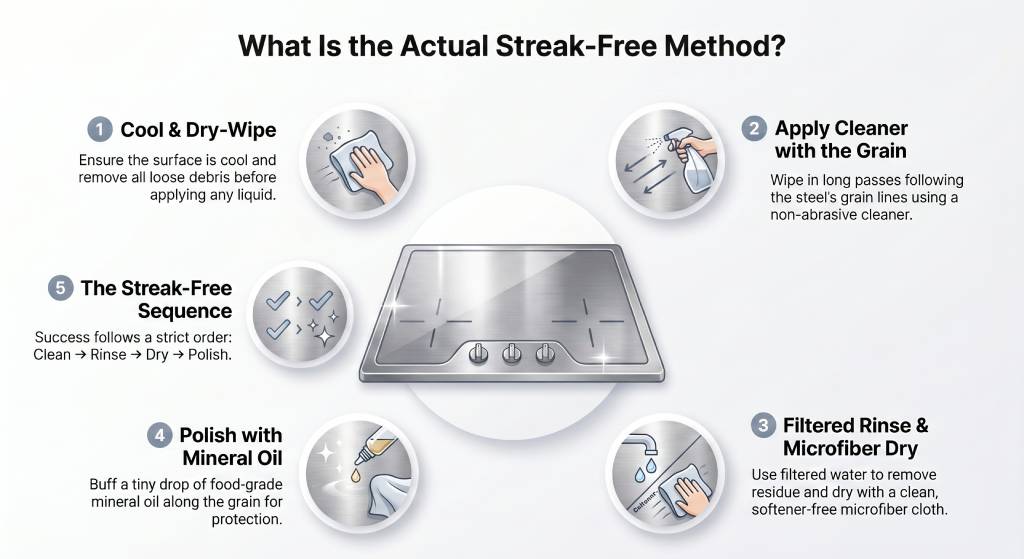
To clean a stainless steel stove top without streaks, wipe along the brushed grain with a damp pre-washed microfiber cloth and a mild, non-abrasive cleaner. Rinse with filtered or distilled water (hard-water minerals cause most haze), then buff dry and finish with a single drop of mineral oil polish.
Most cleans end in streaks for a simple reason. It is not the cleaner. It is the order of steps, the cloth, and the water. Get those three right and stainless steel cleans itself.
Streaks are not a cleaning failure. They are a chemistry tell. Three things happen on a stove top each time liquid touches it. A streak means one of them went sideways.
Stainless steel is not stain-proof because of the iron in it. It is stain-resistant because of a thin chromium-oxide layer. That layer forms when chromium in the alloy meets oxygen in the air. Popular Mechanics has the clearest consumer-level explainer of this. The film gives stainless its rust resistance. Anything that strips or pits it damages the steel underneath. The usual culprits are chlorine bleach, steel wool, gritty powders, and strong acids. Streaks themselves do not damage the layer. Hard scrubbing to remove streaks is what does.
So the goal of a streak-free clean is the opposite of what most people guess. You are not trying to scrub harder. You are trying to leave the chromium-oxide layer intact while lifting the gunk above it.
Wipe with tap water and let it air-dry. The calcium and magnesium in the water do not evaporate. They crystallize on the surface as a chalky white or rainbow film. Weiman, Kinetico, JYTSteel, and Stevealden Appliances all converge on the same explanation. Hard water minerals are the number-one cause of after-cleaning streaks.
This is also why the same cleaner that works in one kitchen leaves a haze in the next. It is not the cleaner. It is the water in your tap line.
Brushed stainless steel has tiny parallel lines milled into the surface. Wipe across those lines and any liquid you leave behind pools in the grooves. It then dries as a visible streak. Wipe along the lines and the same liquid drains evenly. Whirlpool, Maytag, KitchenAid, GE, and Samsung all say to wipe with the grain on brushed finishes. Guidance from multiple major appliance brands is consistent on this point.
Polished stainless does not have a directional grain. The same physics applies in a different form. The cloth direction on a flat polished surface creates an interference pattern in any leftover moisture. That pattern dries as a streak. The fix is the same: last pass in one direction only.
This is the 5-step pass that gets a typical weekly spill back to clean. Each step is short on purpose. The order matters more than any single move.
That is the complete method. No vinegar required, no club soda, no baking-soda paste, no oven cleaner.
Bend down and look at the surface from a low angle. Let a light reflect across it. You will see fine parallel lines running in one direction. Most of the time those lines run left to right across the cooktop. Sometimes they run front to back, depending on how the panel was milled. That direction is the grain.
If the light is wrong and you cannot see lines, run a fingertip along the surface both ways. The grain direction feels smoother. The cross-grain direction feels slightly rougher. Major appliance manufacturers consistently recommend wiping with the grain on brushed stainless surfaces. This is not a style choice it is the industry consensus rule. Manufacturer cleaning guides confirm this across multiple brands.
Six things. The convergence across the GE owner’s manual, The Kitchn, and Real Simple is unusually tight here, so this list is not opinion.
GE’s owner documentation is especially clear here, banning appliance wax, bleach, steel wool, abrasives, ammonia, acids, and oven cleaners in a single cleaning guideline.
This is an important detail many cleaning guides overlook. The honest answer has two parts.
On bare brushed or polished stainless steel, a 1:1 white vinegar and water spray works fine. It handles general grime, fingerprints, and light grease. It is mildly acidic. That acidity cuts mineral haze without harming the chromium-oxide layer.
On fingerprint-resistant stainless, vinegar and citrus-based cleaners may affect warranty coverage. These coated finishes show up on most newer Samsung, LG, and KitchenAid ranges sold since roughly 2019. KitchenAid’s own product help documents warn against acidic cleaners on the fingerprint-resistant coating. The acids degrade the polymer film. Few consumer cleaning guides currently mention this coating-specific caveat. That is why I am leaning on it. The brand is the source, and the warranty language is real.
I cannot tell you, without seeing your range’s model plate, whether your finish is the bare-steel kind or the fingerprint-resistant kind. The quickest field test is simple. Look at the model number on the inside frame of the oven door and search the brand’s product page. The words “fingerprint-resistant,” “PrintShield,” or “Easy Clean” in the product description mean coated. Default to no vinegar if you are unsure.
There is also a “minority counter-view from Homedit (February 2026)” worth knowing about. Their author argues that vinegar over cooking-greased stainless does not dissolve the grease. Instead, it spreads the grease around and produces worse streaks than dish soap alone. This is a single-source expert view, not a brand position. It conflicts with the mainstream advice. The takeaway is simple. Degrease first with dish soap. Then, if you want a final vinegar polish on bare stainless, do it on a surface that is already grease-free. Do not lead with vinegar on a greasy cooktop.
“KitchenAid’s product help page” covers the fingerprint-resistant caveat directly. “Popular Mechanics‘ chromium-oxide explainer” is the cleanest source on why acids matter to the underlying chemistry.
Three finishes, three routines. They are not the same.
| Finish | Test to identify | Cleaner | Wiping direction | Vinegar OK? |
|---|---|---|---|---|
| Brushed (bare) | Visible parallel grain lines under angled light | Mild dish soap, Bar Keepers Friend Soft Cleanser, or a non-abrasive stainless cleaner | Along the grain only | Yes, on degreased surface |
| Polished (bare) | Mirror-finish, no visible grain | Glass cleaner without ammonia, mild dish soap | One direction only on final pass | Yes, on degreased surface |
| Fingerprint-resistant (coated) | “PrintShield,” “Easy Clean,” or “fingerprint-resistant” in model name | Microfiber + warm water; manufacturer-approved coated-finish spray | Same as the underlying grain or polish | NO — voids warranty on most coated finishes |
If you cannot tell your finish from this table, the safe default is the fingerprint-resistant routine. Water plus a soft microfiber is considered safe for any of the three finishes. Vinegar and abrasives can harm one of them.
A streak-free stove top is mostly upstream work. Routines that stop residue from setting take far less effort than ones that strip it off later. Here is the cadence I keep.
After every cook session (30 seconds): Wait for the surface to cool. Run a damp microfiber along the grain to lift any spatter. Dry with a second cloth. No cleaner needed for normal use. The full complete stove care guide also includes the dials and burner caps.
Weekly (5 minutes): Run the 5-step streak-free method above. Spritz cleaner, wipe with the grain, rinse with filtered water, dry, mineral oil polish if it has been a while.
Monthly (10 minutes): Take off any removable knobs and grates (see our gas stove grate cleaning guide), then wipe down the panel under them (food residue collects there even with daily wiping), reapply mineral oil polish.
Microfiber rotation: Keep three cloths on rotation. One for cleaner application. One for the filtered-water rinse. One for the dry polish. Replace any cloth that has gone visibly thin, stiff, or washed with fabric softener. One wash with softener can ruin a cloth for stainless work. Weiman’s own care guide flags worn microfiber as the most common reason a polished cooktop streaks despite a “clean” wipe.
Cleaner inventory worth keeping on hand: one non-abrasive stainless steel cleaner suitable for coated and uncoated finishes, one bottle of Bar Keepers Friend Soft Cleanser (liquid), a small bottle of food-grade mineral oil, and a jug of distilled water for the rinse step. Additional specialty cleaners may be useful for removable grates and burner caps, but for routine surfaces, follow our gas stove top cleaning guide.
Bon Ami and Hope’s Perfect Sink Cleaner are useful for sink work nearby but not the primary cooktop tools.
The forbidden inventory bears repeating. It is the source of most “I cleaned it and now it looks worse” calls. No oven cleaner. No chlorine bleach. No steel wool. No powdered abrasives. No appliance wax. No ammonia on coated finishes.
The brand convergence on the grain-direction rule and the bleach-and-abrasives ban has not shifted in years. The fingerprint-resistant warranty caveat is the one piece of advice that has changed since 2019. Most online guides still have not caught up to it.
What cleans stainless steel without leaving streaks?
A pre-washed microfiber cloth, a mild cleaner Bar Keepers Friend Soft Cleanser or a few drops of dish soap), a filtered-water rinse and a final drop of mineral oil. The cloth and the rinse water matter more than the brand of cleaner. Skip the rinse step on hard tap water and even the best cleaner will leave mineral haze.
Why does my stainless steel stove top look streaky after cleaning?
Three usual causes, in order of likelihood: hard-water minerals from the tap rinse drying on the surface, wiping across the brushed grain instead of along it, or a worn microfiber cloth shedding fibers and sizing residue. Fix the rinse water first (use filtered or distilled), then check the grain direction, then replace the cloth. That sequence solves most cases.
Is it safe to use Dawn dish soap on a stainless steel stove top?
Yes, on all three finishes bare brushed, bare polished, and fingerprint-resistant. A few drops of any mild dish soap in warm water is the most universally safe cleaner for stainless steel cooktops. The catch is that dish soap is a degreaser, not a polish, so you still need the filtered-water rinse and the dry buff to avoid soap-residue streaks. Dawn is one of several PAA-cited acceptable choices alongside manufacturer-branded sprays.
What should I never use to clean stainless steel?
Chlorine bleach, steel wool or scouring pads, oven cleaner, ammonia on fingerprint-resistant finishes, powdered abrasive cleansers, and appliance wax. The GE owner’s manual bans all of these in one paragraph for a reason: each one either pits the chromium-oxide layer or builds a film that traps future residue. Use mild cleaners and a microfiber cloth instead.
Does vinegar damage stainless steel?
Not on bare brushed or polished stainless diluted white vinegar is fine and even helpful for mineral haze. On fingerprint-resistant coated finishes many Samsung, LG, and KitchenAid ranges introduced in recent years, vinegar and other acidic cleaners can degrade the polymer coating and void the manufacturer warranty. Check your model documentation before reaching for vinegar; if you cannot confirm the finish, default to a manufacturer-approved stainless spray instead.
How do I clean a fingerprint-resistant stainless steel finish?
Warm water and a soft microfiber cloth handle 90% of fingerprint-resistant cleaning. For greasier residue, use a manufacturer-approved coated-finish spray (Weiman fingerprint-resistant formula, Therapy, or 3M Stainless Steel Cleaner) rather than a generic stainless cleaner. Avoid vinegar, citrus cleaners, ammonia, and any abrasive all four can damage the coating and void the warranty. Always wipe in one direction on the final pass to prevent streak interference.
To care for a ZLINE gas range, wipe the porcelain enamel cooktop and sealed burners…
RV gas stove care means a quick wipe after every meal, a deep clean where…
Miele gas stove care means wiping the porcelain or stainless deck after every meal with…
Fisher & Paykel gas stove care comes down to a daily wipe of the brushed-stainless…
To care for a Tappan gas stove, wipe the cooktop and grates after each use…
Crosley gas stove care comes down to a daily wipe-down once the cooktop is cool,…